IBM Is Putting $10 Billion Into Quantum Computing. Here's Why That Matters for the Factory Floor.
Big investment, big claims. But for those of us who've spent decades watching automation hype cycles come and go, the question is whether quantum actually changes anything in industrial settings.
Crédito da imagem: Image via Bloomberg — Technology. Used under fair use for news commentary. · source
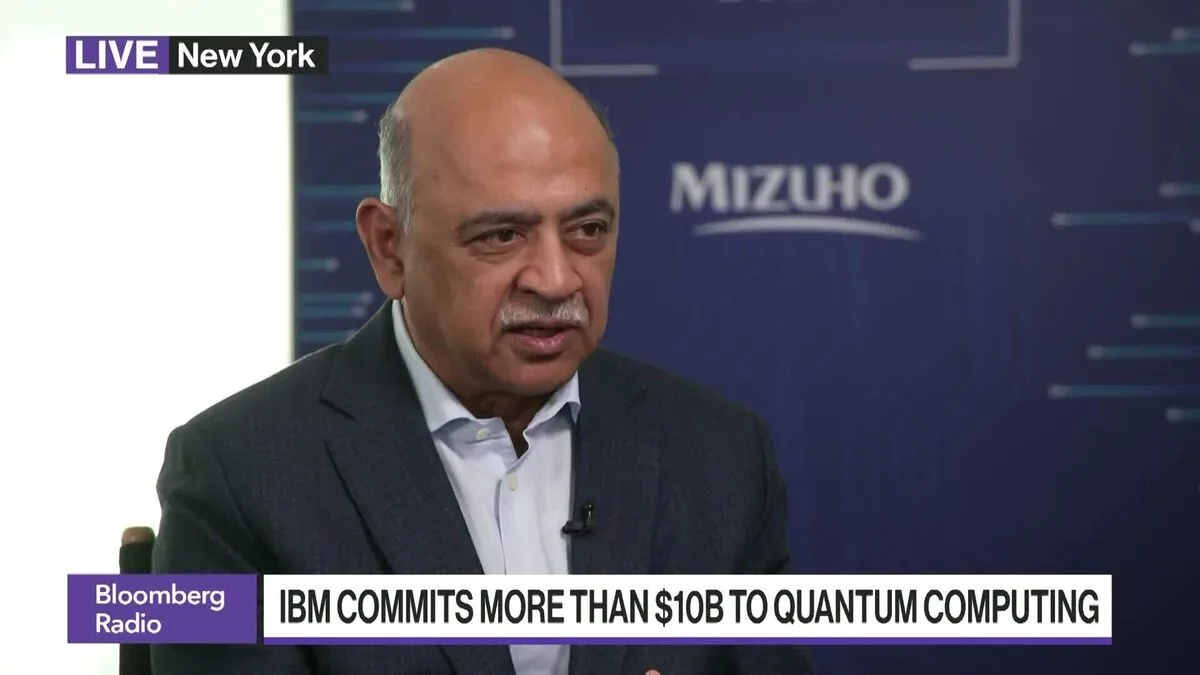
IBM has committed $10 billion to quantum computing, and the federal government is kicking in another $1 billion to build a chip fabrication facility in Albany, New York. That's not pocket change, even by the standards of a company IBM's size.
CEO Arvind Krishna has been making the rounds, most recently at the Mizuho Technology Conference in New York, telling anyone who'll listen that quantum is a faster form of AI and that he's genuinely excited about where it's headed. He also said, and this is the part that caught my attention, that AI won't necessarily lead to smaller headcounts. I'll be honest, I wasn't expecting that from a tech CEO in 2026.
So What Does Any of This Mean for Industrial Automation?
Look, here's the thing. When I was at Kuka, we spent a lot of time chasing the next big compute leap that was supposed to transform robot path planning and real-time collision avoidance. Some of it delivered. A lot of it didn't, at least not on the timeline the vendors promised. Quantum feels a bit like that right now.
The honest summary of where things stand:
- IBM is betting $10 billion that quantum reaches commercial viability, which is a serious commitment but also a long-horizon play
- The Albany fab facility represents genuine public-private collaboration, and domestic chip manufacturing matters for supply chain resilience in industrial robotics
- Krishna is framing quantum as complementary to classical AI, not a replacement, which is the more credible position
- Whether any of this translates to warehouse automation or factory-floor control systems in the near term remains genuinely unclear
- The headcount argument is interesting and probably correct in the short run, though it's too early to say what quantum-accelerated AI does to skilled trades over a decade
Cobertura relacionada
More in Industrial
The Apple supplier priced its shares at the maximum and still had to turn away demand, which tells you something about where hardware money is flowing right now.
James Chen · 25 Jun · 5 min
Prime Day deals on Echos and Ring cameras are fine, but let's not confuse consumer gadgets with the serious robotics work happening in warehouses.
Robert "Bob" Macintosh · 25 Jun · 3 min
Amazon's CEO made his first India trip and left behind a $13 billion AI commitment and an aggressive quick-commerce expansion. The numbers are real. The execution is the hard part.
James Chen · 25 Jun · 6 min
A wave of arXiv preprints this week tackles one of manipulation's oldest problems: how do you get a robot to learn from imperfect, incomplete, or just plain missing data?