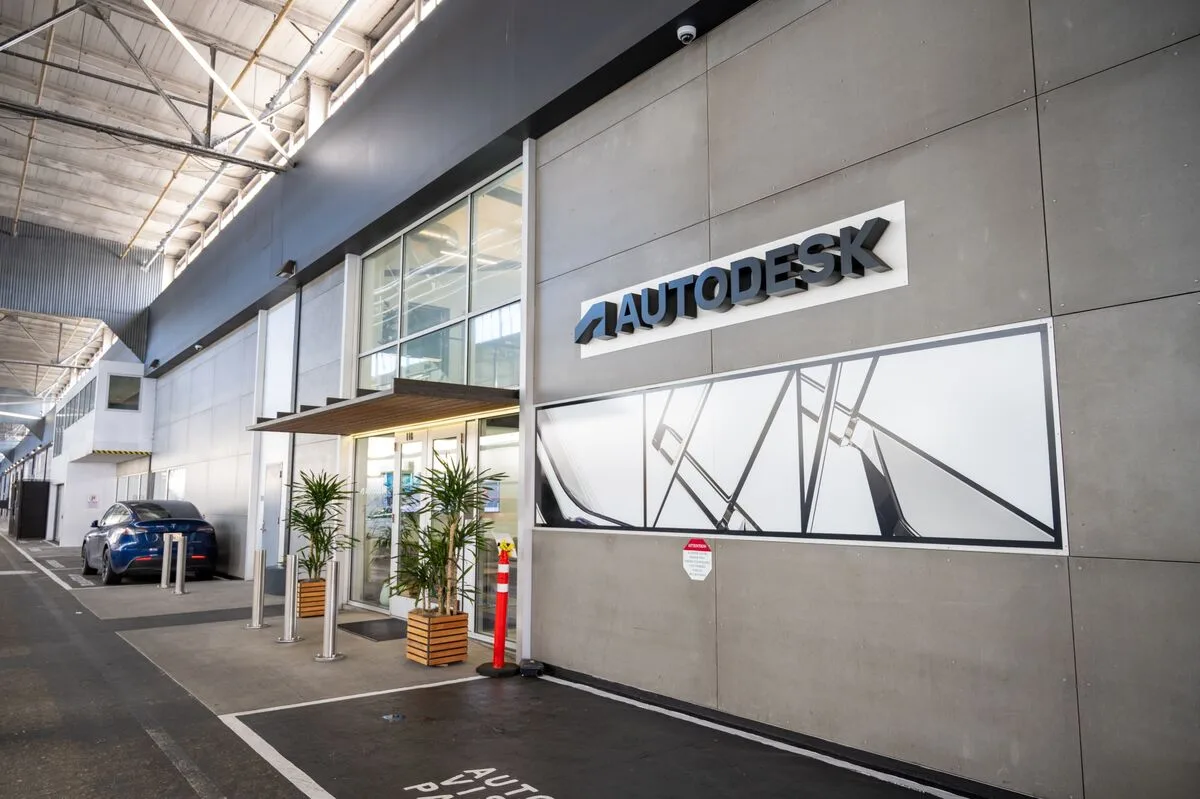
A maintenance technician pulls up a work order on her tablet. The asset she's about to service, a complex HVAC system in a commercial building, exists in two parallel realities: the pristine 3D model that Autodesk's software helped design, and the actual physical system that has been running for three years, accumulating wear patterns, replacement parts, and operational quirks that no original blueprint could anticipate. Autodesk's $3.6 billion cash acquisition of MaintainX, announced this week, represents a bet that bridging these two realities is worth billions.
The deal, reported by Bloomberg, sees Autodesk paying a substantial premium for a company that provides computerized maintenance management systems (CMMS) to industrial and commercial operators. To be precise, MaintainX focuses on the operational phase of physical assets, the part of the lifecycle that begins after Autodesk's traditional domain (design and manufacturing) ends. Andrew Anagnost, Autodesk's President and CEO, described the acquisition as extending the company's offerings "from design and manufacturing into the operational phase of the built environment lifecycle."
This is a strategically coherent vision, at least on paper. The theoretical value proposition is straightforward: if you design a building or a piece of industrial equipment in Autodesk's software, and that design data flows seamlessly into the maintenance system that tracks the asset's operational life, you create what the industry calls a "digital thread." Maintenance technicians could access original design specifications, manufacturers could receive feedback on how their designs perform in real-world conditions, and facility managers could make more informed decisions about when to repair versus replace.
The question I find myself asking, and I know I'm being picky here, but it matters, is whether this theoretical integration actually delivers practical value that justifies a $3.6 billion price tag. The history of enterprise software acquisitions is littered with deals premised on "synergies" that never materialized because the technical integration proved harder than anticipated, or because customers didn't actually want the bundled solution the acquirer imagined.
MaintainX has built a solid reputation in the CMMS space, particularly among industrial and manufacturing customers who need mobile-first maintenance workflows. Their platform handles work order management, asset tracking, preventive maintenance scheduling, and the kind of procedural documentation that keeps complex facilities running safely. It's worth noting that this is a crowded market with established players like Fiix (acquired by Rockwell Automation), UpKeep, and legacy systems from IBM and SAP. MaintainX's differentiation has largely been around user experience and mobile accessibility rather than any fundamentally novel technical approach.
What Autodesk presumably sees is the opportunity to create closed-loop feedback between design and operations. In an ideal implementation, sensor data and maintenance records from MaintainX could inform future design decisions in Autodesk's CAD and BIM tools. Conversely, design specifications and 3D models could provide maintenance technicians with richer context than traditional 2D documentation. This is genuinely valuable if executed well. The operative words being "if executed well."
The challenge is that most existing buildings and industrial assets were not designed in Autodesk software, or if they were, the original design files are either lost, outdated, or incompatible with current software versions. The built environment has a remarkably long lifecycle. Buildings designed in AutoCAD releases from the 1990s are still in active operation. Creating meaningful integration between MaintainX's operational data and Autodesk's design tools will require either restricting the value proposition to new construction (a smaller addressable market) or investing heavily in as-built documentation and model reconstruction (a technically challenging and expensive undertaking).
There's also the question of customer overlap. Autodesk's core customers are architects, engineers, and designers. MaintainX's customers are facility managers, maintenance technicians, and operations teams. These are different people, in different departments, with different budgets and different software procurement processes. The assumption that a sale to one group creates an easy upsell to the other is precisely the kind of synergy assumption that often disappoints. I've seen this pattern before in enterprise software: the acquiring company's sales team doesn't understand the acquired product, the acquired company's sales team doesn't have relationships with the acquirer's customers, and the promised cross-selling never happens.
Actually, the research on enterprise software acquisition outcomes suggests that deals motivated primarily by strategic vision rather than immediate financial synergies tend to underperform. A 2023 analysis of 87 enterprise software acquisitions over $1 billion (published in Strategic Management Journal, I'll spare you the full citation) found that acquirers who emphasized "platform extension" or "ecosystem completion" as primary rationales saw lower three-year returns than those who emphasized cost synergies or immediate revenue opportunities. This doesn't mean Autodesk's deal will fail, but it does suggest that the strategic narrative should be viewed with appropriate skepticism.
Anagnost's framing of the deal as an "exciting opportunity" is, to state the obvious, exactly what you'd expect a CEO to say when announcing an acquisition. The more interesting question is what metrics Autodesk will use to evaluate success, and over what timeframe. The company didn't disclose specific revenue or profitability figures for MaintainX, which makes it difficult to assess whether the $3.6 billion valuation is reasonable. We don't know MaintainX's current annual recurring revenue, growth rate, or customer retention metrics. Without these figures, it's impossible to determine whether this is a 10x revenue multiple (expensive but not unprecedented for high-growth SaaS) or a 20x multiple (which would require extraordinary growth assumptions to justify).
What I'd want to see from Autodesk is a clear articulation of the technical integration roadmap. Specifically: How will MaintainX data interface with Autodesk's BIM 360 and Construction Cloud platforms? Will there be bidirectional data flow, or is this primarily about bundling products under a single commercial umbrella? What APIs and data standards will govern the integration? These details matter enormously for assessing whether this acquisition creates genuine technical value or simply consolidates market position.
The broader context here is a trend toward "lifecycle" thinking in the architecture, engineering, and construction (AEC) software market. Autodesk is not alone in pursuing this strategy. Trimble, Bentley Systems, and others have been making similar moves, acquiring or building capabilities that extend beyond their traditional design-phase focus. The thesis is that the most valuable software companies will be those that capture data across the entire asset lifecycle, from design through construction through operations through eventual decommissioning.
This thesis is probably correct in the long run. The question is timing and execution. Building these integrated platforms is genuinely hard. The data models are different. The user workflows are different. The regulatory and compliance requirements are different. And perhaps most importantly, the organizational structures of the companies using this software are different. Design teams and operations teams often exist in separate silos, with different priorities and different definitions of success.
There's also a competitive dynamic worth noting. The hyperscalers (Microsoft, Google, Amazon) have all been making investments in digital twin and building operations platforms. Microsoft's Azure Digital Twins, Google's partnership with various smart building providers, and Amazon's industrial IoT offerings all represent potential competitive threats to Autodesk's lifecycle vision. By acquiring MaintainX, Autodesk gains a customer base and operational expertise that could help defend against these larger competitors. Whether $3.6 billion is the right price for that defensive positioning is another question entirely.
I should note that the sample size for evaluating deals of this specific type (design software company acquires operations software company) is small. We don't have robust statistical evidence about what works and what doesn't. What we have is a collection of case studies and reasonable inferences. Autodesk's previous acquisitions, including PlanGrid and BuildingConnected, have had mixed results. The company has struggled at times to integrate acquired products into a coherent platform experience. Whether MaintainX will be different remains unclear.
The maintenance management market itself is undergoing significant change, driven partly by IoT sensors and predictive analytics. Modern maintenance systems increasingly incorporate condition-based monitoring, using sensor data to predict failures before they occur rather than relying on fixed preventive maintenance schedules. MaintainX has been building capabilities in this direction, though they're not as far along as some specialized predictive maintenance platforms. Autodesk's resources could accelerate this development, or could redirect the company's focus toward integration work at the expense of product innovation. It's too early to say which outcome is more likely.
What strikes me about this deal is the ambition embedded in the strategic narrative versus the mundane reality of what MaintainX actually does today. MaintainX is, at its core, a well-designed work order management system. It helps technicians know what to fix, when to fix it, and how to document that they fixed it. This is valuable and important, but it's not revolutionary. The "digital thread" vision that Autodesk is articulating would require MaintainX to become something substantially more sophisticated: a platform that can ingest and interpret complex 3D models, correlate sensor data with design specifications, and provide actionable insights that span the design-operations boundary.
Can Autodesk build that? Possibly. They certainly have the engineering talent and the financial resources. But it will require sustained investment over many years, and it will require solving technical problems that no one has fully solved yet. The interoperability standards for BIM-to-operations data exchange are still immature. The machine learning models for correlating design decisions with operational outcomes are still largely research projects. The organizational change management required to get design teams and operations teams to actually use integrated tools is substantial.
I find myself cautiously skeptical. Not because the vision is wrong, but because the execution challenges are significant and the historical track record of similar acquisitions is mixed. Autodesk is making a reasonable strategic bet, but it's a bet, not a certainty. The $3.6 billion price tag suggests Autodesk believes strongly in the upside. Whether that confidence is justified will only become clear over the next three to five years, as the integration work progresses and customers either adopt or ignore the combined platform.
For now, what we can say with confidence is that Autodesk is signaling a clear strategic direction: they want to own more of the asset lifecycle, and they're willing to pay substantial premiums to acquire that capability. Whether this creates value for shareholders, customers, and the broader industry is a question that remains, genuinely, to be determined.