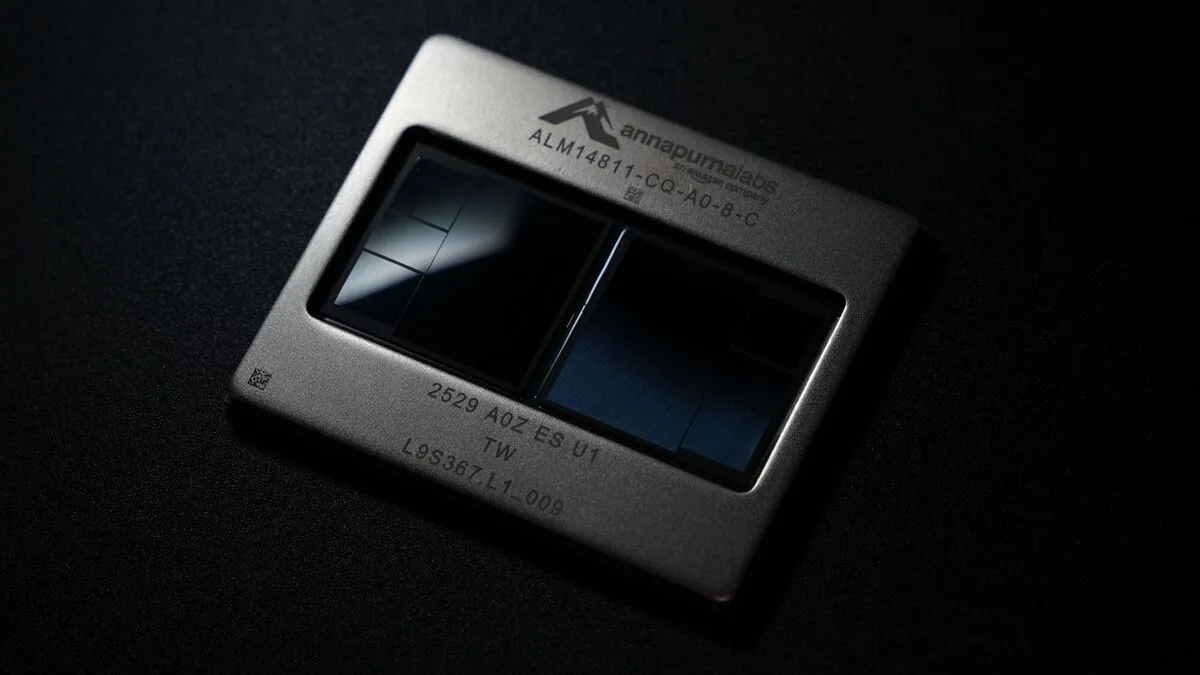
Crédito da imagem: Image via Bloomberg — Technology. Used under fair use for news commentary. · source
Most of the coverage on Amazon's chip push has been written like a boxing match preview. Nvidia in one corner, Amazon in the other, Andy Jassy warming up in the locker room. That framing isn't wrong exactly, but it skips past the part that actually matters to anyone building or running industrial systems right now.
Let me back up.
Bloomberg reported this week that Amazon is in talks to sell its custom-made AI chips, the Trainium and Inferentia lines, to other companies' data centers. Not just using them internally on AWS, but actually licensing them out. TechCrunch put a number on it: CEO Andy Jassy has said this is a $50 billion opportunity. That's a big number. Whether it's a realistic number is a different conversation.
Amazon has been building its own silicon for years. Trainium is their training chip, designed for running the heavy compute work of actually building AI models. Inferentia is the inference side, meaning running models once they're trained. Both are designed to reduce dependence on Nvidia's H100s and whatever comes after them.
When I was at Kuka, we spent a lot of time worrying about single-supplier dependencies, not on chips, but on servo drives, on controller hardware. The logic is the same. You don't want one vendor owning your critical path. Amazon figured this out early and built their own. Fair enough.
Cobertura relacionada
More in AI Models
Chipmakers swung wildly this week, from a Tuesday 'chip-wreck' to a Micron-led surge after hours. What's actually going on with AI's hardware backbone?
Sarah Williams · 26 Jun · 5 min
The original Creator Studio was shut down in 2023. Now it's back, rebuilt around an AI assistant that promises to grow your audience and reply to comments in your voice.
Sarah Williams · 26 Jun · 5 min
At its annual Config conference, Figma announced coding layers, AI-generated motion graphics, and a reimagined canvas that blurs the line between design and full-stack development.
Sarah Williams · 26 Jun · 5 min
Everyone talks about chips and models. The memory bottleneck is the part of the AI buildout that keeps getting underestimated, and Micron's latest earnings make that case hard to ignore.
The question now is whether those chips are good enough to sell externally. Internal use is one thing. Your own engineers tune around the weaknesses. External customers aren't so forgiving.
I'll be honest: I'm skeptical of the $50 billion figure in the near term. Not because Amazon can't build decent silicon, they clearly can, but because the ecosystem around Nvidia is genuinely hard to replicate. CUDA has been baked into ML workflows for over a decade. Developers know it. Toolchains are built around it. That's not impossible to displace, but it takes longer than a press release cycle.
That said, this move isn't really aimed at the customers who are deepest in the Nvidia ecosystem. It's aimed at the ones who aren't yet. Companies standing up new AI infrastructure, particularly in industrial and manufacturing contexts, who haven't committed to a stack. If Amazon can get in front of those buyers with a competitive price and a credible performance story, that's real.
The industrial angle is the one nobody's writing about, and it's the one I find most interesting. Factories running inference workloads at the edge, predictive maintenance systems, vision-based quality control, these applications don't need the absolute bleeding edge of GPU performance. They need reliability, cost efficiency, and vendor support. Amazon has two of those three in spades. The reliability question remains unclear until we see external deployment data.
Because this is still talks. Not launched. Not shipping. In talks.
It's too early to say how many data center operators will actually sign on, what the pricing looks like, or whether Amazon can deliver the software support that enterprise customers will demand. The gap between "we're in talks" and "we have 200 customers running production workloads" is enormous, and the tech press has a habit of treating the former as evidence of the latter.
I called my old colleague Dave, who runs infrastructure procurement for a mid-size contract manufacturer in the Midwest. His take was basically: show me the TCO numbers and the support SLA, and then we'll talk. Which is exactly the right answer. Nobody in industrial operations is switching chip suppliers based on a Bloomberg headline.
Look, here's the thing: the significance of this story isn't really about Amazon versus Nvidia. It's about the broader shift in how AI compute gets provisioned. For years, if you wanted serious AI hardware, you went to Nvidia, full stop. Maybe you looked at AMD. You didn't think much about hyperscaler silicon.
That's changing. Google has TPUs. Amazon has Trainium. Microsoft is building Maia. The hyperscalers are all trying to vertically integrate compute because margins on rented Nvidia GPUs aren't what they used to be.
For industrial buyers, this is actually good news, eventually. More competition in the chip market, assuming these alternatives mature, means better pricing and less exposure to Nvidia's notoriously tight supply allocations. Anyone who tried to get H100s in 2023 knows exactly what I mean.
This is based on limited public information, Amazon hasn't disclosed terms or named any prospective customers, so a lot of this is reading the tea leaves. But the direction of travel seems clear enough. The hyperscalers are getting serious about owning their silicon stack, and the ripple effects for anyone buying AI compute, including industrial operators, will be significant over the next three to five years.
Whether Amazon specifically pulls it off is a separate question. They've surprised people before.