SpaceX's IPO Has Nothing to Do With My Beat, But Everyone's Asking Me About It Anyway
A warehouse automation guy's honest take on why the SpaceX IPO frenzy is being covered wrong, and what it actually means for industrial tech investment.
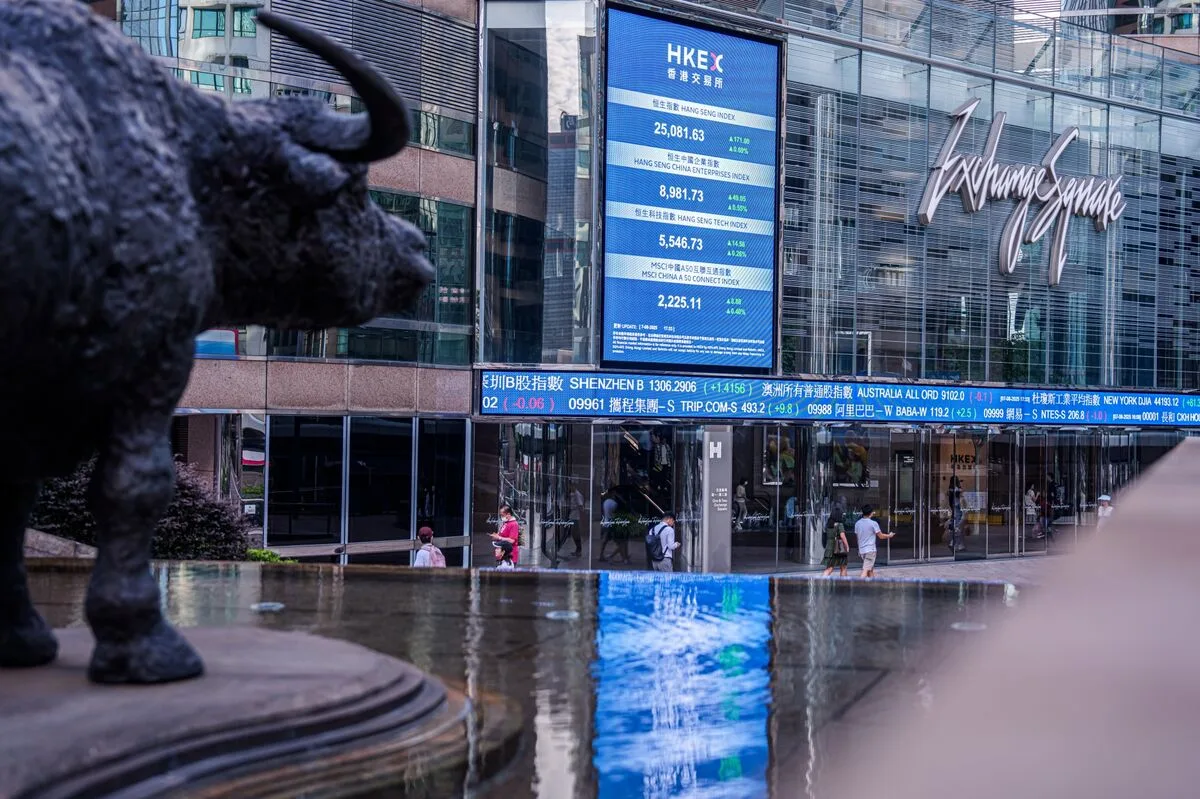
画像クレジット: Image via Bloomberg — Technology. Used under fair use for news commentary. · source
Most of the coverage I've seen this week has been breathless stuff about billionaires getting richer. Which, fine, that's a story. But it's not the story that matters to anyone building real things in factories and warehouses.
Look, here's the thing. I spent twelve years at Kuka watching aerospace money slosh around without ever trickling down to the floor-level automation work we were doing. The SpaceX IPO is a massive event, no question. But the framing has been almost entirely about wealth, not about what a newly public SpaceX means for the broader industrial technology sector. That's the gap I want to fill, even if it's a bit outside my usual lane.
Bloomberg reported that SpaceX shares jumped in premarket trading Monday, extending gains after what they called a record IPO debut on Friday. The company vaulted into the ranks of the world's most valuable public companies almost overnight. A separate Bloomberg piece noted that the share surge was already bolstering the fortunes of Saudi billionaire investors who had positions coming in.
The valuation figures haven't been fully disclosed in what I've seen so far, so I won't throw a number out there. But we're talking about a company that is now publicly traded, liquid, and sitting at a valuation that puts it alongside the biggest names in any sector you care to name.
That's a lot of capital suddenly visible on a balance sheet.
The Apple supplier priced its shares at the maximum and still had to turn away demand, which tells you something about where hardware money is flowing right now.
James Chen · 25 Jun · 5 min
Prime Day deals on Echos and Ring cameras are fine, but let's not confuse consumer gadgets with the serious robotics work happening in warehouses.
Robert "Bob" Macintosh · 25 Jun · 3 min
Amazon's CEO made his first India trip and left behind a $13 billion AI commitment and an aggressive quick-commerce expansion. The numbers are real. The execution is the hard part.
James Chen · 25 Jun · 6 min
A wave of arXiv preprints this week tackles one of manipulation's oldest problems: how do you get a robot to learn from imperfect, incomplete, or just plain missing data?
Here's where I'll be honest: I'm not an aerospace guy. Never was. My world is palletisers, conveyor logic, articulated arms doing repetitive pick-and-place work in facilities that smell like motor oil and cardboard. SpaceX feels remote from that.
But capital markets don't stay in their lanes. When I was at Kuka, we watched the automotive sector's investment cycles ripple outward into everything we touched. A good year for car manufacturers meant easier conversations about automation capex. A bad one meant projects got shelved. The same logic applies here, just at a different scale.
A newly public SpaceX, with real share liquidity and institutional investors now on board, changes the risk calculus for a whole class of industrial technology investment. Robotics, advanced manufacturing, autonomous logistics. These sectors benefit when big, credible tech companies demonstrate that patient capital in hardware actually pays off. SpaceX going public at this kind of valuation is, in a way, a proof-of-concept for the whole category.
It's too early to say whether that effect will be meaningful or just theoretical. But I've seen this pattern before, and it's worth watching.
There's also the supply chain angle, which almost nobody is writing about. SpaceX manufactures at serious scale. Starship components, Starlink hardware, engine assemblies. That's a procurement footprint that touches precision machining, automated assembly, quality inspection systems. Some of those suppliers are companies I know. Some of them have been waiting a long time for SpaceX to have the kind of public accountability that comes with being listed. It changes the vendor relationship in ways that are hard to quantify but real.
Honestly, I don't know. That's not me being coy, it's just the truth. The IPO is two trading days old as I write this, and the share price is still in its honeymoon phase. Whether the valuation holds, whether institutional money stays patient, whether this translates into any of the downstream effects I'm describing, all of that remains unclear.
What I do know is that the coverage has been almost entirely about the financial spectacle, the Saudi prince's net worth, the record-setting debut, the Wall Street reaction. That stuff is real but it's also kind of surface-level. The more interesting questions are about what a public SpaceX does to the competitive and investment landscape for industrial technology companies that don't have Elon Musk's name attached to them.
I called my old colleague Marcus, who's been doing automation consulting for aerospace suppliers for the better part of a decade, and he made a point I thought was worth passing on. His view, roughly, is that SpaceX going public creates a new benchmark that other industrial tech companies will be measured against, whether they like it or not. Investors who now hold SpaceX shares will start asking why the warehouse robotics company they're also invested in can't show similar trajectory.
That's a pressure that could be good or bad depending on where you're sitting. Probably both, at different times.
I'll keep an eye on this one. It's not my usual beat, but the industrial automation world doesn't exist in a vacuum, and anyone who tells you the SpaceX IPO is just a space story isn't paying attention.