画像クレジット: Image via Bloomberg — Technology. Used under fair use for news commentary. · source
For context on just how large $75 billion is as an IPO valuation: Alibaba's 2014 listing, long considered the benchmark for blockbuster public offerings, raised $25 billion. SpaceX just did three times that.
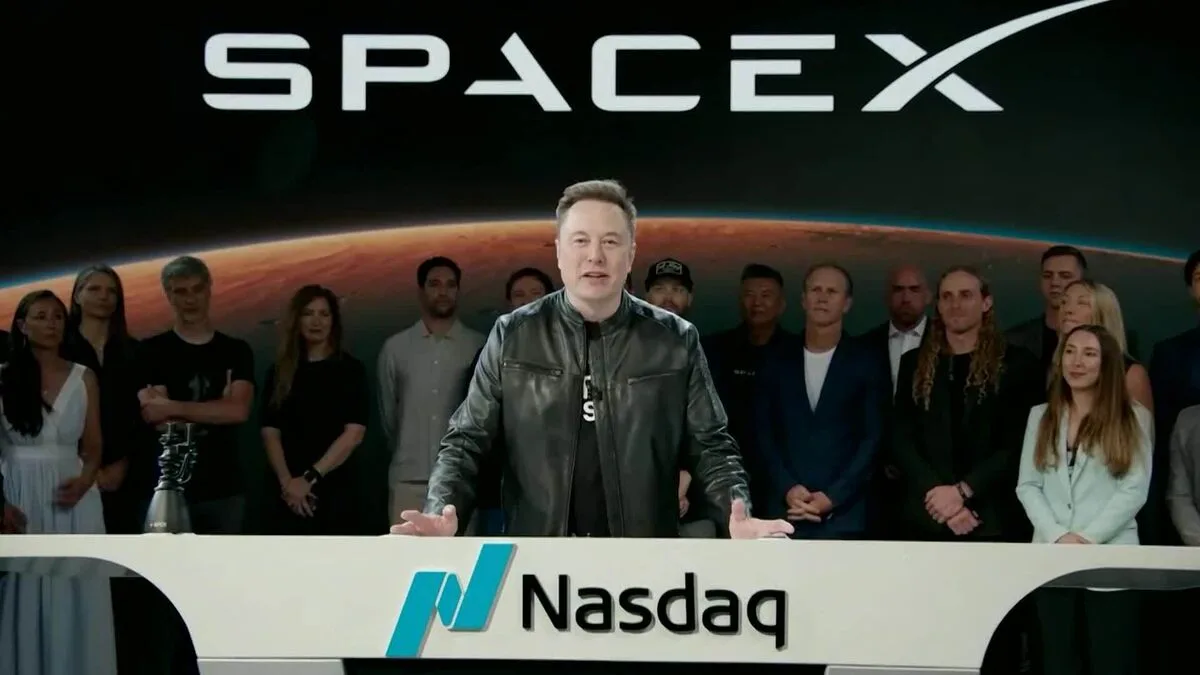
On Friday morning, Elon Musk rang the Nasdaq opening bell in what the company staged as a dual-ceremony event, simultaneously broadcast from New York and Texas. SpaceX employees watched a livestream as their company began trading on the exchange. The rocket manufacturer, which has spent more than two decades operating as a private firm, is now a publicly traded entity worth, at least on paper, $75 billion at IPO.
That's an ambitious number, even by the standards of a company that has genuinely reshaped the launch industry.
Let's put the figure in industrial terms, since that's where it belongs. SpaceX is not a software company with near-zero marginal costs. It manufactures rockets, operates launch facilities, builds and deploys satellites at scale, and runs a growing broadband service in Starlink. Hardware businesses carry real costs: materials, machining, propulsion testing, failure rates. From my time in hardware, I can tell you that valuing a manufacturing operation at this level requires some very optimistic assumptions about future revenue, margin expansion, and competitive moat.
I've seen enough spec sheets to know that the gap between projected throughput and actual production volume is where most ambitious valuations come apart. Whether SpaceX can sustain the margins implied by a $75 billion figure depends heavily on Starlink's subscriber trajectory, continued dominance in commercial launch contracts, and the eventual revenue profile of Starship, which remains in active development.
関連記事
More in Industrial
The Apple supplier priced its shares at the maximum and still had to turn away demand, which tells you something about where hardware money is flowing right now.
James Chen · 25 Jun · 5 min
Prime Day deals on Echos and Ring cameras are fine, but let's not confuse consumer gadgets with the serious robotics work happening in warehouses.
Robert "Bob" Macintosh · 25 Jun · 3 min
Amazon's CEO made his first India trip and left behind a $13 billion AI commitment and an aggressive quick-commerce expansion. The numbers are real. The execution is the hard part.
James Chen · 25 Jun · 6 min
A wave of arXiv preprints this week tackles one of manipulation's oldest problems: how do you get a robot to learn from imperfect, incomplete, or just plain missing data?
It's too early to say whether the market will hold that valuation once analysts start digging into the actual unit economics.
The choice to run a simultaneous bell-ringing in both New York and Texas is worth noting, not just as theater. SpaceX relocated its headquarters to Starbase, Texas, in 2024, part of a broader shift by Musk-affiliated companies away from California. Staging the IPO moment across two locations reinforces that geographic identity while also playing well with the Texas political and business establishment.
Musk addressed SpaceX employees directly via livestream during the ceremony. No specific remarks from that address have been disclosed publicly, though Bloomberg reported that he spoke about the company's future and history. What exactly he said to employees on the day their equity became liquid, and what guidance he offered about expectations going forward, remains unclear.
To understand why this IPO carries weight beyond the headline number, it helps to look at what SpaceX actually controls in the commercial launch market.
The company's Falcon 9 booster has become the workhorse of low-Earth orbit deployment. It has completed more than 300 flights with a reliability record that competitors have not matched. Falcon Heavy handles heavier payloads. Starship, still in iterative testing, is designed to be a fully reusable super-heavy lift vehicle with per-launch economics that, if the projections hold, would make current launch pricing look expensive.
Starlink, the satellite internet constellation, is the other major piece. The service has expanded to millions of subscribers across dozens of countries, including maritime and aviation applications. It's a recurring revenue business layered on top of the launch infrastructure SpaceX already operates, which is a structurally appealing combination for public market investors.
Key figures from the company's public profile:
Falcon 9 flights completed: 300+
Starlink satellites in orbit: approximately 6,000+ as of early 2026
IPO valuation: $75 billion
IPO structure: Dual-listed on Nasdaq, New York and Texas ceremonies
Headquarters: Starbase, Texas
The company didn't disclose exact revenue or margin figures in what's been reported so far from the IPO day coverage.
Look, SpaceX has earned a significant amount of credibility. It solved reusability at scale when most of the industry thought it was impractical. It has real contracts, real hardware, and real launches. This is not a pre-revenue startup projecting hockey-stick growth on a pitch deck.
But there are legitimate questions that a $75 billion IPO valuation raises, and they don't disappear just because the company has an impressive track record.
First, competitive pressure is building. United Launch Alliance, Rocket Lab, and international programs including ESA's Ariane 6 and China's Long March series are all active. Blue Origin's New Glenn is now operational. The assumption that SpaceX maintains pricing power in commercial launch over a ten-year horizon is not guaranteed.
Second, Starlink's long-term competitive position in broadband faces pressure from Amazon's Project Kuiper, which is now deploying satellites. Whether the market can support two large LEO broadband constellations at scale, or whether this becomes a winner-take-most scenario, is genuinely uncertain. Some analysts argue Starlink's first-mover advantage is durable; others counter that Kuiper's distribution through Amazon's existing commercial relationships could erode that lead faster than the current subscriber numbers suggest.
Third, and this is worth stating plainly: Musk's involvement across multiple high-profile companies and his political visibility create headline risk that didn't exist for SpaceX five years ago. Whether that affects institutional appetite for the stock over time is something the market will sort out, but it's a variable that wasn't part of the calculus when SpaceX was private.
For SpaceX employees holding equity, Friday was a liquidity event. That's real and significant. For the company operationally, the implications are more nuanced.
Public companies face quarterly reporting requirements, analyst scrutiny, and shareholder pressure that private companies can largely ignore. SpaceX has operated with unusual autonomy precisely because it didn't have to explain its development timeline or capital allocation to public markets. Starship's iterative test program, which has involved several high-profile vehicle losses, would have generated very different coverage if SpaceX were reporting to public shareholders throughout.
Going public also raises capital, though SpaceX has not been short of private funding. The company has raised billions across multiple funding rounds over the past several years. The IPO is less about needing cash and more about, in a way, formalizing the company's scale and giving early investors and employees a path to liquidity.
Whether Musk retains effective control of the company's direction post-IPO depends on the share structure, which this is based on limited publicly available reporting so far, hasn't been fully detailed in what's surfaced from Friday's coverage.
I cover industrial automation, and SpaceX sits at an interesting intersection of that beat. The company's manufacturing operation in Hawthorne, California (and increasingly at Starbase) is one of the more sophisticated vertically integrated production environments in aerospace. They build engines, structure, avionics, and software largely in-house.
Starship's production ambitions, if Musk's stated goals are taken at face value, involve manufacturing rates that would require industrial automation at a scale the aerospace industry hasn't historically operated at. Traditional aerospace builds aircraft and rockets in relatively low volumes with high labor content. SpaceX has been pushing toward higher cadence with more automation, particularly in Starlink satellite manufacturing, where they've publicly claimed production rates of several satellites per day.
The real test is whether production volume can scale to match the ambitions implied by a $75 billion valuation. That's not a question Friday's bell-ringing answers. It's a question the next several years of quarterly reports will.
For now, SpaceX is public. The number is $75 billion. And the market will spend the coming months deciding whether that number makes sense.