画像クレジット: Image via source article. Used under fair use for news commentary. · source
Remember when every earnings call in 2021 mentioned 'metaverse' at least three times? When companies would see their stock jump just for announcing a vague VR initiative? I'm getting that same feeling watching the current AI discourse from major financial institutions.
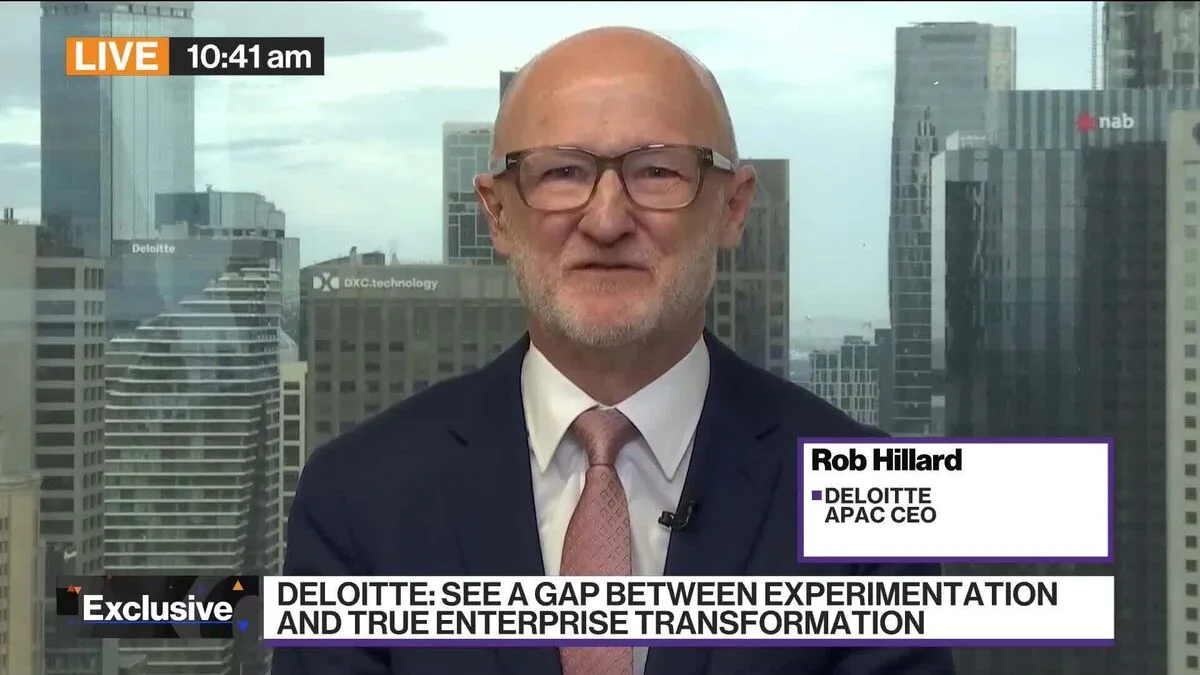
This week, Deutsche Bank's global macro vice chair Ozan Tarman went on Bloomberg and declared that AI, not geopolitical tensions like Iran, is "the key narrative for stocks." Meanwhile, Deloitte's APAC CEO Rob Hillard was making the rounds on Bloomberg discussing how AI is reshaping businesses across the region.
Here's what's bothering me. When financial executives start positioning AI as the market story, they're not really talking about the technology itself. They're talking about sentiment. About where money flows. And that's a different thing entirely.
I initially thought this was just typical Wall Street enthusiasm for the next big thing. But after watching both interviews, I think something more interesting is happening. The conversation has shifted from "will AI work?" to "how fast will it disrupt jobs?" Tarman specifically discussed how AI could impact employment, which suggests we're past the pure hype phase and into the messy implementation questions.
関連記事
More in AI Models
Chipmakers swung wildly this week, from a Tuesday 'chip-wreck' to a Micron-led surge after hours. What's actually going on with AI's hardware backbone?
Sarah Williams · 26 Jun · 5 min
The original Creator Studio was shut down in 2023. Now it's back, rebuilt around an AI assistant that promises to grow your audience and reply to comments in your voice.
Sarah Williams · 26 Jun · 5 min
At its annual Config conference, Figma announced coding layers, AI-generated motion graphics, and a reimagined canvas that blurs the line between design and full-stack development.
Sarah Williams · 26 Jun · 5 min
Everyone talks about chips and models. The memory bottleneck is the part of the AI buildout that keeps getting underestimated, and Micron's latest earnings make that case hard to ignore.
That's progress, sort of.
But here's where I get stuck. The specifics remain frustratingly vague. Neither executive provided concrete numbers on AI adoption rates, productivity gains, or timeline projections. We're still dealing in vibes.
What we actually know (and don't know):
Deutsche Bank sees AI as more market-relevant than major geopolitical events (that's a bold claim, tbh)
Deloitte is tracking AI impact across APAC businesses, but the interview didn't include specific adoption figures
Both conversations mentioned job displacement, but neither offered data on actual workforce changes
It's unclear whether these assessments are based on current deployments or projected future states
You might be wondering why I'm being so skeptical when AI clearly is transforming industries. Fair point. I've covered enough humanoid and embodied AI deployments to know the technology is real and advancing fast. The question isn't whether AI matters. It's whether the financial narrative has gotten ahead of the operational reality.
And I should know this better, but I genuinely can't find good data on enterprise AI ROI at scale. Most case studies I see are either vendor-sponsored or focus on pilot programs. The gap between "we deployed AI" and "AI meaningfully changed our bottom line" remains unclear for most companies.
This matters because when "AI" becomes the dominant stock narrative, it creates pressure for companies to appear AI-forward regardless of whether their implementations make sense. We saw this exact dynamic with blockchain, with metaverse, with (going way back) with dotcom domain names.
The pattern goes like this: technology emerges, financial markets get excited, companies rush to associate themselves with the trend, actual implementation lags behind the stock price movements, and eventually there's a correction when reality catches up with narrative.
I'm not saying we're in a bubble. I'm saying we might be in the phase where distinguishing real AI progress from AI theatre becomes increasingly important.
What Hillard said about AI reshaping businesses across APAC is probably true. Some businesses. Some ways. But "reshaping" is doing a lot of work in that sentence. A company using ChatGPT for customer service emails has been "reshaped by AI" in the same way that a company deploying autonomous warehouse robots has. These are not equivalent transformations.
The job impact question is where things get genuinely complicated. Tarman raised it, which I appreciate, but (and this is frustrating) the available clip doesn't include whatever data or analysis he might have shared. We're left with the headline without the substance.
Here's what I think is actually happening. Major financial institutions are positioning themselves as AI-literate because their clients expect it. The narrative becomes self-reinforcing. If Deutsche Bank says AI is the key story, then fund managers allocate accordingly, which makes AI stocks move, which confirms that AI is the key story.
This isn't necessarily wrong or bad. It's just worth naming.
For those of us watching the actual technology (the robots, the models, the deployments), there's a weird disconnect. The stuff that's genuinely interesting, like embodied AI finally getting good enough for real-world manipulation tasks, often gets less attention than vague corporate AI announcements. The market rewards the narrative, not necessarily the breakthrough.
I don't have a clean conclusion here. It's too early to say whether this AI-as-market-narrative moment will prove justified or overblown. Probably some of both, like most things. But when I hear "AI is the key narrative for stocks," my instinct is to look harder at what's actually shipping. The story and the substance aren't always the same thing.