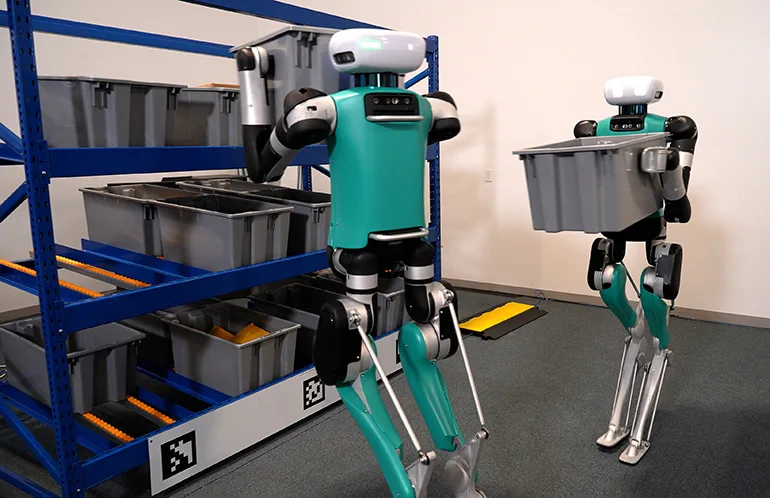
Two New Approaches to Multi-Robot Coordination Might Finally Crack the Scalability Problem
Researchers are combining diffusion models with reinforcement learning to help robots work together without the computational nightmare of centralized planning.
By
·2 June 2026·7 min de lecture
Picture four robots trying to navigate a maze simultaneously. Each one knows where it wants to go, but none of them know what the others are planning. It's basically a recipe for chaos, or at least a lot of awkward collisions and deadlocks.
This is the multi-robot coordination problem, and honestly, it's been bugging researchers for decades. The obvious solution (have one central brain plan everything) works great until you add more robots, at which point the computational requirements explode. The other obvious solution (let each robot figure it out independently) is efficient but, well, leads to robots bumping into each other.
Two new papers caught my attention this week because they're attacking this problem from similar but distinct angles. Both use reinforcement learning to add coordination to decentralized planning. Both seem to actually work. And both suggest we might be closer to scalable multi-robot systems than I initially thought.
The core tension here is pretty fundamental. Centralized planning, where one system computes trajectories for all robots simultaneously, produces optimal results. It accounts for every possible interaction. But the math gets ugly fast. With four robots, you're already dealing with a joint state space that's the product of each individual robot's state space. Add a fifth robot and it gets worse. A sixth? You see where this is going.
Decentralized approaches flip the problem. Each robot plans independently, which scales beautifully. But independent planning means Robot A has no idea Robot B is about to cut across its path. The result: collisions, deadlocks, and generally inefficient behavior.
À lire aussi
More in Humanoids
The headlines are celebrating a $2.5B humanoid robotics deal. I'd pump the brakes a little.
Mark Kowalski · 25 Jun · 6 min
Sometimes the sources don't pan out. Here's what happened when I tried to write a humanoids story this week and ended up with Samsung deals instead.
Sarah Williams · 25 Jun · 3 min
Diffusion models are getting good at imagining robot movements, but 'imaginable' and 'physically possible' aren't the same thing. Researchers are starting to close that gap.
Sarah Williams · 25 Jun · 6 min
A batch of fresh robotics research tackles the same underlying problem from different angles: robots that can see but don't really understand where things are.
Researchers have tried various middle grounds (communication protocols, priority schemes, reactive collision avoidance) but nothing has really solved the fundamental tradeoff. You either get good coordination or good scalability. Picking both has remained elusive.
The first paper, from a team whose affiliations aren't specified in the abstract, proposes something clever. Each robot uses a diffusion model (the same underlying tech behind image generators like Stable Diffusion) to generate candidate trajectories. The diffusion model is trained on single-agent motion data, so it knows how to produce feasible paths for one robot moving through space.
Here's where it gets interesting. During the trajectory generation process, a centralized value function trained via multi-agent reinforcement learning "guides" the diffusion. Think of it like this: the diffusion model proposes trajectories, and the value function nudges those proposals toward ones that won't conflict with other robots.
The technical term is "exponential tilting," which, tbh, I had to look up. It basically means the value function biases the probability distribution during denoising toward trajectories with higher expected multi-agent returns. The robot still generates its own trajectory independently, but the generation process is subtly influenced by coordination concerns.
The results? In a simulated maze with four mobile robots, inter-agent interference dropped from 55.4% to 41.8%. That's not perfect, obviously. You're still looking at conflicts in roughly four out of ten scenarios. But it's a meaningful improvement without sacrificing the scalability benefits of decentralized planning.
What I find compelling here is that you don't need to retrain the generative model for multi-robot scenarios. The single-agent diffusion model stays the same; you're just adding a coordination layer on top. That's architecturally elegant in a way that should make deployment easier.
The second paper, HALO from researchers at Tsinghua University, tackles a related but distinct problem: robots working with humans. This introduces what the authors call a "rationality gap," which is a fancy way of saying humans don't behave like optimal agents, and robots need to account for that.
I initially thought this was just standard human-robot interaction research, but after reading more carefully, I think there's something genuinely new here. The core insight is that when you have heterogeneous agents (a robot and a human, say) doing decentralized learning, the standard policy gradient updates can oscillate or diverge. The math doesn't guarantee convergence because you're essentially playing a general-sum game, not a cooperative one.
HALO addresses this by using Lyapunov-based contraction in policy-parameter space. If that sounds like jargon, here's the intuition: Lyapunov functions are a classic tool for proving stability in dynamical systems. The researchers are using similar mathematics to ensure that the learning process itself stays stable, that the robot's policy updates don't wildly swing around but instead converge toward something useful.
The paper includes both simulation results and real-world experiments with a humanoid robot, which is notable. A lot of multi-agent RL research stays in simulation forever. Seeing actual hardware validation suggests the approach is robust enough to handle real-world messiness.
You might be wondering whether these two papers are competing or complementary. Honestly, I think they're addressing different layers of the same problem.
The diffusion-based approach is fundamentally about trajectory generation. It's asking: given that each robot needs to produce a path, how do we inject coordination into that generation process without centralized joint planning?
HALO is more about policy learning in the presence of heterogeneous agents. It's asking: given that robots and humans have fundamentally different decision-making processes, how do we ensure stable learning?
You could imagine combining them. A humanoid robot using HALO to learn stable collaborative policies with humans, while also using value-guided diffusion to generate coordinated trajectories with other robots in the environment. Whether that combination would actually work is, well, remains unclear. Neither paper addresses integration with the other's approach.
The diffusion paper's experiments are limited to four robots in a maze. That's a controlled environment with relatively simple dynamics. How this scales to, say, a warehouse with 50 robots and complex obstacle geometries is an open question. The authors claim scalability benefits, but the empirical validation is modest.
The HALO paper does include real-world experiments, but the specifics of those experiments aren't detailed in the abstract. What tasks were tested? How many human participants? What were the failure modes? I'd need to dig into the full paper to assess how robust these results really are.
There's also a broader question about generalization. Both approaches rely on learned components (value functions, policies) that were trained in specific environments. Transfer to new environments, new robot morphologies, or new task types isn't guaranteed.
Multi-robot coordination isn't an academic curiosity. It's increasingly a practical necessity. Warehouses, construction sites, agricultural operations, basically any domain where you want to deploy robots at scale eventually hits this problem.
The current solutions are mostly ad hoc. Companies like Amazon use sophisticated traffic management systems for their warehouse robots, but these are heavily engineered for specific environments. General-purpose coordination that works across domains has remained elusive.
What these papers suggest, and I want to be careful not to oversell this, is that learned coordination might be more tractable than we thought. The combination of generative models for trajectory planning and reinforcement learning for coordination could be a genuinely useful paradigm.
I think the diffusion-based approach is particularly interesting because it's modular. You could potentially drop it into existing systems that already use generative planning, adding coordination without a complete architectural overhaul. That matters for adoption.
The HALO work is more foundational, addressing stability guarantees that will matter as human-robot collaboration becomes more common. If we're going to have humanoids working alongside people in factories and homes, we need the learning process itself to be stable and predictable. Oscillating policies that suddenly change behavior would be, to put it mildly, bad.
Both papers are incremental advances, not paradigm shifts. The interference rate in the diffusion paper is still above 40%. The HALO paper's real-world validation, while encouraging, is limited. We're not at solved yet.
But I'm cautiously optimistic. The combination of diffusion models and MARL feels like the right architectural direction. It preserves scalability while adding coordination. It's learnable rather than hand-engineered. And it's showing real empirical improvements in controlled settings.
The next steps are probably obvious: larger-scale experiments, more diverse environments, integration with real robotic systems. The gap between academic papers and deployed products remains wide. But these two papers suggest the fundamental algorithmic pieces might be falling into place.
Whether that translates to robots that can actually coordinate in the messy real world? Ask me again in a few years. I genuinely don't know yet.