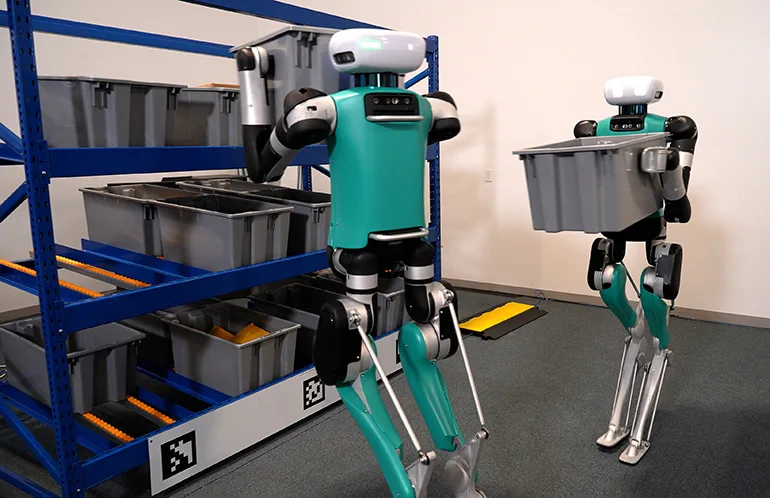
Crédit photo: Image via The Robot Report. Used under fair use for news commentary. · source
Most of the coverage on Agility Robotics going public has focused on the headline number, the $2.5 billion valuation, the $620 million in expected proceeds, the excitement around Digit v5. And sure, fine, those are real numbers worth reporting. But nobody seems to want to say the quiet part out loud, which is that we've been here before, and it didn't end great last time.
Agility Robotics, the humanoid startup that spun out of Oregon State University back in 2015, announced it's merging with Churchill Capital Corp XI to go public via SPAC. TechCrunch has the deal details, and The Robot Report covers the Digit v5 angle well enough. The company expects to raise $620 million from the merger, which will go toward advancing the robot itself and fulfilling what they're calling growing customer orders. That last part is important, and I'll come back to it.
But first, the SPAC thing. I've seen this movie before. The SPAC boom of 2020 and 2021 was supposed to unlock a new era of high-potential companies getting public market access without the friction of a traditional IPO. Instead it became, at least in a lot of cases, a way for companies with shaky near-term fundamentals to get retail investors excited before the hard questions got asked. Electric vehicle startups. Flying car companies. A whole parade of autonomous vehicle firms that are now either bankrupt, drastically scaled back, or still limping along years behind their own projections. Nikola went public via SPAC. Lordstown Motors went public via SPAC. I'm not saying Agility is those companies. I'm saying the mechanism itself has a track record that deserves at least a raised eyebrow.
À lire aussi
More in Humanoids
Sometimes the sources don't pan out. Here's what happened when I tried to write a humanoids story this week and ended up with Samsung deals instead.
Sarah Williams · 25 Jun · 3 min
Diffusion models are getting good at imagining robot movements, but 'imaginable' and 'physically possible' aren't the same thing. Researchers are starting to close that gap.
Sarah Williams · 25 Jun · 6 min
A batch of fresh robotics research tackles the same underlying problem from different angles: robots that can see but don't really understand where things are.
Sarah Williams · 25 Jun · 7 min
The new Section 232 tariff rules for steel and aluminum aren't just a manufacturing story. For anyone building metal-bodied robots at scale, the supply chain math just got harder.
And look, Agility isn't some vaporware shop. These are serious engineers who've been working on bipedal locomotion for over a decade, which in this industry is practically a geological era. Digit is a real robot that has done real work in real warehouses, including a well-documented deployment with Amazon. That's more than most humanoid companies can say, where the product is still a rendered video and a pitch deck. So I'm not here to bury Agility. I actually think they're one of the more credible players in this space, which is exactly why the SPAC route is worth scrutinizing rather than just celebrating.
The $2.5 billion valuation is where things get genuinely murky. It's too early to say whether that number reflects actual near-term revenue potential or whether it's priced on a vision of a future that's still years away from materializing at scale. The company mentions growing customer orders, but the exact figures haven't been disclosed, and that matters enormously. There's a big difference between ten customers ordering fifty robots each and two customers with letters of intent. We don't know yet which end of that spectrum we're looking at, and the market will eventually want to know.
This is the self-driving car hype cycle all over again in some respects. Not the technology itself, which is genuinely advancing, but the capital markets story layered on top of it. In the early 2010s, every autonomous vehicle company was going to have robotaxis on the road by 2020. The technology was real, the progress was real, but the timelines were fantasy and the valuations got way out ahead of the business fundamentals. A lot of investors got hurt. The companies that survived, and some did survive and are doing meaningful work now, mostly had to reset expectations pretty painfully along the way. Humanoid robotics feels like it's entering that same phase of the cycle, where the technology has crossed some genuine threshold of credibility and now the capital is rushing in faster than the actual commercial deployment can justify.
Agility going public accelerates that dynamic. Once you're a public company, the quarterly earnings call doesn't care about your five-year roadmap. It cares about whether you hit the number. And for a company still in relatively early commercial deployment of a complex physical product, that pressure can be brutal. It can push companies toward overpromising on timelines, toward chasing revenue that isn't quite ready rather than getting the product right, toward cutting R&D when the stock dips. These are structural incentives that don't care how good your engineers are.
Now, maybe Agility has thought all this through. Maybe the $620 million in proceeds gives them enough runway that the quarterly noise doesn't force bad decisions. Maybe the customer order pipeline is genuinely robust enough to support the valuation. Maybe Digit v5 is a meaningful enough leap over Digit v4 that new verticals open up faster than anyone expects. All of that is possible, and it remains unclear from what's been disclosed publicly whether any of those maybes are actually true. The company has every incentive to frame the story optimistically in the lead-up to a public offering, which isn't a criticism exactly, it's just how these things work.
What I'd want to know, and what I haven't seen anyone really dig into yet, is the unit economics. What does it cost to build one Digit? What does it cost to maintain it in the field? What are customers paying, and what's the margin? What does the service and support model look like, because a bipedal robot operating in a warehouse is not a set-it-and-forget-it product? These are the questions that separate a real business from a compelling demo, and they're the questions that SPAC structures sometimes let companies defer a little too long.
I want Agility to succeed, genuinely. They're one of the few humanoid companies that seems to actually care about building something useful rather than just building something impressive. Digit isn't trying to look like a person, it's trying to do a job, and that pragmatism is refreshing in a field full of anthropomorphic vanity projects. The Oregon State roots, the decade-plus of serious research, the real-world deployments, these things matter and they distinguish Agility from a lot of the kids showing up with fresh funding and a robot that can do a backflip but not fold a box.
But the SPAC structure, the valuation, the timing, all of it sits in a part of the story that deserves more scrutiny than it's getting. The robotics press, and I'll include myself here, has a tendency to get excited when a company clears a credibility threshold and then go a little soft on the hard financial questions. This is one of those moments where the hard questions matter more than usual. A company going public at $2.5 billion on the back of humanoid robot hype is either a genuinely transformative business getting the capital it needs to scale, or it's another chapter in a very familiar story about technology timelines and investor patience. Probably it's somewhere in between. But that somewhere in between is worth a lot more ink than it's getting right now.