Locus Robotics Acquires Nexera to Boost Array's Grasping Range, But Questions Remain About Real-World Performance
The acquisition brings adaptive gripper technology to Locus's mobile manipulator, though independent validation of the claimed SKU expansion is still lacking.
Bildnachweis: Image via The Robot Report. Used under fair use for news commentary. · source
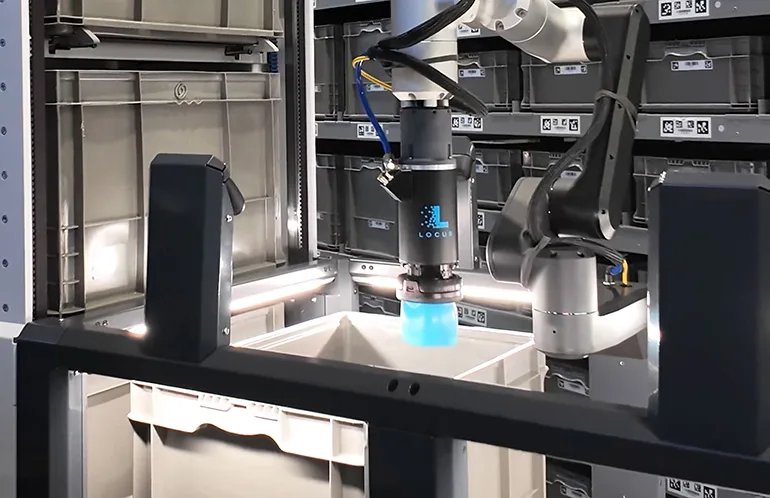
Picture a warehouse worker's hands. They can pick up a rigid cardboard box, a floppy polybag containing a t-shirt, a cylindrical bottle of shampoo, and a blister-packed phone charger, all within seconds of each other. Now picture a robot gripper trying to do the same thing. This is the fundamental challenge that has kept mobile manipulation from scaling in e-commerce fulfillment, and it is the problem that Locus Robotics is betting it can solve with its acquisition of Nexera Robotics.
The deal, announced this week, brings Nexera's patented NeuraGrasp adaptive gripper technology under the Locus umbrella. The stated goal is to dramatically expand the range of stock-keeping units (SKUs) that the Locus Array mobile manipulator can autonomously pick. It is worth noting that Locus has not disclosed the acquisition price, the number of Nexera employees joining the company, or specific performance metrics for the combined system.
Mobile manipulation in warehouses has been, to be precise, a story of constrained success. Autonomous mobile robots (AMRs) have proven themselves for transport tasks. Companies like Locus, 6 River Systems (now part of Shopify), and Fetch Robotics (acquired by Zebra Technologies) have deployed tens of thousands of units that move goods from point A to point B. The hard part has always been the picking itself.
The challenge is not grasping per se. Robotic arms with standard parallel-jaw grippers can reliably pick rigid, uniform objects. The challenge is grasping everything. A typical e-commerce fulfillment center might stock 50,000 to 500,000 unique SKUs, and those items vary wildly in size, shape, weight, rigidity, and packaging. A gripper optimized for boxes will crush a bag of chips. A suction-based system that works on flat surfaces will fail on mesh fabric.
Verwandte Beiträge
More in Industrial
The Apple supplier priced its shares at the maximum and still had to turn away demand, which tells you something about where hardware money is flowing right now.
James Chen · 25 Jun · 5 min
Prime Day deals on Echos and Ring cameras are fine, but let's not confuse consumer gadgets with the serious robotics work happening in warehouses.
Robert "Bob" Macintosh · 25 Jun · 3 min
Amazon's CEO made his first India trip and left behind a $13 billion AI commitment and an aggressive quick-commerce expansion. The numbers are real. The execution is the hard part.
James Chen · 25 Jun · 6 min
A wave of arXiv preprints this week tackles one of manipulation's oldest problems: how do you get a robot to learn from imperfect, incomplete, or just plain missing data?
The research community has explored this problem extensively. Work from groups at Berkeley (Dex-Net), CMU, and MIT has demonstrated learned grasping policies that generalize across object categories. Startups like RightHand Robotics (piece-picking for e-commerce) and Soft Robotics (now Soft Robotics AI, focused on food handling) have commercialized adaptive gripper designs. The Locus Array, which the company began shipping in limited quantities last year, represents Locus's entry into this space.
According to The Robot Report, the NeuraGrasp is described as an "adaptive" gripper, though the specific mechanism (soft robotics, variable stiffness, hybrid suction-mechanical, or something else entirely) is not detailed in available materials. Automated Warehouse similarly describes the technology as "patented" without providing the patent numbers or technical specifications.
What we can infer is that the NeuraGrasp is designed to handle a broader range of object geometries and compliance levels than standard grippers. The "Neura" prefix suggests some form of neural network-based control or grasp planning, which would be consistent with the direction the field has moved over the past five years. But I should be careful here (I know I'm being picky, but this matters): "neural" has become a marketing term as much as a technical descriptor, and without access to the actual patents or peer-reviewed publications, it is difficult to assess what is genuinely novel versus incremental improvement over existing adaptive gripper designs.
The integration with the Locus Array is the more significant aspect of this announcement from a systems perspective. Mobile manipulation requires tight coordination between the mobile base, the arm, the gripper, and the perception system. Getting all of these components to work together reliably, at speed, in a dynamic warehouse environment, is a substantial engineering challenge. By acquiring Nexera rather than partnering, Locus gains full control over the gripper's development roadmap and can optimize the entire stack.
Both press reports emphasize that the NeuraGrasp will "significantly expand" the range of SKUs the Array can pick. This is the central value proposition, and it is also where I find myself wanting more data.
The question is: expand from what baseline to what new capability? If the Array without NeuraGrasp could reliably pick 40% of a typical e-commerce catalog, and NeuraGrasp brings that to 70%, that is a meaningful improvement. If we are talking about going from 85% to 88%, that is incremental. The distinction matters enormously for the business case. Warehouse operators need to understand what percentage of their SKUs will still require human intervention, because that determines staffing levels and workflow design.
Actually, the research shows that SKU coverage percentages can be misleading without additional context. A gripper might successfully pick 90% of SKU types in a controlled test environment but achieve much lower success rates in production due to item presentation variability, bin clutter, and time constraints. The relevant metric is picks per hour at a given reliability threshold, not just binary "can it pick this item" assessments.
I reached out to Locus for specific performance data but did not receive a response before publication. This is not unusual for acquisition announcements, which tend to focus on strategic narrative rather than technical specifics, but it does mean we are working with limited information.
This acquisition should be understood in the context of intensifying competition in warehouse automation. Amazon, which operates the largest warehouse robotics fleet in the world (over 750,000 robots as of their last disclosure), has been steadily expanding its mobile manipulation capabilities through its Sparrow picking system. Boston Dynamics is piloting Stretch, a mobile manipulator designed for truck unloading and case picking. Berkshire Grey, Dexterity, and Covariant are all pursuing piece-picking with varying approaches to the gripper problem.
For Locus, which built its business on collaborative transport robots, the Array represents a strategic expansion into higher-value automation. Transport robots are increasingly commoditized. The margins and differentiation are in manipulation. The Nexera acquisition signals that Locus is serious about competing in this space, not just dabbling.
There is also a consolidation dynamic at play. The warehouse robotics sector saw significant venture funding in 2021 and 2022, followed by a pullback that has left many smaller companies struggling. Nexera, as a gripper-focused startup, likely faced the classic deep-tech challenge: long development timelines, capital-intensive hardware iteration, and a limited set of potential customers. An acquisition by Locus provides a path to market that might have been difficult to achieve independently.
Several things remain unclear about this deal and the technology it brings:
Technical specifics. What is the actual mechanism of the NeuraGrasp? Is it a soft gripper, a reconfigurable rigid gripper, a hybrid system? What sensors does it incorporate, and how does it determine grasp strategy? Without this information, it is difficult to assess how the technology compares to alternatives.
Performance validation. Has the NeuraGrasp been tested in production environments, or only in lab settings? What are the cycle times, success rates, and failure modes? I could not find any peer-reviewed publications or independent benchmarks for Nexera's technology.
Integration timeline. When will existing Locus customers be able to deploy Arrays with NeuraGrasp? The announcement does not specify whether this is a product available now, in beta, or still in development.
Competitive positioning. How does the NeuraGrasp compare to RightHand Robotics' RightPick, which has been deployed in production at scale? Or to Soft Robotics' mGrip? The press materials make no comparative claims, which makes it hard to evaluate the technology's standing in the market.
If Locus wants to establish credibility for the Array plus NeuraGrasp combination, a few things would help.
First, publish real performance data. Not marketing percentages, but actual metrics: picks per hour across a defined SKU set, grasp success rates, mean time between failures. The robotics community has developed standardized benchmarks (the YCB object set, for instance) that would allow meaningful comparison.
Second, provide technical detail on the gripper mechanism. This does not require revealing trade secrets. A high-level description of the actuation principle, sensing modalities, and control approach would allow informed evaluation.
Third, share customer deployment data. Even a single case study with specific numbers (warehouse size, SKU count, items picked per day, labor impact) would be more valuable than general claims about "expanded capability."
I am not suggesting that Locus is overstating the technology's capabilities. I simply do not have enough information to assess them one way or the other, and that is a problem for anyone trying to evaluate this acquisition's significance.
Mobile manipulation in warehouses is genuinely hard, and progress is genuinely happening. The combination of better gripper hardware, learned grasping policies, and improved perception systems has made it possible to automate picking tasks that were out of reach five years ago. This is not hype. The question is always about the gap between research demonstrations and production deployment, and about the economics of partial automation (where robots handle some SKUs and humans handle the rest).
The Locus-Nexera deal is a reasonable strategic move. Vertical integration of the gripper technology makes sense for a company trying to compete in mobile manipulation. Whether the NeuraGrasp represents a genuine technical advance or a competent implementation of known approaches, I cannot say based on available information.
What I can say is that the warehouse automation market is moving toward manipulation as the key differentiator, and Locus is positioning itself to compete. The next twelve to eighteen months will reveal whether the Array with NeuraGrasp can deliver on the implied promise of dramatically expanded SKU coverage. Until then, we are working with announcements rather than evidence, and the skeptical reader should calibrate accordingly.