Amazon Drops $13 Billion More on India AI Infrastructure as Jassy Bets Big on Fast Commerce
Amazon's CEO made his first India trip and left behind a $13 billion AI commitment and an aggressive quick-commerce expansion. The numbers are real. The execution is the hard part.
Bildnachweis: Image via Bloomberg — Technology. Used under fair use for news commentary. · source
Thirteen billion dollars. That's the additional AI and cloud infrastructure investment Amazon just committed to India by 2030, on top of whatever was already on the books. When a company drops that kind of number during a CEO's maiden visit to a market, it's worth paying attention to, not because the press release says so, but because the underlying infrastructure logic actually holds up.
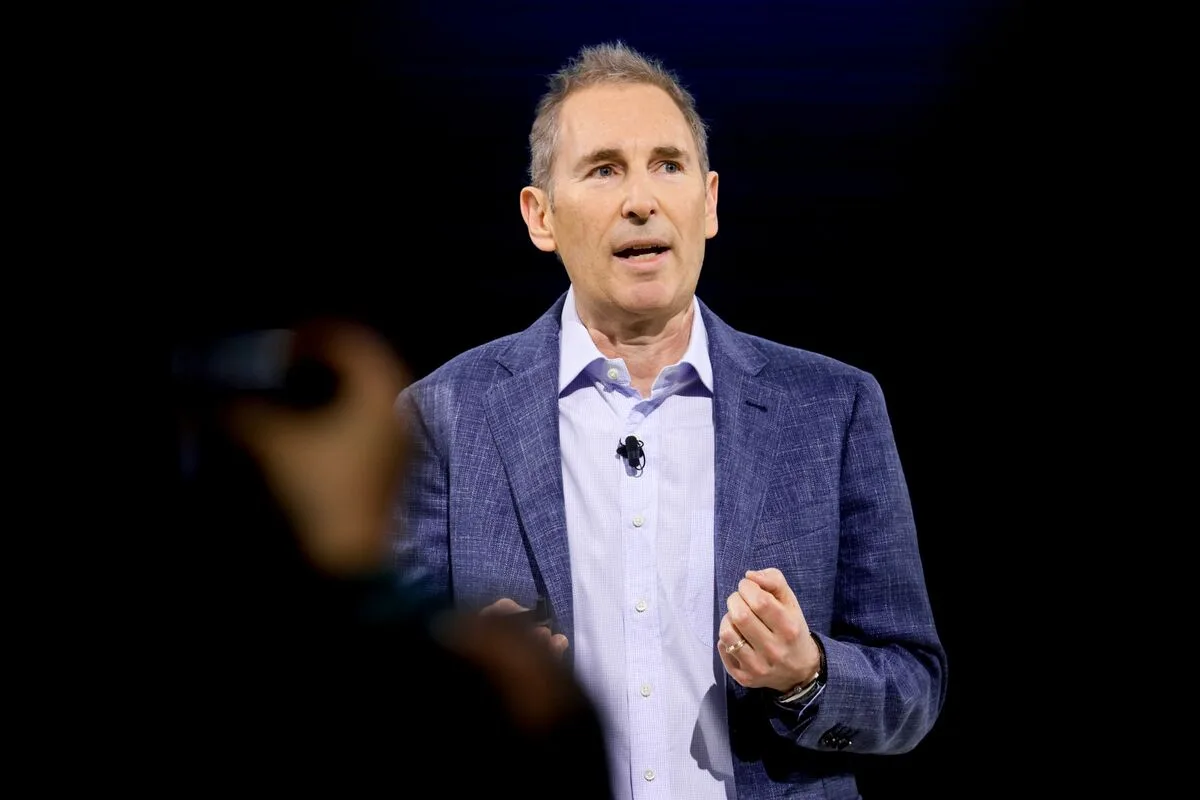
Andy Jassy landed in India for his first trip as chief executive and left behind two major announcements. One was the expanded $13 billion AI and cloud buildout, reported by Bloomberg. The other was a significant acceleration of Amazon Now, the company's quick-commerce delivery service, which is now expanding to cover more Indian cities and towns than it previously reached. Both moves are clearly aimed at the same thing: making Amazon competitive in a market where local players have built serious infrastructure advantages.
India's quick-commerce segment is genuinely competitive in a way that Western markets haven't seen. Blinkit, Zepto, and Swiggy Instamart have spent years building dense dark-store networks in Indian metro areas, and they've trained consumers to expect 10-to-15-minute grocery delivery. Amazon Now is playing catch-up, and Jassy's visit suggests the company knows it. Expanding city coverage is the right move, but I've seen enough logistics build-outs to know that coverage announcements and actual operational density are two very different things. The real test is whether Amazon Now can match delivery times and SKU depth in tier-two cities where the local players may have less of a head start.
Verwandte Beiträge
More in Industrial
The Apple supplier priced its shares at the maximum and still had to turn away demand, which tells you something about where hardware money is flowing right now.
James Chen · 25 Jun · 5 min
Prime Day deals on Echos and Ring cameras are fine, but let's not confuse consumer gadgets with the serious robotics work happening in warehouses.
Robert "Bob" Macintosh · 25 Jun · 3 min
A wave of arXiv preprints this week tackles one of manipulation's oldest problems: how do you get a robot to learn from imperfect, incomplete, or just plain missing data?
James Chen · 25 Jun · 5 min
Separate research teams have published fault-tolerant control frameworks for legged robots this week, and the approaches are different enough to be worth comparing.
The $13 billion AI figure is where things get more interesting from a hardware and infrastructure standpoint. Amazon's cloud arm, AWS, has been building data center capacity in India, and this commitment accelerates that substantially. India is the world's most populous country and has a growing base of enterprises that need cloud compute, AI inference capacity, and the kind of low-latency infrastructure that running large language models at scale actually requires. From my time in hardware, one thing that becomes obvious quickly is that AI workloads are brutally demanding on physical infrastructure. You need power, cooling, fiber density, and land. India has historically had constraints on all of those, particularly reliable power supply in some regions.
That's not a dealbreaker. It's a solvable engineering problem with enough capital, and $13 billion is a lot of capital. But it does mean the 2030 timeline matters. Deploying that level of infrastructure isn't a software sprint. It's permitting, construction, grid negotiations, and supply chain coordination across a country of 1.4 billion people with significant regional variation in regulatory environments. Whether Amazon hits that number on schedule remains unclear, and the company didn't offer a detailed breakdown of how the $13 billion splits between data center construction, networking, hardware procurement, and other categories.
What's easier to evaluate is the strategic logic. India is a market where AWS is competing directly with Google Cloud and Microsoft Azure, both of which have made substantial infrastructure commitments of their own. Sitting still wasn't an option. The $13 billion announcement is, in part, a competitive signal as much as it is an operational plan. That's not cynical, it's just how large infrastructure investments work. You commit publicly, you lock in enterprise customers who want assurance that the vendor will be there in five years, and then you execute.
The Amazon Now expansion is a more operationally immediate story. Quick commerce in India is a different beast than what Amazon has dealt with in the US or Europe. Basket sizes are smaller, margins are thinner, and the consumer expectation for speed has been set by well-funded local competitors who have been doing this for years. Amazon is not walking into a greenfield market here. It's walking into a fight.
Look, the expansion to more cities makes sense as a volume play. More coverage means more potential order density, and order density is what makes the unit economics of quick commerce work. A dark store serving a dense urban neighborhood can turn a profit if it's processing enough orders per hour. A dark store in a lower-density area that's covering too large a geographic radius is a money pit. The question of how Amazon Now calibrates that in smaller Indian cities is one the company hasn't answered publicly, at least not in detail.
Jassy's personal presence in India for this announcement is also worth noting, though probably not in the way the press release intended. CEOs don't fly to markets just to cut ribbons. They go when there's a strategic relationship to build, a regulatory environment to navigate, or a competitive situation that needs visible commitment from the top. India has all three right now. The government has been increasingly focused on ensuring that large foreign technology companies invest locally rather than just extracting value from the market. A CEO visit with a $13 billion check attached is a pretty clear signal that Amazon understands that dynamic.
This raises questions about the longer-term structure of Amazon's India operations, well, multiple things actually. How much of the AI infrastructure investment will be oriented toward serving Indian enterprises versus being part of Amazon's global capacity planning? How aggressively will Amazon Now price against Blinkit and Zepto, and for how long can it sustain any losses in pursuit of market share? And on the cloud side, will the $13 billion commitment translate into meaningful data localization capabilities that Indian regulators and enterprises increasingly want?
I don't have clean answers to any of those. This is based on two sources covering the initial announcements, and neither provided granular operational detail. What's clear is the scale of the commitment and the competitive context. What's less clear is the execution roadmap.
For the industrial and automation angle that I tend to care about most: quick commerce at Amazon's scale runs on serious warehouse automation. Amazon Now's dark stores almost certainly use some version of Amazon's robotics stack, the same ecosystem that includes Proteus, Sequoia, and the various picking and sorting systems the company has been deploying in its larger fulfillment centers. Scaling that to more Indian cities means either replicating that hardware footprint locally or adapting it for smaller-format dark stores. That's a non-trivial engineering and supply chain challenge, and it's one Amazon has more experience with than any of its Indian quick-commerce competitors. That might be the company's actual edge here, not the brand, not the Prime ecosystem, but the operational technology stack.
The $13 billion AI investment and the Amazon Now expansion are connected in that sense. Both are bets on infrastructure as a competitive moat. In a market as large and as competitive as India, that's probably the right frame. Whether the execution matches the ambition is a 2030 question.