Bildnachweis: Image via The Robot Report. Used under fair use for news commentary. · source
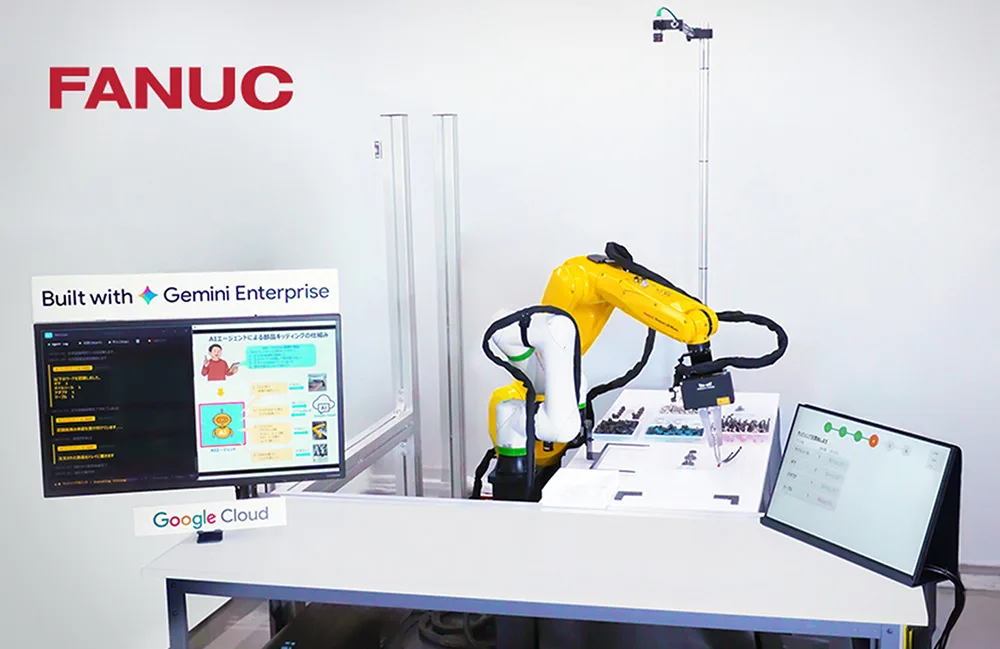
FANUC, the Japanese robotics company that's been making industrial robots since before most startup founders were born, just announced partnerships with both Google and NVIDIA to advance what the industry is calling "physical AI" in its robot systems. I've been covering tech long enough to know that when legacy players start partnering with the AI giants, something's actually happening, not just a press release dressed up as progress.
The news comes out of IREX in Tokyo, where FANUC apparently unveiled its physical AI system to considerable customer interest, according to The Robot Report. The company didn't disclose exact figures on that interest (they never do, call me old-fashioned but I'd love some actual numbers), but the fact that they're now working with both Google and NVIDIA suggests they're not just dipping a toe in the water here.
Let me explain why this matters more than the usual partnership announcement. FANUC isn't some scrappy startup trying to get attention by name-dropping big tech partners. They're one of the largest industrial robot manufacturers in the world, with millions of robots deployed in factories globally. When a company like that decides physical AI is worth pursuing with this level of commitment, it's a signal that the technology has moved past the "interesting research" phase into the "we need this to stay competitive" phase.
The NVIDIA side of things involves integration with Isaac Sim, NVIDIA's simulation platform that lets you train robots in virtual environments before deploying them in the real world. FANUC is integrating both its robots and its teach pendant (that's the handheld device operators use to program robot movements, for those who haven't spent time on a factory floor) with NVIDIA's simulation and AI technology. The goal, according to , is "smoother, smarter action," which is the kind of vague language that makes me want to see actual demos before I get too excited.
Verwandte Beiträge
More in Industrial
The Apple supplier priced its shares at the maximum and still had to turn away demand, which tells you something about where hardware money is flowing right now.
James Chen · 25 Jun · 5 min
Prime Day deals on Echos and Ring cameras are fine, but let's not confuse consumer gadgets with the serious robotics work happening in warehouses.
Robert "Bob" Macintosh · 25 Jun · 3 min
Amazon's CEO made his first India trip and left behind a $13 billion AI commitment and an aggressive quick-commerce expansion. The numbers are real. The execution is the hard part.
James Chen · 25 Jun · 6 min
A wave of arXiv preprints this week tackles one of manipulation's oldest problems: how do you get a robot to learn from imperfect, incomplete, or just plain missing data?
I've seen this movie before, honestly. The autonomous vehicle industry spent years promising that simulation would solve the deployment problem, that you could train cars in virtual worlds and they'd work perfectly in real ones. It didn't quite work out that way, and we're still waiting for the robotaxi revolution that was supposed to arrive five years ago. But industrial robotics is different in important ways. Factory environments are controlled, predictable, designed by humans for humans and machines to work in. The gap between simulation and reality is smaller when you're not dealing with drunk pedestrians and construction zones.
The Google partnership is more interesting to me, though details remain frustratingly sparse. Google has been building up its robotics capabilities quietly, acquiring companies and publishing research papers while everyone focuses on their large language models. Physical AI (the ability for robots to understand and interact with the physical world using AI techniques) is where Google's massive compute resources and AI research could actually matter in ways that go beyond chatbots.
What we don't know yet is substantial. How exactly is Google contributing? Is this about their foundation models, their cloud infrastructure, their robotics research, or all of the above? FANUC isn't saying, and Google's not elaborating. It's too early to say whether this partnership will produce anything meaningful or whether it's just two big companies agreeing to explore possibilities together, which is corporate speak for "we'll figure it out later."
Here's what I think is actually going on, and this is where I'll probably get some emails disagreeing with me (my email's on the about page if you want to argue). The industrial robotics industry is facing a genuine inflection point. For decades, industrial robots have been powerful but dumb, requiring extensive programming for every task, unable to adapt when things change even slightly. A robot that can pick up a specific part from a specific location and place it in a specific spot is incredibly useful, but it falls apart the moment that part is oriented differently or the lighting changes.
Physical AI promises to change that. Robots that can see, understand, and adapt. Robots that can learn new tasks from demonstration rather than extensive reprogramming. Robots that can work alongside humans without elaborate safety cages because they can perceive and respond to their environment in real time. This isn't science fiction anymore, it's what every major robotics company is working toward, and FANUC clearly doesn't want to get left behind.
The timing here is also worth noting. NVIDIA has been aggressively pushing into robotics, with Jensen Huang declaring that the next wave of AI will be physical AI at basically every keynote for the past year. Google has been quieter but no less ambitious, with their DeepMind robotics research producing increasingly impressive results. And FANUC, sitting on decades of mechanical engineering expertise and an installed base that most startups would kill for, needs the AI capabilities that these tech giants have been developing.
It's a classic technology industry dynamic: the old guard has the customers, the manufacturing capability, the domain expertise, and the trust of factory operators who don't want to bet their production lines on unproven technology. The new players have the AI models, the compute infrastructure, and the software talent. Partnerships like this are how these capabilities get combined, at least in theory.
But what do I know! I've been covering tech since the 90s and I've watched plenty of promising partnerships fizzle into nothing. The enterprise software graveyard is full of joint ventures and strategic alliances that produced press releases and not much else. What makes me cautiously optimistic here is that all parties have something concrete to gain. FANUC gets AI capabilities without having to build them from scratch. Google and NVIDIA get access to real industrial environments and real customer problems, which is invaluable for training and validating AI systems.
The customer interest FANUC mentioned is probably the most telling part of this whole story. Industrial customers are notoriously conservative, they don't adopt new technology because it's cool, they adopt it because it solves real problems or saves real money. If FANUC's physical AI demos at IREX generated genuine interest (and I wish we had numbers on what that means), it suggests the technology is approaching the point where practical deployment makes sense.
I should note the limitations of what we actually know here. I only found two sources covering this in detail, and both are from the same publication. FANUC hasn't released technical specifications, benchmark results, or deployment timelines. We don't know what "physical AI" means in FANUC's specific implementation, whether it's vision-based manipulation, learning from demonstration, adaptive motion planning, or something else entirely. The phrase itself is marketing as much as it is technical description.
What I'm watching for next: actual product announcements with specifications, customer case studies showing real deployments, and whether this partnership produces anything beyond the initial announcement. The robotics industry has learned some hard lessons from the autonomous vehicle hype cycle, and I think there's more discipline now about separating research demonstrations from production-ready systems. But old habits die hard, and the temptation to overpromise is always there when the technology is genuinely exciting.
For now, I'd say this is one of the more significant partnership announcements in industrial robotics in recent memory. Not because of what it promises, promises are cheap, but because of who's involved. FANUC doesn't need to chase hype, they're already dominant in their market. If they're making this kind of commitment to physical AI, it's because they see it as essential to their future. And that, more than any press release, tells you where the industry is heading.