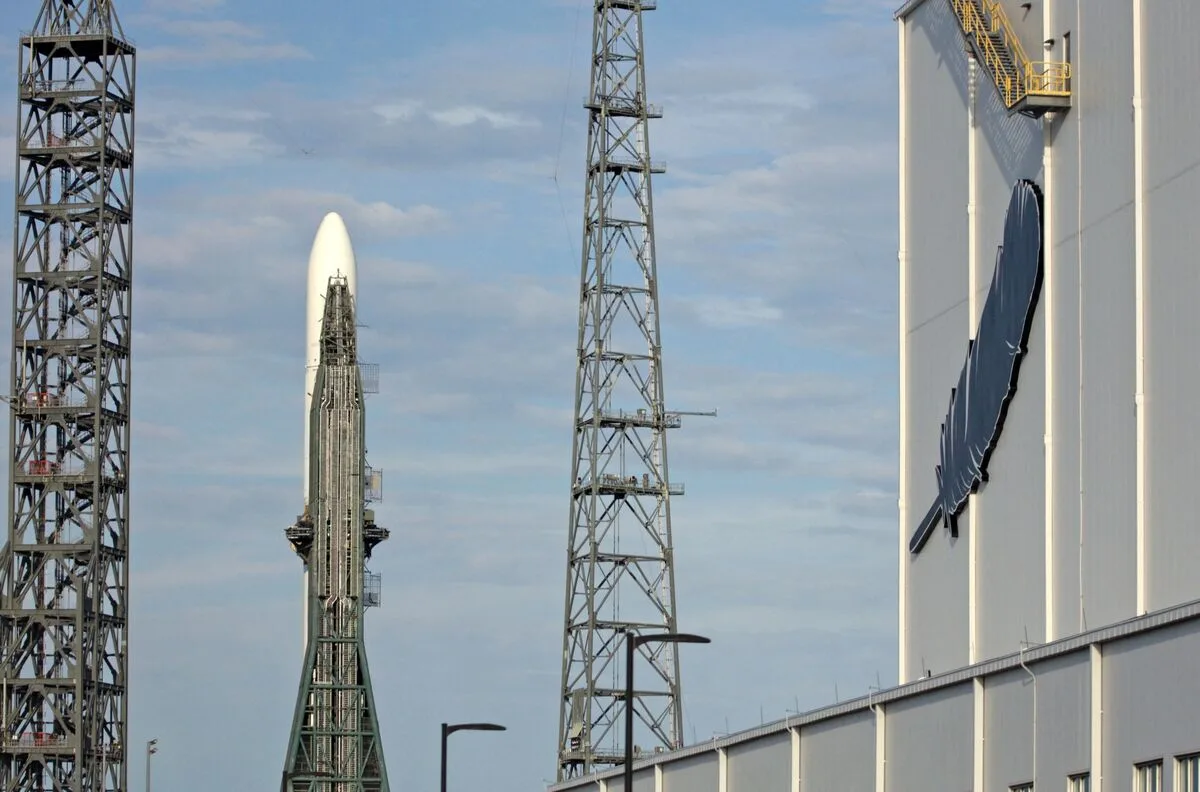
Blue Origin Is Already Rebuilding Its Florida Launch Pad After New Glenn Explosion
Less than a month after New Glenn exploded on the pad in Florida, Blue Origin says it's back to work and targeting another launch before the end of 2026.
Bildnachweis: Image via Bloomberg — Technology. Used under fair use for news commentary. · source
Blue Origin has begun rebuilding the Florida launch site where its New Glenn rocket exploded last month, with the company now targeting a second flight attempt before the end of 2026.
That's a fast turnaround, on paper at least. Whether it holds is the more interesting question.
New Glenn, Blue Origin's heavy-lift orbital rocket, exploded at its Cape Canaveral launch site in May 2026. The company hasn't released a detailed public failure analysis, which is worth noting. We don't yet know the root cause, whether it was a propulsion issue, a structural failure, or something in the ground systems. That information matters a lot for assessing how credible a late-2026 relaunch timeline actually is.
Jeff Bezos addressed the incident at VivaTech 2026, calling it "a rough moment" and saying it was "a gut punch" for the whole team involved. That's about as candid as you tend to get from a founder in a public setting, and I'll give him credit for not dressing it up. But candor about how bad something felt isn't the same as transparency about what went wrong technically.
Serious enough that it matters, not serious enough to count Blue Origin out. New Glenn is a two-stage rocket designed to carry payloads to low Earth orbit and geostationary transfer orbit, competing directly with SpaceX's Falcon 9 and ULA's Vulcan. Losing a vehicle on the pad, before it even reaches orbit, is a significant technical and reputational hit.
Verwandte Beiträge
More in Industrial
The Apple supplier priced its shares at the maximum and still had to turn away demand, which tells you something about where hardware money is flowing right now.
James Chen · 25 Jun · 5 min
Prime Day deals on Echos and Ring cameras are fine, but let's not confuse consumer gadgets with the serious robotics work happening in warehouses.
Robert "Bob" Macintosh · 25 Jun · 3 min
Amazon's CEO made his first India trip and left behind a $13 billion AI commitment and an aggressive quick-commerce expansion. The numbers are real. The execution is the hard part.
James Chen · 25 Jun · 6 min
A wave of arXiv preprints this week tackles one of manipulation's oldest problems: how do you get a robot to learn from imperfect, incomplete, or just plain missing data?
For context: SpaceX had its own high-profile failures early in Falcon 9's development. Falcon 1 failed three times before successfully reaching orbit in 2008. The difference is that SpaceX had a decade-plus head start on operational cadence. Blue Origin is still trying to establish New Glenn as a reliable commercial option, and a pad explosion mid-campaign doesn't help that pitch to potential customers.
I've seen enough spec sheets to know that a rocket that explodes on the ground tells you something different than one that fails during ascent. Ground explosions often point to propellant handling, pressurization systems, or pre-ignition sequencing. Ascent failures are more likely propulsion or structural. The specific failure mode here remains unclear, and until Blue Origin publishes something more detailed, any timeline claims deserve some skepticism.
According to Bloomberg, the company is actively rebuilding the launch site in Florida to support another attempt this year. The company didn't disclose specific figures on the cost of the rebuild or the extent of the pad damage, which is frustrating. Pad damage from an explosion can range from relatively contained, affecting primarily the flame trench and hold-down hardware, to extensive structural damage requiring months of civil construction.
From my time in hardware, the thing that often gets underestimated in these situations isn't the physical rebuild. It's the re-certification process. Before you put another vehicle on that pad, you need to verify that every system that was in proximity to the explosion hasn't been compromised in ways that aren't immediately visible. That includes propellant lines, electrical conduits, structural fasteners, and ground support equipment. That work is slow and methodical, and it probably should be.
Blue Origin says it will launch this year. That's an ambitious number given we're already in mid-June and the investigation presumably isn't closed. It's possible. It's also possible the timeline slips into early 2027, and that wouldn't be surprising.
First, the U.S. Space Force and NASA, both of which have been interested in New Glenn as a launch option to reduce dependence on a single provider (read: SpaceX). The National Security Space Launch program has been trying to build out a second certified heavy-lift option for years. New Glenn was supposed to be part of that picture.
Second, commercial satellite operators who have contracted with Blue Origin or are evaluating it. A second failure, or even a prolonged delay, will push some of those customers toward Falcon 9 or Vulcan by default.
Third, and this is the broader industry angle: the competitive pressure on SpaceX's dominance in heavy lift is real but still largely theoretical. Falcon 9 flew 96 times in 2024. New Glenn has not yet successfully completed a single orbital mission. That gap doesn't close with press releases.
Some in the industry argue that Blue Origin's deep pockets (Bezos has reportedly committed billions to the company) give it the runway to absorb setbacks that would kill a smaller launch startup. Others counter that money doesn't substitute for flight heritage, and that every month of delay is market share that SpaceX consolidates. Both arguments are probably right to some degree.
A few specific things will tell us whether the late-2026 timeline is credible or optimistic:
Failure investigation completion. Blue Origin should publish at least a summary of root cause findings before attempting another launch. If they don't, that's a flag.
Pad reconstruction milestone. When does the rebuilt launch site get certified for vehicle integration? That date will be a real indicator of whether a 2026 launch is feasible.
Vehicle readiness. Does Blue Origin have another New Glenn vehicle already in production? If they're building the next rocket in parallel with the investigation, that suggests genuine confidence. If they're waiting on investigation results before starting vehicle assembly, the timeline gets tighter.
Customer announcements. If a commercial or government customer publicly reaffirms a New Glenn launch booking, that's a signal that the market hasn't written off the vehicle.
Look, Blue Origin has been working on New Glenn for over a decade. The company has the resources, the facilities, and clearly the motivation to push through this. Bezos calling it a gut punch suggests the team is treating this with appropriate seriousness rather than brushing it off. But this is based on limited public information, and the company has a history of keeping technical details close.
The real test, as always, is whether New Glenn can reach orbit, do it reliably, and do it at a cadence that makes it a genuine alternative to Falcon 9. A successful launch before the end of 2026 would be a meaningful step toward that. An explosion on the pad followed by a second failure would be a different kind of story entirely.