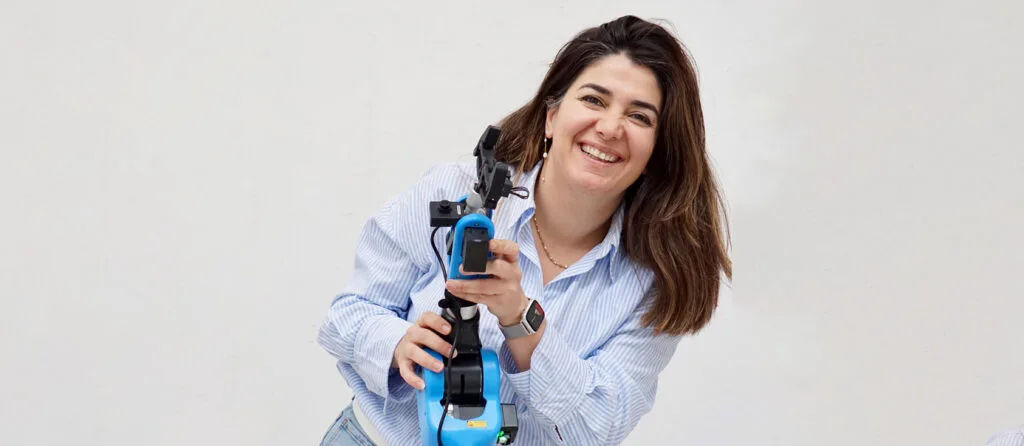
Crédito da imagem: Image via Robohub. Used under fair use for news commentary. · source
If you have ever tried to have a conversation in a noisy restaurant, you already understand one of the fundamental challenges facing social robots. Humans effortlessly filter out background chatter, locate speakers by sound, and adjust their responses based on who they are talking to. Robots, to be precise, are terrible at all of this.
Two recent research conversations highlight how far the field has come, and how much further it needs to go. Elmira Yadollahi at Lancaster University is studying how children interact with robots, while Christine Evers at the University of Southampton is working on what she calls "machine listening," the ability for robots to understand their environment through sound. Both lines of work address the same underlying question: how do we build robots that can function in messy, unpredictable social environments?
Yadollahi's research, which she discussed in a recent Robohub interview, sits at the intersection of robotics, computer science, and developmental psychology. She holds a joint PhD from EPFL and Instituto Superior Técnico, which is worth noting because the interdisciplinary training shows up in her approach. She is not just building robots for children; she is trying to understand how children build mental models of robots.
This matters more than it might seem. Children do not interact with robots the way adults do. They anthropomorphize more readily, form attachments differently, and have wildly varying expectations based on age and prior exposure to technology. A six-year-old who has grown up with voice assistants treats a robot companion very differently than one who has not. Actually, the research shows that even siblings in the same household can have dramatically different interaction patterns.
Cobertura relacionada
More in Research
TurboMPC and jaxipm tackle the same bottleneck from different angles: getting constrained optimization off the CPU and onto the GPU where the rest of modern robotics already lives.
Aisha Patel · 25 Jun · 8 min
New work on exoskeletons, hybrid supervision, humanoid data collection, and vibrotactile sensing all circle the same bottleneck: getting good demonstration data into dexterous robot hands.
Aisha Patel · 25 Jun · 10 min
A flow-matching framework for cross-embodiment manipulation and a point-cloud feasibility predictor both land this week. One is genuinely novel. The other is incremental but useful.
Aisha Patel · 25 Jun · 10 min
The explainability angle is particularly interesting. Yadollahi's work tackles how robots can explain their actions to children in ways that are developmentally appropriate. This is harder than it sounds. An explanation that satisfies a ten-year-old might confuse a five-year-old or bore a teenager. The robot needs to model not just what the child knows, but how the child thinks.
I know I'm being picky here, but this is where a lot of child-robot interaction research falls short. Many studies use convenience samples (university lab schools, children of researchers) that do not represent the broader population. The sample sizes tend to be small, often under 50 children, and replication is rare. Yadollahi's work appears to be methodologically careful, though I would want to see more details on participant demographics and recruitment before drawing strong conclusions.
Evers' research addresses a different but related challenge. Her work on machine listening, covered in another Robohub conversation, focuses on helping robots make sense of acoustic environments. As Director of the Centre for Robotics at Southampton, she is pushing on a problem that vision-focused robotics research has largely ignored.
Consider what a robot in a home environment actually hears. There is speech from multiple people, possibly overlapping. There is background noise from appliances, traffic, television. There are acoustic cues that indicate spatial relationships (is that voice coming from the kitchen or the living room?). Humans process all of this automatically. For robots, each component requires dedicated algorithms that often fail in real-world conditions.
The gap between lab performance and deployment performance is, in a way, the central challenge. A speech recognition system that works at 95% accuracy in a quiet room might drop to 60% in a living room with a running dishwasher. Sound source localization that works perfectly with a single speaker becomes unreliable with three people talking at once.
Evers' research pushes on these boundaries, though the specifics of her current methods were not detailed in the interview. What we do know is that the field is moving toward multimodal approaches, combining audio with visual and other sensory inputs. This is genuinely new territory, not in the sense that no one has tried it before, but in the sense that the integration is becoming sophisticated enough to work in uncontrolled environments.
Both research directions are responding to the same market pressure. Social robots are leaving the lab. We are seeing companion robots for elderly care, educational robots in classrooms, and assistive robots in therapeutic settings. The companies building these systems need the fundamental science to catch up with deployment timelines.
It's worth noting that the gap is substantial. Most commercial social robots still rely on cloud-based speech recognition, scripted interaction patterns, and minimal environmental awareness. They work in demos. They struggle in homes.
The research from Yadollahi and Evers represents incremental progress on hard problems rather than breakthrough solutions. This is how science actually works, though it makes for less exciting headlines. A robot that can reliably identify which child in a classroom is speaking to it, and respond in an age-appropriate way, would be genuinely useful. We are not there yet.
The timeline remains unclear. Both researchers are working on foundational capabilities that will take years to mature into deployable systems. The companies that are shipping social robots today are mostly working around these limitations rather than solving them.
Several things remain genuinely uncertain. For child-robot interaction, we do not know how long-term exposure affects children's social development. Most studies are short-term, measuring interactions over days or weeks rather than months or years. The longitudinal data simply does not exist yet.
For machine listening, the computational requirements are still prohibitive for many applications. Running sophisticated audio processing on embedded hardware, the kind that would go in an affordable home robot, is difficult. Cloud processing introduces latency and privacy concerns. There is no obvious solution.
I would want to see more cross-pollination between these research communities. A robot that can hear well but does not understand child development is going to make mistakes. A robot designed for children that cannot function in noisy environments is going to frustrate users. The integration work is where the real challenges lie.
(As an aside, both researchers came through European institutions, EPFL, IST, Southampton. This is not coincidental. European robotics funding has historically been stronger on social and assistive applications than US funding, which skews toward industrial and military uses. The research priorities follow the money.)
If I were reviewing grant proposals in this space, I would push for three things.
First, larger and more diverse participant pools for child-robot studies. The field needs to move beyond convenience samples.
Second, standardized benchmarks for machine listening in social contexts. We have benchmarks for speech recognition accuracy, but not for the kind of integrated audio understanding that social robots need.
Third, and this is the hardest one, longitudinal studies that track children's interactions with robots over extended periods. This requires sustained funding and institutional commitment that is rare in academic research.
The work being done at Lancaster and Southampton is solid. It is also, basically, early-stage science on problems that will take decades to fully solve. Anyone promising you a socially competent robot in the next five years is probably overselling. The researchers actually doing the work know how hard this is.
A cluster of new robotics research tackles cloth manipulation, VLA latency, and humanoid locomotion. The results are genuinely interesting, though production-ready is still a ways off.