Nvidia's humanoid play is the Android strategy all over again
Jensen Huang wants to be the foundation layer for every humanoid robot. I've seen this movie before.
By
·25 May 2026·5 min de leitura
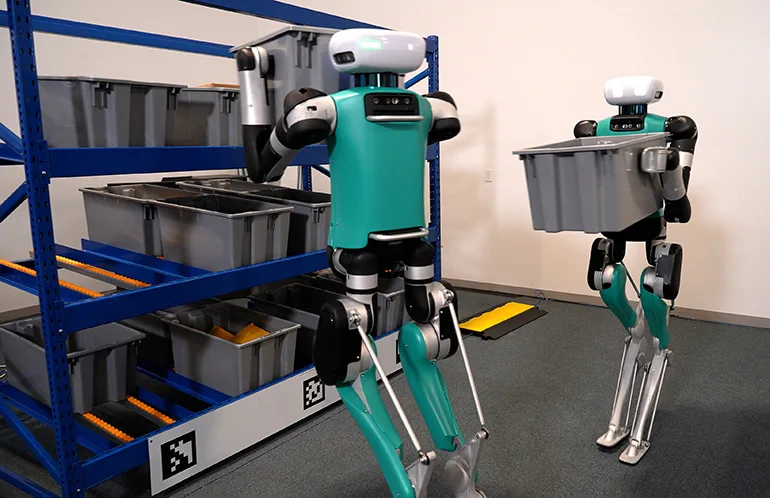
Nvidia released a developer SDK for its Isaac GR00T humanoid robotics foundation model this week, and if you've been paying attention to tech for more than a decade, the playbook should look awfully familiar.
The company is opening up its simulation stack to a half-dozen robot platforms, signing partnerships with five humanoid hardware makers according to The Information, and positioning itself as the indispensable middle layer between ambitious startups and actual deployed robots. CEO Jensen Huang called humanoids "the largest robotics opportunity in front of us" which, sure, but he also needs to sell GPUs so take that with appropriate seasoning.
A partner told The Information that "Nvidia is going to be the Android of humanoid robotics" and honestly that's exactly right. It's also exactly why I'm not sure this is unambiguously good news for the humanoid companies betting their futures on it.
The GR00T SDK gives robotics developers access to Nvidia's foundation model for humanoid control, plus integration with their simulation environment. The idea is you train your robot in simulation using Nvidia's tools, deploy using Nvidia's model, run it on Nvidia's hardware. Soup to nuts, as we used to say.
This is genuinely useful! Simulation is expensive and hard to build, foundation models require massive compute to train, and most humanoid startups are burning cash faster than they can raise it. Having Nvidia provide the base layer lets them focus on the stuff that actually differentiates their robots, the mechanical design and the specific applications and the go-to-market.
Cobertura relacionada
More in Humanoids
The headlines are celebrating a $2.5B humanoid robotics deal. I'd pump the brakes a little.
Mark Kowalski · 25 Jun · 6 min
Sometimes the sources don't pan out. Here's what happened when I tried to write a humanoids story this week and ended up with Samsung deals instead.
Sarah Williams · 25 Jun · 3 min
Diffusion models are getting good at imagining robot movements, but 'imaginable' and 'physically possible' aren't the same thing. Researchers are starting to close that gap.
Sarah Williams · 25 Jun · 6 min
A batch of fresh robotics research tackles the same underlying problem from different angles: robots that can see but don't really understand where things are.
But here's the thing, and call me old-fashioned, but when someone offers to be your platform they're also offering to own your fate. The Android comparison is instructive because Android worked out great for Google and worked out fine for Samsung and worked out terribly for basically everyone else who tried to compete on Android devices.
I've covered three major platform shifts now and the pattern is remarkably consistent. The platform provider comes in with generous terms and open APIs, everyone builds on the platform because it's the rational short-term choice, and then the platform provider gradually extracts more value as switching costs accumulate.
This isn't cynicism, it's just how platforms work! Nvidia knows this better than anyone, they've been running this play in the datacenter for years. The CUDA ecosystem is a moat that AMD has been trying to cross for a decade with limited success.
The humanoid robotics space is early enough that we don't know yet whether Nvidia's foundation model will actually be good enough to matter. GR00T is impressive in demos but demos are not deployments, and the gap between "works in simulation" and "works in a warehouse for 8 hours without breaking something expensive" is, based on limited data from the companies actually deploying robots, still pretty wide.
This is where it gets tricky. The alternative to building on Nvidia's stack is building your own stack, which requires capital that most humanoid startups don't have and expertise that's genuinely scarce. Figure and 1X and Apptronik are all well-funded but they're not Nvidia-funded, and training foundation models from scratch is not cheap.
Some of the bigger players might try to maintain independence. Tesla's obviously doing their own thing with Optimus, and the Chinese companies (Unitree, various others) seem to be building more vertically integrated stacks. But for the Western startups trying to get to market in the next two to three years, Nvidia's offer is going to be hard to refuse.
The question these founders should be asking, and I suspect some of them are, is what happens in year five. When Nvidia has the data from your deployments and the relationships with your customers and the ability to adjust pricing or API terms. The kids running these companies are smart but some of them weren't around for the mobile platform wars and it shows.
A few things I couldn't nail down from the available reporting:
First, the economics. Nvidia hasn't disclosed what the revenue share or licensing terms look like for GR00T deployments. "Partnerships" can mean a lot of things, and the difference between "we take 5% of deployment revenue" and "we take 30%" is the difference between a sustainable business and a thin-margin hardware trap.
Second, the technical depth. The SDK supports "a half-dozen robot platforms" according to Reuters, but we don't know how much work is required to actually integrate a new platform, or how much of the model's capability transfers across different mechanical configurations. Foundation models are supposed to generalize but in practice the generalization is often, let's say, optimistic.
Third, the competitive response. What are the Chinese platform players doing? What's Google doing with their robotics research? Is anyone else going to try to build an open alternative? It's too early to say but these questions will matter a lot in 18 months.
Nvidia is making a big bet on humanoids and they're doing it the smart way, by becoming infrastructure rather than building robots themselves. This is probably good for the near-term development of the industry because it lowers barriers and provides shared tooling that accelerates everyone.
But I've been around long enough to know that platform dependency is a trap that looks like an opportunity, and the humanoid companies signing up for GR00T should be thinking very carefully about their long-term positioning. The ones that survive will probably be the ones that treat Nvidia as a tool rather than a foundation, that build proprietary capability on top of the shared layer rather than just assembling commodity parts.
Then again, what do I know. Maybe this time is different and the platform provider will remain a benevolent partner forever. If you want to argue about it, my email's on the about page.