S&P 500 Keeps Its Gates Closed to Mega-IPOs, and SpaceX Will Have to Wait
The index provider rejected proposals for fast-track entry, which means even the most valuable private company on Earth plays by the same rules as everyone else.
Crédito da imagem: Image via Source article. Used under fair use for news commentary. · source
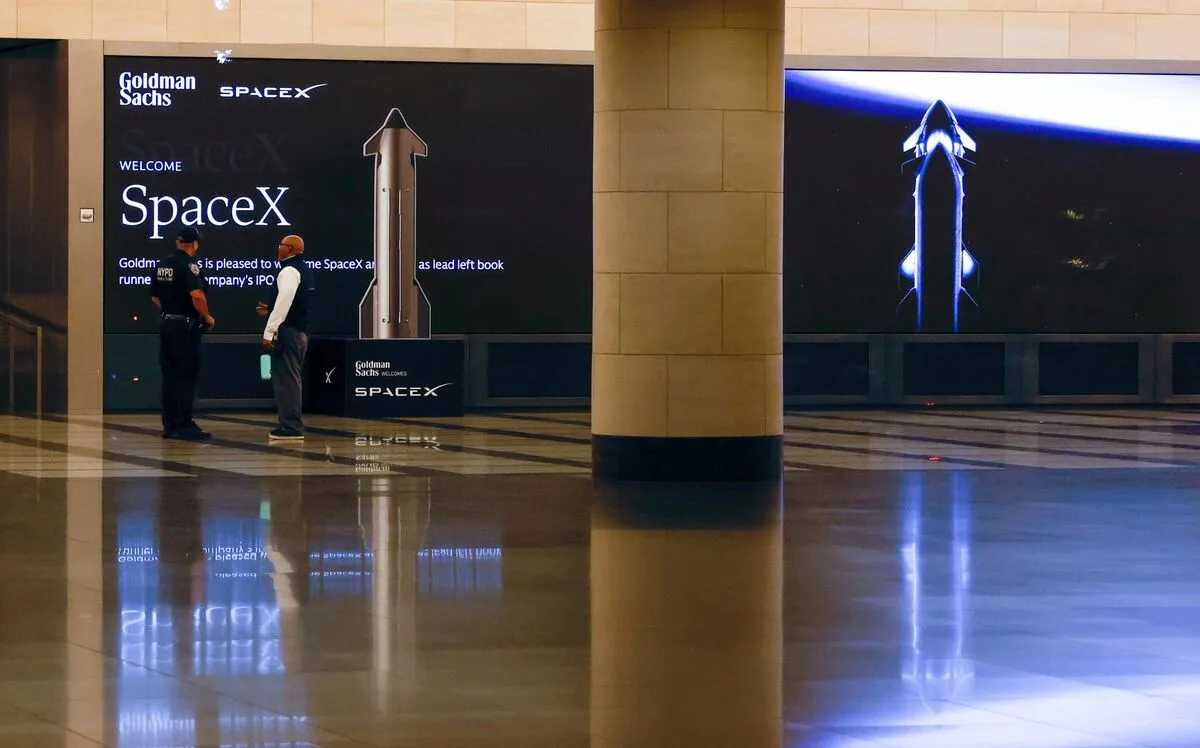
Twelve months. That's the minimum waiting period S&P Dow Jones Indices requires before any newly public company can join the S&P 500, regardless of how large it is. And after a consultation period that concluded this week, that rule isn't changing.
This matters for robotics and AI observers because SpaceX, which operates the world's largest satellite constellation and is increasingly positioning itself as an autonomy and AI company, remains the most valuable private company globally. When it eventually goes public, many assumed it would waltz straight into the benchmark that passive investors track with hundreds of billions of dollars. It won't.
To be precise, Bloomberg reported that S&P Dow Jones rejected proposals that would have created a fast-track mechanism for mega-cap IPOs. The existing rules require companies to demonstrate four consecutive quarters of positive earnings and meet liquidity thresholds before eligibility. SpaceX, whenever it lists, will need to wait just like Tesla did, just like every other company has.
I know I'm being picky here, but the framing of this as purely a financial story misses something important for anyone tracking the robotics and AI ecosystem.
SpaceX isn't just a rocket company anymore. Starlink's satellite network relies heavily on autonomous systems for orbital maneuvering and collision avoidance. The company's manufacturing facilities use significant automation. And Musk has been explicit about his vision for SpaceX's role in supporting his broader AI and robotics ambitions, including eventual Mars colonization that would require extensive autonomous systems.
Cobertura relacionada
More in Autonomy
A startup called REO says it will sell a pickup truck for $21,500. The price is striking. The evidence for it is less so.
Aisha Patel · 24 Jun · 9 min
Researchers are patching the 'trajectory scoring gap' in sidewalk robots with VLMs and human attention modeling. The ideas are clever. The caveats are real.
Mark Kowalski · 20 Jun · 6 min
Two new papers tackle one of robotics' most stubborn problems: getting a robot to figure out its location using LiDAR, without needing to have visited the place before.
Sarah Williams · 19 Jun · 5 min
The defense tech startup is moving from drones to full autonomous fighters, and it raises questions about where the line between AI autonomy and human oversight actually sits.
The S&P 500 inclusion question matters because index inclusion drives massive passive investment flows. When a company joins the benchmark, index funds must buy shares to match their tracking. For a company of SpaceX's expected valuation (estimates range from $200 billion to over $350 billion, though the company hasn't disclosed recent figures), we're talking about tens of billions in automatic buying pressure.
That capital, in turn, funds R&D. It funds acquisitions. It funds the kind of long-term research that robotics companies need but often struggle to finance.
S&P Dow Jones periodically reviews its methodology and accepts public comment. This consultation specifically examined whether mega-cap IPOs deserved expedited treatment. The argument for changing the rules was straightforward: if a company is worth $200 billion on day one of trading, does it really need to prove itself for a full year?
The argument against, which apparently prevailed, centers on stability and earnings quality. The four-quarter profitability requirement exists because index providers learned, painfully, that market capitalizations can be misleading. The dot-com era taught that lesson. More recently, companies like WeWork demonstrated that private valuations can be, well, optimistic.
It's worth noting that S&P didn't release detailed reasoning for maintaining the status quo. We don't know the vote breakdown or which arguments proved most persuasive. Bloomberg's video coverage confirms the decision but doesn't illuminate the internal deliberations.
The company hasn't announced IPO plans, so this is somewhat speculative. But the S&P decision does create a concrete constraint.
Assume SpaceX goes public in, say, 2027. It would need four quarters of reported positive earnings before becoming eligible for S&P 500 consideration. That pushes potential inclusion to 2028 at the earliest. And eligibility isn't automatic inclusion; the index committee makes discretionary decisions about which eligible companies actually join.
For comparison, Tesla went public in June 2010 but didn't join the S&P 500 until December 2020. That's a decade, though most of that delay was due to Tesla's struggle to achieve consistent profitability rather than timing rules. SpaceX, which has reportedly been profitable for several years based on Starlink revenue, might move faster once public.
But the twelve-month floor is now confirmed. No shortcuts.
This decision fits a pattern of index providers resisting pressure to accommodate the peculiarities of modern tech companies. S&P has previously declined to add companies with dual-class share structures to certain indices. The rationale is similar: protecting index integrity matters more than capturing any single company.
For robotics and AI companies specifically, this creates an interesting dynamic. Many of the most ambitious companies in the space remain private for extended periods, accumulating massive valuations before (if ever) going public. Boston Dynamics has changed hands multiple times without ever listing. Figure AI has raised billions privately. Anduril remains private despite significant scale.
When these companies eventually seek public markets, they'll face the same twelve-month waiting period. The S&P 500's rules weren't designed with robotics companies in mind, but they apply equally.
First, did any robotics or AI-focused investors submit comments during the consultation? The S&P process accepts public input, and I couldn't find evidence of participation from the autonomy sector. This seems like a missed opportunity, though it's possible submissions weren't made public.
Second, how will this affect SpaceX's IPO timing decisions? Some have speculated that Musk was waiting for more favorable index inclusion rules. If that's true, this decision might actually accelerate an IPO, since waiting no longer offers advantages. But this is speculation; the company's actual reasoning isn't public.
Third, what happens if other index providers take a different approach? The S&P 500 is the most tracked benchmark, but it's not the only one. If a competitor offered faster inclusion, would that create pressure for S&P to reconsider? It's too early to say, but the competitive dynamics among index providers deserve watching.
If I were advising robotics companies considering eventual public listings, I'd suggest several things.
Plan for the twelve-month waiting period explicitly. Don't assume rules will change to accommodate you. The S&P consultation proves that mega-cap status doesn't guarantee special treatment.
Focus on demonstrating consistent profitability before listing. The four-quarter earnings requirement means companies that go public while still unprofitable face even longer waits. For capital-intensive robotics companies, this might mean delaying IPOs until unit economics are clearly positive.
Consider the index inclusion timeline as part of capital planning. If you're counting on passive fund inflows to support post-IPO operations, build in realistic expectations. Twelve months minimum, potentially longer.
The S&P decision isn't exciting news. It's the absence of change, the maintenance of status quo. But for anyone tracking when and how major robotics and AI companies might access public market capital, it's a concrete data point in what is otherwise a fairly speculative conversation.
SpaceX will eventually go public. It will eventually join the S&P 500. But it will do so on the index's terms, not its own. That's actually how it should work.