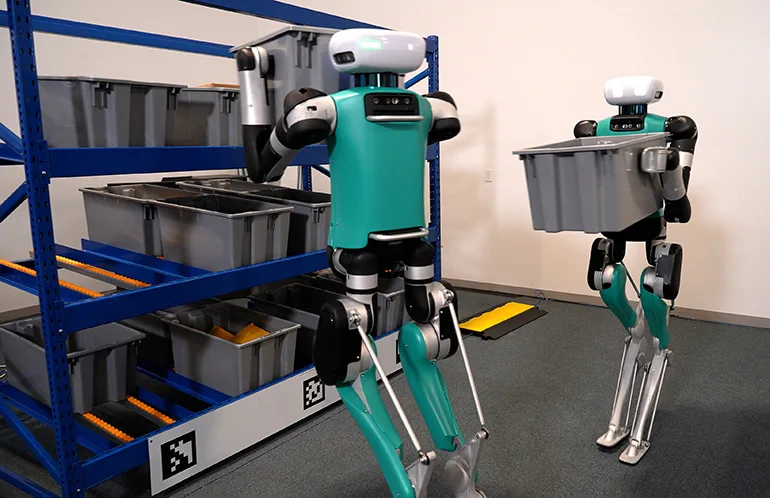
画像クレジット: Image via The Autopian — Autonomy. Used under fair use for news commentary. · source
Most coverage of humanoid robots focuses on the flashy stuff: the latest demo video, the funding round, the promise of general-purpose machines that'll fold your laundry and save manufacturing. But I've been thinking about something different lately, something I stumbled into while reading about old cars of all things.
Here's what caught my attention: The Autopian recently ran a comparison of 1987 vehicles, a Mazda 626 GT against an Alfa Romeo Milano. Japanese tech-forward engineering versus Italian design philosophy. And honestly, I couldn't stop thinking about how perfectly this maps onto what's happening in humanoid robotics right now.
The two schools of robot building are becoming increasingly clear if you pay attention. You've got companies loading their humanoids with sensors, compute, and every conceivable technical advantage (the Japanese approach, if we're extending this metaphor). Then you've got others betting on elegance, on doing more with less, on design philosophy over raw capability. Neither is obviously right. That's what makes this interesting.
I should probably admit something here: I initially thought the tech-maximalist approach was obviously correct. More sensors, more compute, more data, better robots. Simple math, right? But after reading through some recent industry discussions and, tbh, just watching how different companies are iterating, I'm less certain.
The 1987 Mazda had features that wouldn't become standard for decades. Four-wheel steering. Adjustable suspension. The kind of engineering ambition that said "we can solve problems by adding capability." Sound familiar? That's basically the pitch from half the humanoid companies I talk to. More degrees of freedom. Better actuators. Denser sensor arrays. The theory is that capability enables everything else.
関連記事
More in Humanoids
The headlines are celebrating a $2.5B humanoid robotics deal. I'd pump the brakes a little.
Mark Kowalski · 25 Jun · 6 min
Sometimes the sources don't pan out. Here's what happened when I tried to write a humanoids story this week and ended up with Samsung deals instead.
Sarah Williams · 25 Jun · 3 min
Diffusion models are getting good at imagining robot movements, but 'imaginable' and 'physically possible' aren't the same thing. Researchers are starting to close that gap.
Sarah Williams · 25 Jun · 6 min
A batch of fresh robotics research tackles the same underlying problem from different angles: robots that can see but don't really understand where things are.
But here's where it gets complicated. The Alfa Romeo from that same year took a completely different approach. Less technically ambitious, sure, but designed around a coherent philosophy. It prioritized how the whole system felt rather than checking specification boxes. And you might be wondering why this matters for robots. I think it matters a lot.
We're at a weird inflection point in humanoid development. The hardware is getting good enough that the bottleneck is shifting. It's not "can we build a robot that walks" anymore. It's "can we build a robot that does useful work in unstructured environments without requiring a team of engineers on standby." Those are very different problems.
The tech-maximalist robots look incredible in demos. I'm not going to pretend otherwise. But demos are controlled environments with favorable lighting and carefully chosen tasks. The question I keep asking (and honestly, I'm not sure I have a good answer yet) is whether all that capability translates to robustness in the real world.
The practical vehicle parallel is instructive too. The Autopian also compared a 2003 Toyota RAV4 to a 2014 Fiat 500L, both manual transmission wagons designed for actual daily use rather than showing off. The RAV4 approach: proven, reliable, maybe boring but definitely functional. The 500L: more personality, more design ambition, less certainty about long-term dependability.
I see this exact split in robotics. Some companies are building the RAV4 of humanoids. Not the most impressive specs, not the flashiest demos, but designed from the ground up for reliability and serviceability. Others are building the 500L: more interesting, more ambitious, more likely to end up with weird edge-case failures that nobody anticipated.
Neither approach is wrong, exactly. It depends what you're optimizing for. But I think the industry conversation has been too focused on the impressive demo and not focused enough on the boring questions. How easy is this thing to repair? What happens when a sensor fails? Can a factory technician troubleshoot it, or do you need a PhD?
The bubble economy comparison is almost too on the nose. Japanese automakers in 1987 were riding a wave of capital that let them experiment wildly. Sound like any industry you know? The robotics funding environment has enabled a lot of ambitious technical bets. Some of those will pay off. Some won't. We don't know yet which is which, and anyone who claims certainty is probably selling something.
What I keep coming back to is this: the cars that survived from that era weren't always the most technically impressive ones. Sometimes they were the ones that were easiest to maintain, or the ones that had the most coherent design philosophy, or just the ones that happened to hit the market at the right moment.
Humanoid robotics is going to shake out the same way. We're going to look back in ten years and some of today's darlings will have disappeared, while some company that nobody's paying attention to right now will have figured out the right combination of capability, reliability, and cost.
I don't know which companies those will be. I should know this better, probably, but prediction is hard, especially about the future (as the saying goes). What I do know is that the conversation needs to shift. Less "look at this amazing demo" and more "show me your maintenance documentation." Less "we have 47 degrees of freedom" and more "here's our mean time between failures in actual deployment."
The automotive industry learned these lessons over decades. Robotics is trying to compress that timeline, and I'm genuinely uncertain whether that's possible or whether we're going to have to learn the hard way.
One thing I've noticed talking to people actually deploying robots (not building them, deploying them) is that their concerns are almost entirely different from what gets covered in the press. They don't care about the spec sheet. They care about whether the thing works when nobody's watching, whether they can get replacement parts, whether the software updates break things that were working fine before.
This is the unsexy reality of robotics maturation. The exciting phase is building the first prototype. The hard phase is making the thousandth unit as reliable as the first one. The automotive industry figured this out. The question is whether robotics will figure it out before the current funding cycle ends.
I think about this a lot, actually. The window for proving that humanoids can do useful work in the real world isn't infinite. There's a lot of capital deployed right now based on the assumption that these machines will reach commercial viability within a certain timeframe. If that doesn't happen, we could see a significant pullback, and that would set the whole field back years.
So maybe the lesson from 1987 isn't which approach is better (Japanese or Italian, tech-maximalist or design-coherent). Maybe the lesson is that survival depends on factors that aren't obvious in the moment. The Mazda 626 GT was genuinely impressive for its time. You can probably find one for cheap now because it turned out all that complexity was expensive to maintain.
I'm not saying the complex humanoids will fail. I'm saying we should be asking harder questions about what happens after the demo ends and the real work begins. That's where the actual story is.