Steel Tariffs Are a Humanoid Robot Problem Too, and Most Coverage Is Missing It
The new Section 232 tariff rules for steel and aluminum aren't just a manufacturing story. For anyone building metal-bodied robots at scale, the supply chain math just got harder.
画像クレジット: Image via Supply Chain Dive. Used under fair use for news commentary. · source
Most of the coverage around the new Section 232 tariff rules has focused on automakers and traditional heavy industry. Fair enough. Those are the obvious victims. But I've been thinking about this from a different angle, because honestly, the robotics industry is about to feel this in ways that aren't showing up in the trade press yet.
The short version: Canada and Mexico-based steel and aluminum manufacturers who want reduced tariffs under the updated Section 232 framework now have to meet two conditions. First, they need to commit to verifiable U.S. capacity expansion, meaning they can't just promise to invest domestically, they have to prove it. Second, they need to maintain what Supply Chain Dive is calling a "records gauntlet": meticulous, traceable documentation of where their materials go and how they're used.
That second part is the one I keep coming back to.
Traceability requirements sound boring until you think about who's downstream. And increasingly, downstream includes humanoid robot manufacturers, exoskeleton companies, and the whole ecosystem of embodied AI startups that have been quietly sourcing structural steel and aluminum components from Canadian and Mexican suppliers because, well, it was cheaper and faster than domestic alternatives.
関連記事
More in Humanoids
The headlines are celebrating a $2.5B humanoid robotics deal. I'd pump the brakes a little.
Mark Kowalski · 25 Jun · 6 min
Sometimes the sources don't pan out. Here's what happened when I tried to write a humanoids story this week and ended up with Samsung deals instead.
Sarah Williams · 25 Jun · 3 min
Diffusion models are getting good at imagining robot movements, but 'imaginable' and 'physically possible' aren't the same thing. Researchers are starting to close that gap.
Sarah Williams · 25 Jun · 6 min
A batch of fresh robotics research tackles the same underlying problem from different angles: robots that can see but don't really understand where things are.
I want to be honest here: I only found two sources reporting on the specifics of these tariff rules, and neither of them is focused on robotics. So what follows is partly my own extrapolation, and you should weight it accordingly.
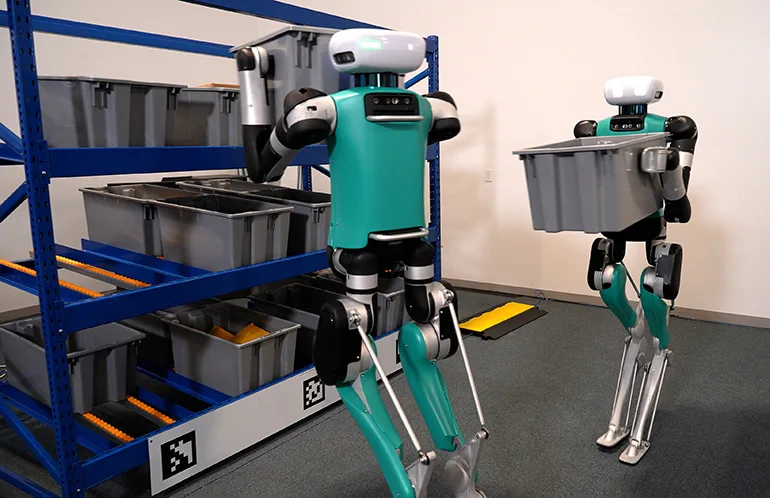
What we do know is that humanoid robot frames are metal-heavy. A lot of metal-heavy. Boston Dynamics, Agility Robotics, Figure, 1X, Apptronik, the whole field is building systems with significant structural steel and aluminum content. Exact sourcing details for most of these companies aren't public, the companies didn't disclose figures when I looked, but supply chain logic suggests that North American cross-border sourcing is common. It's been the default for manufacturers of all kinds for decades.
The tariff rate itself matters less than the compliance burden, tbh. Even if a supplier qualifies for reduced rates, the documentation requirements are substantial. Someone has to build and maintain those traceable records. That costs money and time. And for smaller robotics startups that are already running lean, adding supply chain compliance overhead is genuinely painful.
Who gets hurt most
The big players, your Boston Dynamics types, probably have procurement teams that can absorb this. They're not thrilled, but they'll manage.
The companies I'm more worried about are the ones at Series A or B, trying to get to meaningful production volumes for the first time. A company trying to manufacture, say, 500 humanoid units for a pilot deployment doesn't have a dedicated trade compliance officer. They're probably relying on their suppliers to handle this, and if those suppliers can't meet the records gauntlet, the options are: pay full tariff rates, find new suppliers, or eat the delay while everything gets sorted out.
I initially thought this was mostly a story about steel mills and auto parts. After sitting with it, I think it's something more interesting.
The tariff rules are, in a roundabout way, pressure toward domestic sourcing. That's clearly the intent. And for the robotics industry specifically, there's a version of this where that pressure accelerates something that was probably going to happen anyway: American companies building more of their supply chains inside the U.S.
You might be wondering whether that's actually bad. It's a reasonable question. There's an argument that domestically sourced materials, produced under clearer regulatory frameworks, are better for a nascent industry that's going to face enormous scrutiny as it scales. If humanoid robots are going to be operating in hospitals, warehouses, and eventually homes, knowing exactly where every structural component came from isn't the worst thing.
But the transition costs are real, and the timing is awkward. The humanoid sector is at a genuinely fragile moment. Several companies are trying to cross the valley between impressive demos and actual commercial deployment. Adding supply chain friction right now, when capital is tighter than it was two years ago and every dollar of runway matters, is a complication nobody needed.
It remains unclear how strictly the traceability requirements will be enforced in practice, or whether there will be carve-outs or phase-in periods for smaller manufacturers. That's the kind of regulatory detail that takes months to shake out, and the robotics industry probably isn't organized enough as a lobbying force to influence it much.
Honestly, I'm not sure this holds up as a clean prediction, but here's my best read.
In the short term, expect some robotics companies to quietly absorb higher materials costs without talking about it publicly. Nobody wants to signal supply chain vulnerability to investors or customers. In the medium term, I'd expect to see more announcements about domestic manufacturing partnerships, framed as strategic choices but partly driven by tariff avoidance.
The longer arc is more interesting. If the rules stick and enforcement is real, the robotics industry may end up with a more traceable, more auditable supply chain than it would have built on its own. That's not nothing. For an industry that's going to need public trust to actually deploy at scale, knowing where your robot is made, and being able to prove it, has real value.
But that's a years-long story. Right now, in the near term, there are procurement managers at humanoid companies having some very stressful conversations with their Canadian and Mexican suppliers about what these records requirements actually look like in practice. I'd love to talk to some of them. If you're one of them, you know where to find me.
The trade press will keep covering this as a steel industry story. I think that's missing at least half of it.