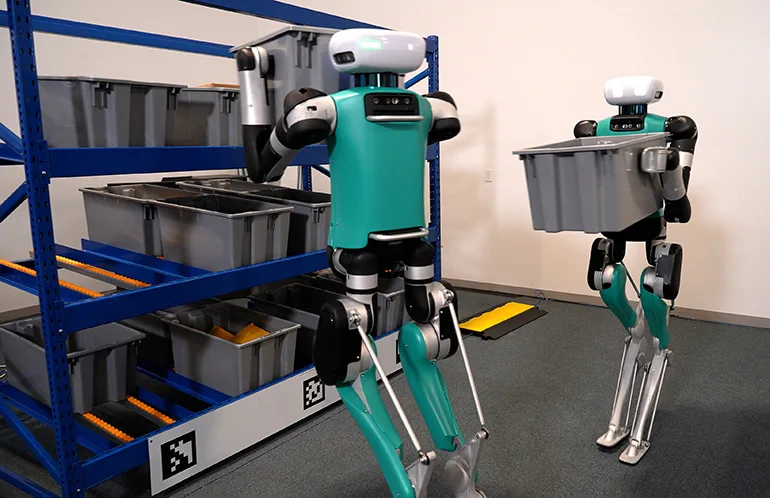
画像クレジット: Image via Robohub. Used under fair use for news commentary. · source
27 years. That's how long RoboCup has been running, and honestly, watching footage from the early tournaments versus now is a bit like comparing dial-up internet to fiber optic. The robots still fall over a lot (I find this weirdly endearing), but they're falling over while attempting things that would've seemed impossible in 1997.
Here's the thing that's been stuck in my head: RoboCup's official goal is to have a team of fully autonomous humanoid robots defeat the most recent FIFA World Cup winners by 2050. My first reaction was, that's absurd. My second reaction, after actually digging into the competition's history, was more like... okay, maybe absurd goals are the whole strategy here.
I spoke with some background material from Robohub featuring Professor Manuela Veloso, one of RoboCup's founders. What struck me wasn't the technical stuff (though that's interesting), it's that the competition was designed from the start to be a moving target. The challenges get harder as the robots get better. It's not a static benchmark.
This is different from how we usually think about robotics competitions. Most have a fixed goal: complete this task, navigate this course, whatever. RoboCup keeps shifting the goalposts (sorry, had to). The soccer leagues have progressively moved from tiny wheeled robots to full-sized humanoids, from simplified rules to something approaching actual soccer.
関連記事
More in Humanoids
The headlines are celebrating a $2.5B humanoid robotics deal. I'd pump the brakes a little.
Mark Kowalski · 25 Jun · 6 min
Sometimes the sources don't pan out. Here's what happened when I tried to write a humanoids story this week and ended up with Samsung deals instead.
Sarah Williams · 25 Jun · 3 min
Diffusion models are getting good at imagining robot movements, but 'imaginable' and 'physically possible' aren't the same thing. Researchers are starting to close that gap.
Sarah Williams · 25 Jun · 6 min
A batch of fresh robotics research tackles the same underlying problem from different angles: robots that can see but don't really understand where things are.
I initially thought this was just marketing, you know, a flashy 2050 deadline to attract funding and attention. But after reading more about the research that's come out of the competition, I'm less sure. The constraint of "make robots play soccer" has forced researchers to solve problems they might not have tackled otherwise. Real-time decision making. Multi-agent coordination. Dealing with an unpredictable opponent. These aren't soccer problems, they're embodied AI problems.
Let me be honest about the gap here, because it's significant. Current humanoid soccer robots can walk, kick, and sort of coordinate with teammates. They cannot do anything resembling what a professional human soccer player does. The speed difference alone is almost comical. Human players make split-second decisions while sprinting; robots make decisions while... carefully not falling over.
Alessandra Rossi, a RoboCup trustee, has been working on pushing the humanoid leagues forward. According to coverage from Robohub, the focus is on making the competition progressively more realistic, which means bigger robots, faster play, and eventually outdoor matches on real grass.
That last part, outdoor matches, is where I start to see the real challenge. Controlled indoor environments are one thing. Grass, wind, sun glare, uneven terrain? That's a completely different problem set. And tbh, I don't think anyone has a clear roadmap for getting from here to there.
The 26-year question
So can robots actually beat World Cup champions by 2050? I should probably know the technical details better, but here's my read: almost certainly not if we're talking about robots that look and move like current humanoids. The mechanical limitations alone seem insurmountable on that timeline.
But (and this is where I keep getting stuck) the goal might not be meant to be achievable in any literal sense. It's a north star. A direction, not a destination.
You might be wondering why that matters. Here's why I think it does: robotics research often gets trapped in narrow, immediately practical problems. Which is fine, we need practical robots. But the weird, ambitious, slightly ridiculous challenges are where unexpected breakthroughs happen. Nobody builds a soccer-playing humanoid because it's the most efficient way to play soccer. They build it because the attempt teaches you things you couldn't learn any other way.
The next few years of RoboCup will be interesting for reasons that have nothing to do with the 2050 goal. The humanoid leagues are at an inflection point. We've got better actuators, better sensors, better AI models for decision-making. The question is whether these improvements compound or plateau.
I'm also curious about the relationship between RoboCup research and commercial humanoid development. Companies like Figure and Tesla are pouring money into humanoid robots for industrial applications. Does that research flow back into academic competitions? Does competition research influence commercial development? It's unclear to me how much cross-pollination actually happens.
The other thing worth watching is how the competition handles the AI question. Current RoboCup rules require full autonomy, no remote control, no human intervention during matches. As AI models get more capable, there's going to be pressure to define what "autonomous" actually means. Is a robot running a foundation model that was trained on millions of hours of human soccer footage truly autonomous? I don't know. I don't think anyone does yet.
Look, I remain skeptical that we'll see robots beating Messi's successors in my lifetime. The gap between current capabilities and professional human athleticism is vast, and 26 years isn't that long in robotics development terms.
But I've also learned to be careful about dismissing ambitious goals in this field. The people who started RoboCup in 1997 couldn't have predicted where we'd be now. The founders set a goal they knew was probably impossible, and in doing so, they created a research community that's been productive for nearly three decades.
Maybe that's the actual point. Not the 2050 deadline itself, but the sustained, directed effort it creates. The robots don't need to beat World Cup champions for the competition to have been worthwhile. They just need to keep getting better, keep pushing researchers to solve harder problems, keep falling over in increasingly sophisticated ways.
I'll be watching. And honestly, I'm rooting for the robots. Even if they lose.