Image credit: Image via Source article. Used under fair use for news commentary. · source
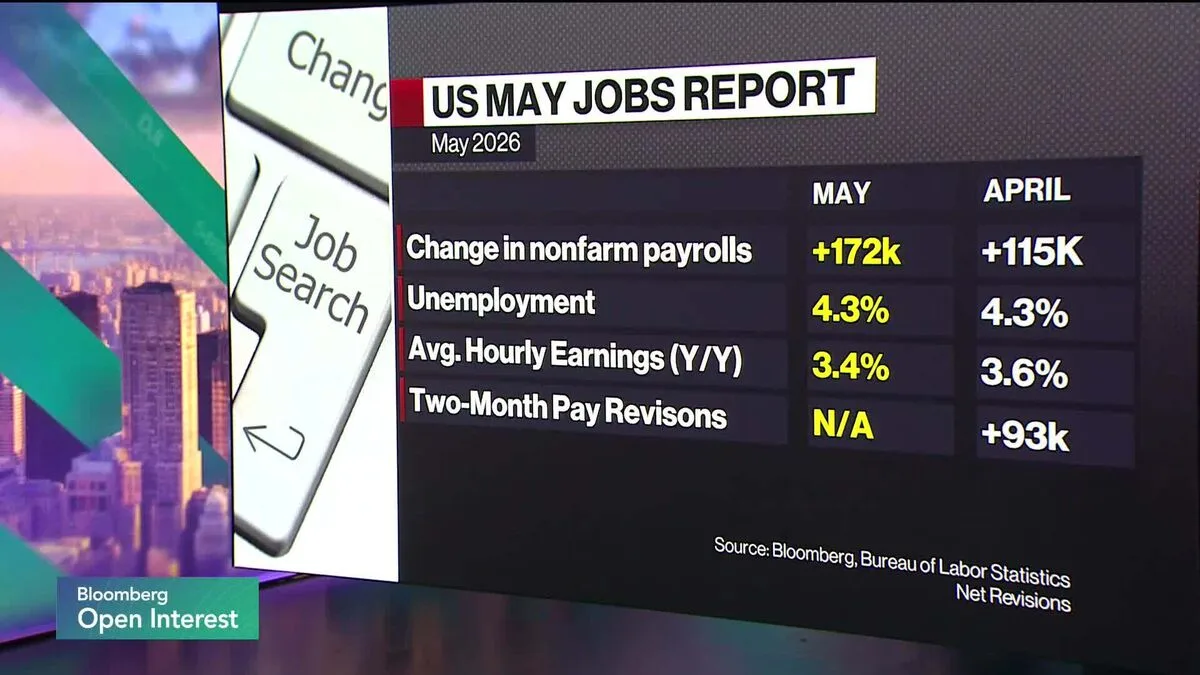
Most coverage of AI and jobs focuses on the same tired narrative: will robots take our jobs, are coders safe, what about customer service reps? Honestly, I've written versions of that story myself. But BlackRock's Global Fixed Income CIO Rick Rieder just highlighted something in the May employment data that I think deserves way more attention.
The jobs growth isn't coming from where you'd expect. It's construction.
Rieder called the report "fascinating," and I initially thought that was just finance-speak for "mildly interesting." But after digging into what he actually said on Bloomberg, I changed my mind. The construction sector showed surprising strength, and he attributed it specifically to nonresidential projects tied to AI infrastructure buildout. We're talking data centers, power facilities, the physical backbone that makes all this AI stuff actually work.
You might be wondering why this matters for a robotics publication. Here's my thinking: we spend so much time talking about AI as software, as models, as disembodied intelligence. But AI needs a body. Not a humanoid body (though I cover those too), but a physical presence in the world. Server racks. Cooling systems. Buildings to house them. And apparently, enough of those buildings that it's showing up in national employment statistics.
The scale here is what got my attention. I should know this better, but I hadn't fully processed how much physical infrastructure the AI boom requires. We're not talking about a few data centers in Oregon. This is a buildout significant enough that a BlackRock CIO is pointing to it as a driver of solid jobs numbers. That's not nothing.
Related coverage
More in Industrial
The Apple supplier priced its shares at the maximum and still had to turn away demand, which tells you something about where hardware money is flowing right now.
James Chen · 25 Jun · 5 min
Prime Day deals on Echos and Ring cameras are fine, but let's not confuse consumer gadgets with the serious robotics work happening in warehouses.
Robert "Bob" Macintosh · 25 Jun · 3 min
Amazon's CEO made his first India trip and left behind a $13 billion AI commitment and an aggressive quick-commerce expansion. The numbers are real. The execution is the hard part.
James Chen · 25 Jun · 6 min
A wave of arXiv preprints this week tackles one of manipulation's oldest problems: how do you get a robot to learn from imperfect, incomplete, or just plain missing data?
I don't have exact figures on how many construction jobs are directly attributable to AI infrastructure. Rieder didn't give specifics, and the Bureau of Labor Statistics doesn't break it down that granularly. But the fact that someone managing trillions in assets is highlighting this connection suggests the numbers are material.
Here's where I think the robotics angle gets interesting. Construction is one of the industries most actively experimenting with automation. We've got autonomous excavators, bricklaying robots, 3D-printed structures. And now we have a surge in construction demand driven by AI. There's a feedback loop forming here that I don't see many people talking about.
Think about it: AI creates demand for data centers. Data centers require construction. Construction companies are increasingly using robotics and AI to meet demand. Those robots and AI systems need more computing power. Which means more data centers. I'm not saying this is some exponential growth spiral (it's too early to say that), but the interconnections are more complex than the simple "AI takes jobs" or "AI creates jobs" framing.
What remains unclear is how sustainable this is. Construction booms driven by infrastructure buildout have a natural ceiling. You can only build so many data centers before you've met demand. Or before you run out of suitable locations. Or before the power grid can't handle any more. Rieder seemed optimistic about the current numbers, but I didn't hear him make claims about long-term trends.
There's also the question of what kind of jobs we're talking about. Construction work varies enormously, from highly skilled electricians and engineers to entry-level laborers. The AI infrastructure buildout probably requires more of the former than the latter, given the technical complexity of data center construction. But again, I'm speculating here based on limited information.
The broader context matters too. Rieder also discussed the Iran conflict's impact on markets and Federal Reserve policy in the same Bloomberg appearance. He touched on Bank of Japan monetary policy, bond yields, private credit markets. The AI jobs story is just one thread in a much larger economic tapestry. I think sometimes tech coverage (mine included, tbh) treats AI as if it exists in a vacuum, disconnected from geopolitics, interest rates, and the messy reality of global finance.
So what should we take from this? A few things, I think.
First, the physical economy still matters. All the talk about digital transformation and the metaverse and software eating the world can obscure the fact that even the most advanced AI systems need concrete, steel, copper, and people to put it all together. The embodied AI I usually cover (humanoid robots, autonomous systems) is just one manifestation of this. The data centers those robots will eventually connect to are another.
Second, the jobs impact of AI is more distributed than most coverage suggests. It's not just about whether ChatGPT will replace copywriters or whether autonomous vehicles will displace truck drivers. It's about electricians in Texas, concrete pourers in Virginia, HVAC technicians in Nevada. The people building the physical infrastructure are as much a part of the AI economy as the engineers training models.
Third, and this is where I'm genuinely uncertain, I don't know if this is good news or bad news. More construction jobs sounds positive. But if those jobs are temporary (the buildout phase) and the long-term effect is still displacement elsewhere, then we're just shifting the timeline. I initially wanted to write a more optimistic piece here, but after sitting with it, I think the honest answer is: it's complicated.
One thing I keep coming back to is how this changes the conversation about humanoid robots and automation in construction. If AI infrastructure is creating construction demand, and that demand is being partially met by increased automation in construction, we're in a weird situation where AI is simultaneously creating and automating jobs in the same sector. That's not a paradox, exactly. It's just messier than either the techno-optimist or techno-pessimist framings allow for.
Rieder's comments were brief, just part of a broader markets discussion. He didn't dive deep into the implications for robotics or automation. But I think there's a bigger story here that deserves more attention. The AI boom is a physical phenomenon, not just a digital one. And the people building that physical infrastructure are, for now at least, benefiting from it.
Whether that continues, and what it means for the construction automation companies I cover regularly, remains to be seen. But I'll be watching the jobs reports more closely now. Sometimes the most interesting AI story isn't about algorithms at all.