Meredith Whitney Says AI Is Propping Up the Economy. She's Not Wrong.
The legendary analyst is making noise about AI and inflation again, and honestly, she's seeing what we've been seeing on factory floors for years.
Image credit: Image via source article. Used under fair use for news commentary. · source
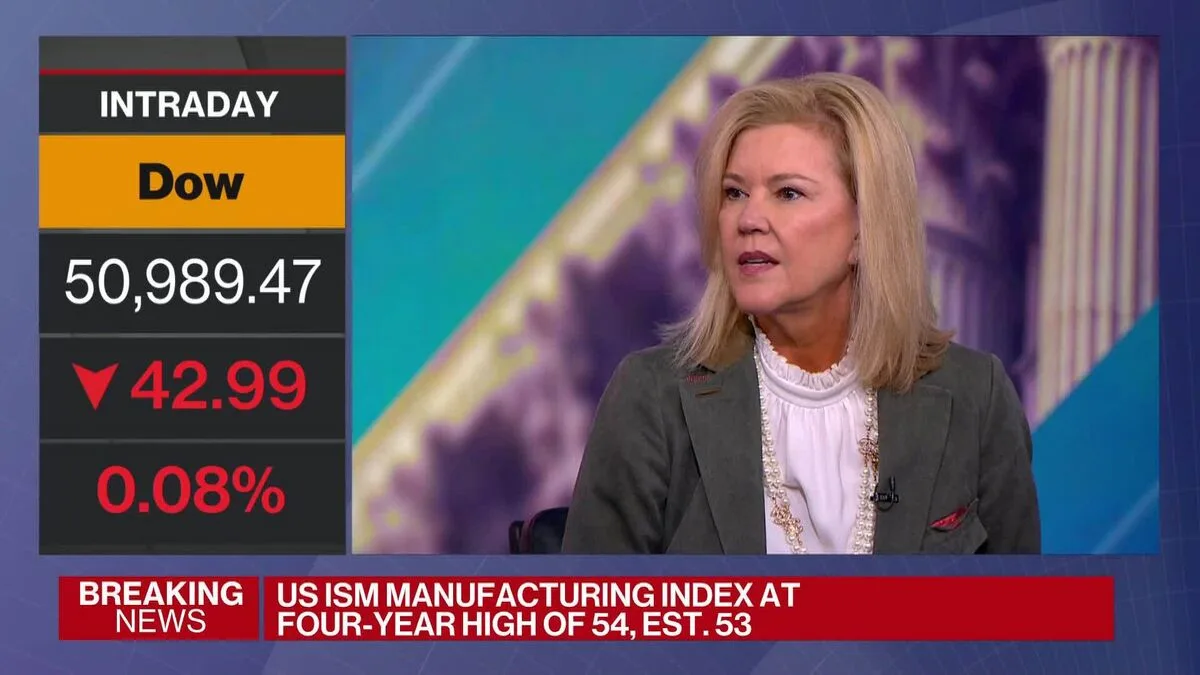
Zero. That's how many times I heard "AI" mentioned in earnings calls when I started at Kuka back in the day. Now you can't get through a quarterly report without tripping over it. Meredith Whitney, the CEO of Meredith Whitney Advisory Group, went on Bloomberg recently to talk about how the economy is doing "well" amid the expansion of AI and rising inflation. And look, here's the thing: she's basically confirming what those of us in industrial automation have been watching unfold for the past three years.
What's Whitney Actually Saying?
Whitney, if you don't remember her, called the 2008 financial crisis before most of Wall Street knew what a subprime mortgage was. So when she talks macro, people listen. In her Bloomberg appearances, she's been connecting dots between AI expansion and broader economic resilience. The argument, as I understand it, is that AI investment is acting as a kind of economic backstop even as inflation chews through other sectors.
Now, I'll be honest, I'm not an economist. I spent my career making sure robot arms didn't take someone's head off. But I've watched enough capital flow into automation over the decades to recognize a pattern. When I was at Kuka, we'd see investment spike right when labour costs started pinching. Companies would rather spend $400,000 on a welding cell than deal with turnover and wage pressure. What Whitney's describing feels like that, just at a much larger scale.
Does This Match What's Happening on Factory Floors?
Related coverage
More in Industrial
The Apple supplier priced its shares at the maximum and still had to turn away demand, which tells you something about where hardware money is flowing right now.
James Chen · 25 Jun · 5 min
Prime Day deals on Echos and Ring cameras are fine, but let's not confuse consumer gadgets with the serious robotics work happening in warehouses.
Robert "Bob" Macintosh · 25 Jun · 3 min
Amazon's CEO made his first India trip and left behind a $13 billion AI commitment and an aggressive quick-commerce expansion. The numbers are real. The execution is the hard part.
James Chen · 25 Jun · 6 min
A wave of arXiv preprints this week tackles one of manipulation's oldest problems: how do you get a robot to learn from imperfect, incomplete, or just plain missing data?