Forty-seven percent. That's the figure that keeps coming up when people talk about how fast Chinese AI investment is compounding right now. Spend enough years watching automation cycles come and go, and you get a nose for when a number is real and when it's a talking point.
I'll be honest, I'm not sure which one this is yet.
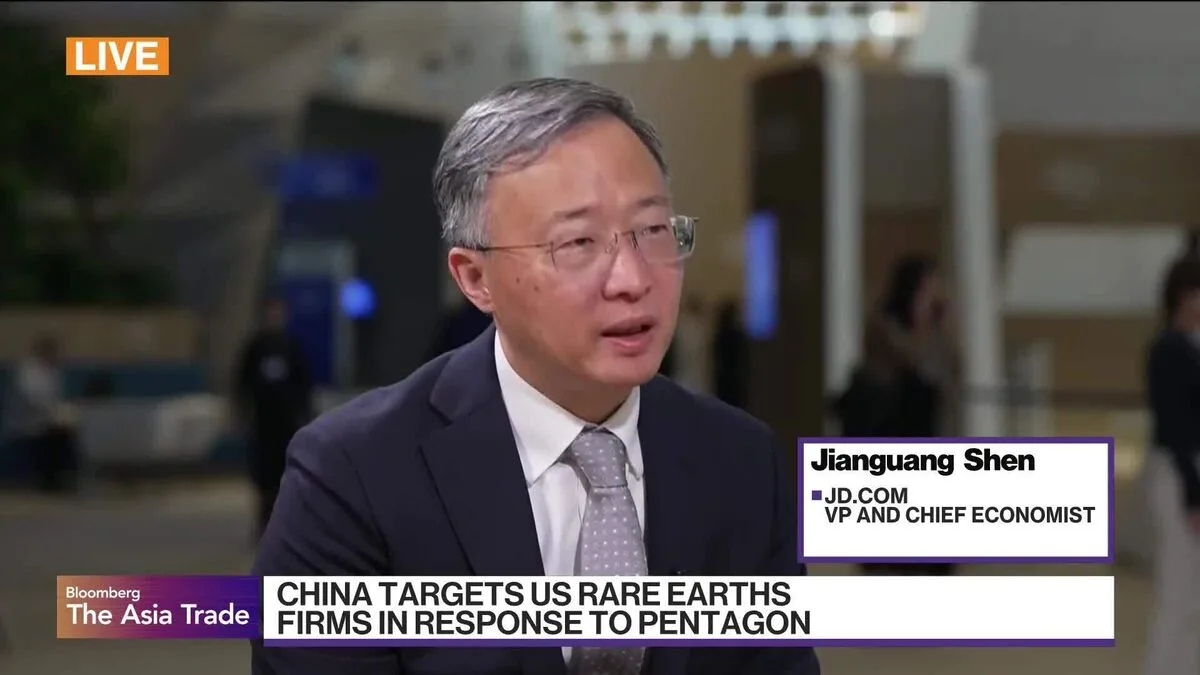
The World Economic Forum held its Summer Davos meeting in Dalian last week, and Bloomberg caught up with a few people worth listening to on the sidelines. Shen Jianguang, VP and Chief Economist at JD.com, was one of them. His read: China is accelerating hard into an AI-driven era, demand is surging, and the macro picture is better than Western headlines suggest. André Hoffmann, Co-Chair of the WEF, was cautiously optimistic about global growth while flagging the usual headwinds, Middle East instability, market jitters, the general background noise of 2026. And Jonathan Zhu from Bain Capital's Greater China operation talked through where he's actually putting money in the Chinese market right now.
None of this is robotics news, strictly speaking. But it's the water that industrial automation swims in, so I pay attention.
When I was at Kuka, we used to watch Chinese GDP forecasts the way farmers watch weather reports. Not because the number itself told you much, but because of what it implied about capex cycles. When Chinese manufacturers felt confident about the next three years, they bought equipment. Big equipment. The kind with our name on it.
What Shen is describing, an economy leaning into AI investment rather than retreating from trade headwinds, suggests that capex appetite could stay strong. JD.com alone operates something like 25 automated fulfillment centers across China. Their logistics automation buildout has been one of the more serious in the world, not just in scale but in engineering ambition. So when their chief economist says demand is surging, he's not talking abstractly.
Zhu's comments from Bain are worth noting too, though the details of his investment thesis weren't fully disclosed in what Bloomberg aired. The framing was broadly positive on China exposure, which at least tells you that institutional money isn't running for the exits. That matters for anyone trying to read where the next wave of automation procurement is headed.
Here's the thing, though. Economic optimism at a forum in Dalian and actual purchase orders hitting the floor of a systems integrator are two very different things. I've sat through enough industry conferences to know that the gap between "surging demand" and a signed contract can be enormous, and it's usually filled with procurement delays, spec changes, and someone's cousin who wants to do the installation himself.
It's also too early to say how much of China's AI investment surge is filtering into physical automation versus pure software and data infrastructure. Those are very different stories for the industrial robotics market. A billion dollars going into LLM training clusters doesn't move a single KUKA KR QUANTEC off the shelf. A billion going into smart manufacturing and warehouse robotics does.
This raises questions about... well, multiple things. How much of the "AI-driven era" Shen describes is actually embodied AI, robots, cobots, autonomous mobile robots in logistics, versus the kind that lives in a server farm? We don't have a clean answer to that yet, at least not from what came out of Dalian.
I'm not pessimistic about China's automation trajectory. I haven't been for years. The demographic pressures alone, an aging workforce, rising labor costs in coastal manufacturing hubs, make sustained investment in factory and warehouse robotics almost structurally inevitable. That's not a hot take, it's arithmetic.
But I've learned to be skeptical of the summit-circuit version of any story. The people talking to Bloomberg on the sidelines of the WEF are, almost by definition, the optimists. That's not a criticism, it's just selection bias. The factory manager in Wuhan who's waiting six months for a spare servo drive doesn't get a seat at that table.
So: real trend, real momentum, real money moving. How much of it lands in industrial automation specifically? That remains unclear. I'll be watching the order books, not the panel discussions.