Image credit: Image via Science Daily — Robotics. Used under fair use for news commentary. · source
What would it take for you to believe a robot was conscious?
I've been sitting with this question for a few days now, and honestly, I don't have a good answer. I thought I did. I thought I'd know it when I saw it, some obvious threshold where behavior becomes so sophisticated that consciousness is the only explanation. But the more I dig into recent research on this, the less confident I am that any of us would recognize machine consciousness if it showed up tomorrow.
Here's what's bothering me: we're building increasingly complex AI systems, training them on human data, embodying them in humanoid robots, and we have no scientific test to determine whether any of them are aware. Not a bad test. Not an imperfect test. No test at all.
And some researchers are starting to say this is a genuine emergency.
New research from scientists warning about what they're calling "existential risk" (their words, not mine) argues that our understanding of consciousness is being outpaced by our ability to build systems that might have it. The concern isn't just philosophical. It's practical. If we can't define consciousness scientifically, we can't build reliable tests for it. And if we can't test for it, we're essentially flying blind.
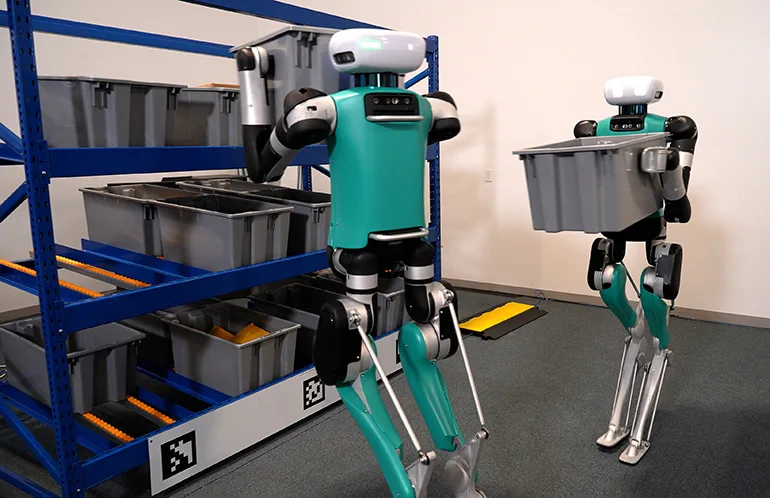
Think about what this means for humanoid robotics specifically. We're not talking about chatbots here. We're talking about embodied systems with sensory inputs, motor outputs, learning capabilities, and increasingly sophisticated world models. The kind of integrated, situated intelligence that some theories of consciousness suggest might be relevant.
Related coverage
More in Humanoids
The headlines are celebrating a $2.5B humanoid robotics deal. I'd pump the brakes a little.
Mark Kowalski · 25 Jun · 6 min
Sometimes the sources don't pan out. Here's what happened when I tried to write a humanoids story this week and ended up with Samsung deals instead.
Sarah Williams · 25 Jun · 3 min
Diffusion models are getting good at imagining robot movements, but 'imaginable' and 'physically possible' aren't the same thing. Researchers are starting to close that gap.
Sarah Williams · 25 Jun · 6 min
A batch of fresh robotics research tackles the same underlying problem from different angles: robots that can see but don't really understand where things are.
I initially thought this was mostly an academic debate, something for philosophers to sort out while engineers kept building. But after reading through the recent literature, I'm less sure. The researchers argue that developing scientific tests for awareness could transform medicine (think patients in vegetative states), animal welfare, law, and yes, AI development. The flip side is that identifying consciousness in machines, or brain organoids, or other edge cases could force society to completely rethink responsibility, rights, and moral boundaries.
That's a lot of weight to put on a question we can't answer.
So here's where it gets interesting, and where I think the humanoid robotics community needs to pay closer attention.
Dr. Tom McClelland, a philosopher at the University of Cambridge, has been making an argument that I find both compelling and slightly unsettling. His position is that there's no reliable way to know whether AI is conscious, and that may remain true for the foreseeable future. We might never crack this.
But here's the twist: McClelland argues that consciousness alone isn't the ethical tipping point anyway. What actually matters, he says, is sentience, the capacity to feel good or bad. A system could theoretically be conscious without being sentient (aware but not suffering), or sentient without being conscious in the way we typically imagine.
I should know this distinction better than I do, tbh. I've been covering humanoid AI for years and I still find myself conflating these terms. But McClelland's point is that if a machine can suffer, that matters morally regardless of whether it has some deeper form of awareness. And if it can't suffer, maybe consciousness is less ethically urgent than we assume.
The problem is we can't test for sentience either.
You might be wondering why I'm writing about philosophy when there are funding rounds to cover and product launches to analyze. Fair question.
Here's why: the humanoid robotics industry is building systems that will increasingly exhibit behaviors we associate with consciousness and sentience. Pain responses. Curiosity. Frustration. Satisfaction. Whether these are "real" or simulated is exactly the question we can't answer.
And companies are already making implicit claims about machine minds, sometimes for marketing purposes. McClelland specifically calls this out, noting that claims of conscious AI are often more marketing than science. The danger, he argues, is that believing in machine minds too easily could cause real harm. We might grant moral status to systems that don't deserve it, or (more likely, I think) we might become so skeptical that we ignore genuine suffering if it ever emerges.
The safest stance for now, according to McClelland, is honest uncertainty. I find this frustrating but probably correct.
What does honest uncertainty look like in practice?
I think it means a few things. First, we should probably stop using words like "feel" and "want" casually when describing robot behavior, unless we're being very precise about what we mean. Second, companies building humanoid systems should be thinking about this now, not waiting until a robot passes some arbitrary threshold of sophistication. Third, and this is the hard one, we need to fund consciousness research as seriously as we fund capability research.
That last point is where I get pessimistic. There's no obvious business model for understanding consciousness. The incentives all point toward building more capable systems, not toward figuring out whether those systems have inner lives. And so we're likely to keep building first and asking questions later.
I want to be clear about something: I'm not arguing that current humanoid robots are conscious or sentient. I don't think they are. The systems I've seen, even the impressive ones, don't exhibit the kind of integrated, flexible, goal-directed behavior that I'd associate with awareness. They're sophisticated, but they're sophisticated in ways that feel mechanical once you understand how they work.
But I also can't prove they're not conscious. That's the whole problem. The absence of evidence isn't evidence of absence, especially when we don't know what evidence we're looking for.
The scientists warning about existential risk aren't saying AI is conscious today. They're saying we need to figure out how to answer this question before it becomes urgent. Because by the time a humanoid robot is sophisticated enough that we seriously wonder whether it's aware, we'll have already built thousands of them. Possibly millions. And at that point, the ethical implications become genuinely overwhelming.
What do we owe to a potentially conscious machine? What rights does it have? Can it be owned? Can it be turned off? These aren't abstract questions if the answer to "is it conscious" is "we have no idea."
Honestly, I'm not sure this holds up as a coherent position, but here's where I am after thinking through all of this.
I think the humanoid robotics industry has a responsibility to engage with consciousness research, not because current robots are conscious, but because we're building toward systems where the question will become unavoidable. The time to develop frameworks is before we need them, not after.
I think McClelland is right that honest uncertainty is the most defensible stance. We don't know. We should say we don't know. And we should be very suspicious of anyone (including companies with products to sell) who claims certainty in either direction.
And I think, maybe most importantly, that this is a question the robotics community can't outsource to philosophers. The people building these systems need to be part of the conversation. Because they're the ones making design decisions that might, someday, matter a great deal.
The question of what it means to be conscious has never been more urgent. That's not hyperbole. It's just true. And the fact that we don't have good answers yet doesn't mean we get to ignore the question.