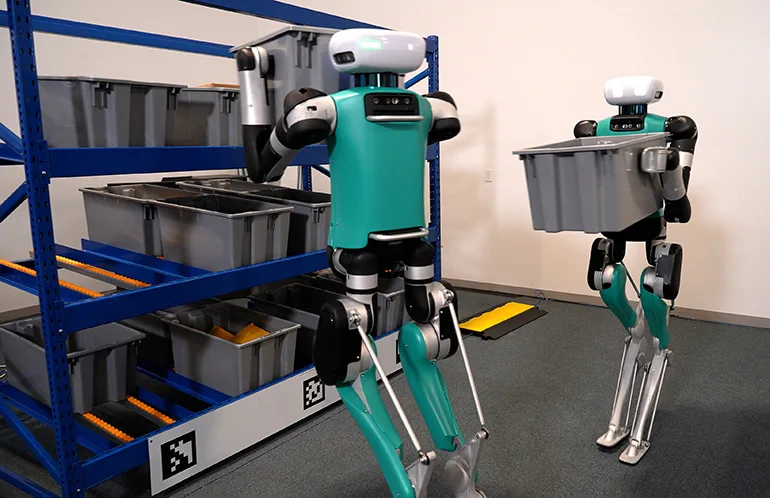
Humanoid robots are learning to walk like humans, and I've seen this movie before
Three new papers show robots mastering terrain that would've been science fiction five years ago. But the gap between lab demos and real deployment? That's the part nobody wants to talk about.
By
·5 June 2026·6 min read
1.2 meters. That's the gap a humanoid robot can now jump across, according to researchers behind a new system called TAGA. For context, that's about the width of a standard doorway, cleared by a bipedal machine using nothing but onboard sensors and learned behavior. No remote control, no pre-programmed path, just a robot that figured out where to look and where to step.
I've been covering tech long enough to know that impressive demos don't always translate to impressive products (remember when Segway was going to replace walking?), but something's shifted in humanoid locomotion research over the past year. Three papers dropped this month that, taken together, suggest we're past the "can robots walk" phase and into the "can robots walk anywhere" phase. Whether that matters for anyone outside a research lab is a different question.
Let's start with the basics. The three systems, CoRe-MoE, TAGA, and LadderMan, all tackle the same fundamental problem: humanoid robots are great at walking on flat floors and terrible at everything else. Stairs, slopes, gaps, obstacles, the kind of terrain humans navigate without thinking, these have historically been where bipedal robots embarrass themselves.
arXiv published the CoRe-MoE paper, which focuses on something deceptively simple: getting a robot to switch between walking and running smoothly while handling different terrain types. The researchers used a Unitree G1 humanoid and achieved what they call "zero-shot deployment," meaning the robot could handle stairs, slopes, steps, obstacles, and unstructured outdoor terrain without any additional training after leaving simulation. Call me old-fashioned, but "unstructured outdoor terrain" is doing a lot of work in that sentence, and I'd love to see exactly what that means in practice.
Related coverage
More in Humanoids
The headlines are celebrating a $2.5B humanoid robotics deal. I'd pump the brakes a little.
Mark Kowalski · 25 Jun · 6 min
Sometimes the sources don't pan out. Here's what happened when I tried to write a humanoids story this week and ended up with Samsung deals instead.
Sarah Williams · 25 Jun · 3 min
Diffusion models are getting good at imagining robot movements, but 'imaginable' and 'physically possible' aren't the same thing. Researchers are starting to close that gap.
Sarah Williams · 25 Jun · 6 min
A batch of fresh robotics research tackles the same underlying problem from different angles: robots that can see but don't really understand where things are.
The TAGA system, detailed in a separate arXiv paper, takes a different approach. Instead of trying to process everything the robot sees, it teaches the robot to look at what matters. The researchers call this "active gaze learning," and it's basically teaching robots to do what humans do naturally: when you're walking across a rocky path, you don't stare at the sky, you look at where you're about to step. The 1.2 meter gap traversal I mentioned? That's apparently the largest reported real-world gap crossing for any perceptive humanoid locomotion system. Though I should note, "largest reported" leaves a lot of room for unreported attempts that went poorly.
Then there's LadderMan, which is exactly what it sounds like: a humanoid robot that climbs ladders. This one's wild because ladders are basically worst-case scenarios for robots. Sparse footholds, handholds that require whole-body coordination, zero margin for error. The system can handle "a wide range of geometries" and even do manipulation tasks while clinging to a ladder, like grabbing tools or opening hatches.
Here's where I get skeptical, and if you want to argue with me, my email's on the about page.
The technical achievements are real. Five years ago, humanoid robots falling over was a reliable source of viral videos. Now we've got robots that can run across uneven ground, jump gaps, and climb ladders. The progression from Boston Dynamics' early stumbling Atlas to these new systems is genuinely remarkable.
But, and this is a big but, there's a pattern in robotics I've watched play out multiple times. Researchers demonstrate impressive capabilities in controlled conditions. Companies announce ambitious deployment timelines. The gap between demo and product turns out to be wider than anyone admitted. Timelines slip. Funding gets tight. The cycle repeats.
I'm not saying that's what's happening here! These papers show real technical progress on problems that have blocked humanoid deployment for years. The terrain adaptation stuff in particular seems like it could matter for applications like warehouse work, construction, or disaster response.
What remains unclear is how these systems handle the long tail of weird situations that happen in real environments. A robot that can traverse stairs 95% of the time is impressive in a lab and dangerous in a building. The papers mention "robustness" and "stability under disturbances" but we don't know yet how that translates to months of continuous operation.
All three systems use reinforcement learning, which is the approach that's dominated robotics research since around 2020. The basic idea: instead of programming specific movements, you let the robot figure out what works through trial and error in simulation, then transfer that learned behavior to real hardware.
CoRe-MoE uses something called Mixture of Experts, which is a neural network architecture that's been getting a lot of attention in AI generally. The clever bit is how they train it: first they teach the robot stable walking and running, then they add terrain awareness as a separate module. This "two-stage" approach apparently prevents the kind of training interference that makes robots forget how to walk while learning how to handle slopes.
TAGA's innovation is the attention mechanism for gaze. The robot learns to predict which parts of its visual field contain useful information for the next few steps, basically filtering out noise before it becomes a problem. The researchers claim this "naturally emerges" through reinforcement learning without explicit supervision, which is either fascinating or concerning depending on how much you trust emergent behavior in safety-critical systems.
LadderMan combines motion tracking (learning from reference motions) with a dual-agent setup where one policy handles climbing and another handles manipulation. They also use vision foundation models to bridge the "sim-to-real gap," which is the perennial problem of robots that work perfectly in simulation and fail immediately on real hardware.
This is the self-driving car hype cycle all over again, in a way. The technical capabilities are advancing faster than anyone expected. The deployment challenges are more stubborn than anyone wants to admit. And the timeline from "impressive demo" to "thing you can actually buy" is probably longer than the press releases suggest.
What's different with humanoid locomotion, maybe, is that the applications are clearer. Self-driving cars had to solve a problem (driving) that humans are already pretty good at, in an environment (public roads) with massive liability concerns. Humanoid robots could target environments where humans don't want to go: disaster sites, hazardous industrial settings, space exploration.
The Unitree G1 that CoRe-MoE used costs somewhere in the mid five figures, which isn't cheap but isn't the millions that previous humanoids cost. If these locomotion systems can be made reliable enough for real deployment, the economics might actually work for some applications.
But what do I know. I've been wrong about technology timelines before (I thought tablets were a fad in 2010), and I'll be wrong again. What I can say is that the gap between "robot walks across a lab" and "robot walks across your job site" is measured in years, not months, and probably in billions of dollars of additional R&D.
The kids building these systems are doing genuinely impressive work. Whether that work becomes a product or another chapter in the long history of robotics demos that didn't quite pan out, well, check back in five years. I'll still be here, probably still preferring email to whatever communication platform has replaced Slack by then.