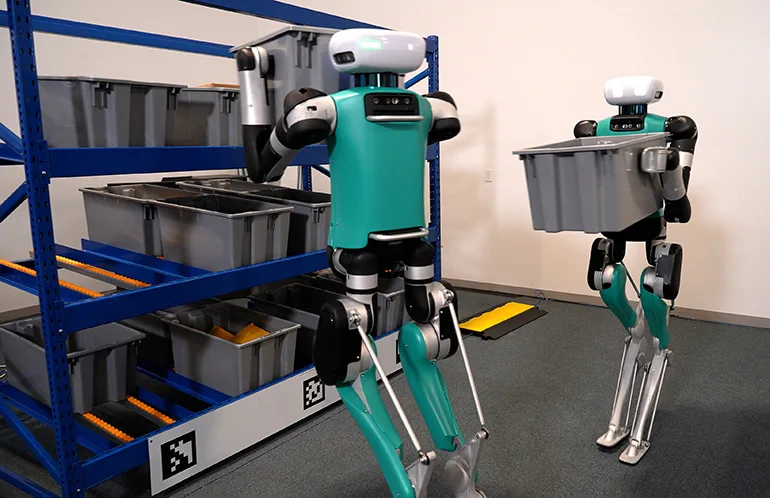
Humanoid robots are finally learning to watch where they step
Two new papers tackle the same problem: teaching robots to look at terrain before they plant their feet. It's harder than it sounds.
By
·1 June 2026·6 min read
Why do humanoid robots still trip over curbs?
I've been asking this question for years, and I'm not being rhetorical. We've got machines that can do backflips, run faster than most humans, and hold conversations about philosophy. But put a standard humanoid on a gravel path with a few unexpected steps, and suddenly it's a toddler at a playground. The answer, it turns out, has less to do with motors or balance and more to do with something deceptively simple: robots don't really look at the ground the way we do.
Two papers dropped on arXiv this month that attack this problem from slightly different angles, and together they paint a picture of where legged robotics is actually headed. Not the flashy demos, not the choreographed warehouse tours, but the genuinely hard engineering of making a machine walk through the real world without face-planting.
Let's start with SSR from a team working on humanoid traversal. The paper's full title is a mouthful, "Scaling Surefooted and Symmetric Humanoid Traversal to the Open World," but the core idea is elegant. When you walk down a flight of stairs, you don't consciously think about where each foot will land, but your visual system is doing an enormous amount of preprocessing. You're identifying edges, estimating surface stability, predicting where your weight will shift. SSR tries to replicate this with what they call "imagined foothold guidance."
Here's how it works, roughly. The system learns to model where the swing foot is going to contact the ground before it actually touches down. Then it evaluates whether that spot is actually stable (is it an edge? a gap? loose gravel?) and adjusts the trajectory mid-swing if needed. The researchers report significant reductions in edge slips, which is exactly the kind of failure mode that makes humanoids look drunk on uneven terrain.
Related coverage
More in Humanoids
The headlines are celebrating a $2.5B humanoid robotics deal. I'd pump the brakes a little.
Mark Kowalski · 25 Jun · 6 min
Sometimes the sources don't pan out. Here's what happened when I tried to write a humanoids story this week and ended up with Samsung deals instead.
Sarah Williams · 25 Jun · 3 min
Diffusion models are getting good at imagining robot movements, but 'imaginable' and 'physically possible' aren't the same thing. Researchers are starting to close that gap.
Sarah Williams · 25 Jun · 6 min
A batch of fresh robotics research tackles the same underlying problem from different angles: robots that can see but don't really understand where things are.
The other clever bit is something called equivariant latent-space symmetry augmentation. I know, I know, the jargon is thick. But basically it's a way to teach bilateral coordination, making sure the left and right legs learn from each other's experiences, without drowning in the computational cost of processing high-dimensional visual data twice. Call me old-fashioned, but I appreciate when researchers find ways to make things more efficient rather than just throwing more GPUs at the problem.
The second paper, TA-WBC from a different team, tackles a related but arguably messier challenge: legged manipulators. These are robots with legs for locomotion and arms for, well, manipulating things. Think of a quadruped with a robotic arm mounted on top, trying to walk across rough terrain while also reaching for objects.
The problem here is that most whole-body controllers (the systems that coordinate legs and arms together) rely primarily on proprioception, which is the robot's internal sense of where its limbs are. They don't really use exteroception, the perception of the external environment. It's like trying to walk through a cluttered room with your eyes closed, relying only on the feeling of your feet hitting the floor.
TA-WBC introduces a terrain-aware framework that actually looks at the ground and adjusts accordingly. They use a hybrid exteroception encoder to extract terrain features, which then inform both posture adjustments and foothold selection. The robot can proactively adapt rather than just reacting after it's already stumbling.
One detail I found particularly interesting: they propose sampling manipulation targets based on the foot contact plane rather than the robot's base. This decouples the arm movements from the natural wobble and fluctuation of the body during locomotion. It's a small thing, but it means the robot can actually reach for something while walking without the arm trajectory going haywire every time the body shifts.
If you've been following robotics for a while, and I have been, too long probably, this all feels familiar. We went through a similar phase with self-driving cars about a decade ago. The early systems were reactive: see obstacle, brake. The breakthrough came when perception and planning got tightly integrated, when the car started anticipating what would happen three seconds from now rather than just responding to what was happening right now.
Legged robots are going through that same transition. The reactive approach, feel the ground, adjust, works fine in controlled environments. But the open world is full of surprises, and you can't react your way through a staircase with missing steps or a rocky hillside with loose stones. You have to look ahead. You have to predict.
Both of these papers are essentially about giving robots the ability to plan their footsteps visually, in real time, while moving. That's harder than it sounds! The visual processing has to be fast enough to inform decisions mid-stride. The predictions have to be accurate enough to actually improve stability rather than introducing new failure modes. And the whole system has to generalize across terrains the robot has never seen before.
I should be clear about the limitations here. Both papers show impressive results in simulation and some real-world testing, but it's too early to say how well these approaches will transfer to truly novel environments. The SSR paper mentions "extreme challenges such as wide gaps and high platforms," but the specific dimensions and success rates aren't fully detailed. The TA-WBC paper validates on "complex terrains," but what counts as complex is somewhat in the eye of the beholder.
There's also the question of computational cost. These systems use neural networks for perception and control, and running inference fast enough for real-time locomotion isn't trivial. The papers don't give detailed benchmarks on what hardware they require, which makes it hard to assess how deployable these approaches actually are on current humanoid platforms.
And then there's the generalization problem. Both papers use simulation-to-real transfer, training primarily in simulation and then deploying on physical robots. This works better than it used to, but sim-to-real gaps remain a persistent headache in robotics. A terrain that looks one way in simulation might behave differently in the real world due to material properties, lighting conditions, or sensor noise.
Why does any of this matter? Because the entire premise of humanoid robots, the reason companies are pouring billions into them, is that they can operate in human environments. Our world is built for bipeds. Stairs, doorways, furniture, all of it assumes a roughly human form factor. If humanoids can't reliably navigate the terrain that humans navigate every day, they're just expensive lab curiosities.
The kids building these systems, and yes, a lot of them are young, sometimes forget that the hard part isn't the flashy demo. It's the boring reliability. It's walking through a parking lot with cracks and curbs and random debris without tripping. It's climbing stairs that aren't perfectly uniform because real-world construction isn't perfect. It's operating in rain and snow and mud.
These papers represent genuine progress on that front. Not breakthroughs, exactly, but solid incremental advances in making robots actually look where they're going. The SSR approach of imagining footholds before contact and the TA-WBC approach of terrain-aware whole-body control are complementary ideas that could eventually be combined.
I remain cautiously optimistic, which for me is practically giddy enthusiasm. We're still years away from humanoids that can walk as reliably as a human through arbitrary environments. But the research is moving in the right direction. The questions being asked are the right questions. And the solutions are getting more sophisticated without getting more brittle.
If you want to argue about any of this, my email's on the about page. I actually read it, unlike some people's Slack channels.