London Tech Week 2026 Kicks Off With AI Policy Talk But Few Hardware Specifics
The UK's AI Minister made the media rounds, but if you were hoping for concrete robotics investment numbers or deployment targets, you'll have to keep waiting.
Crédit photo: Image via Source article. Used under fair use for news commentary. · source
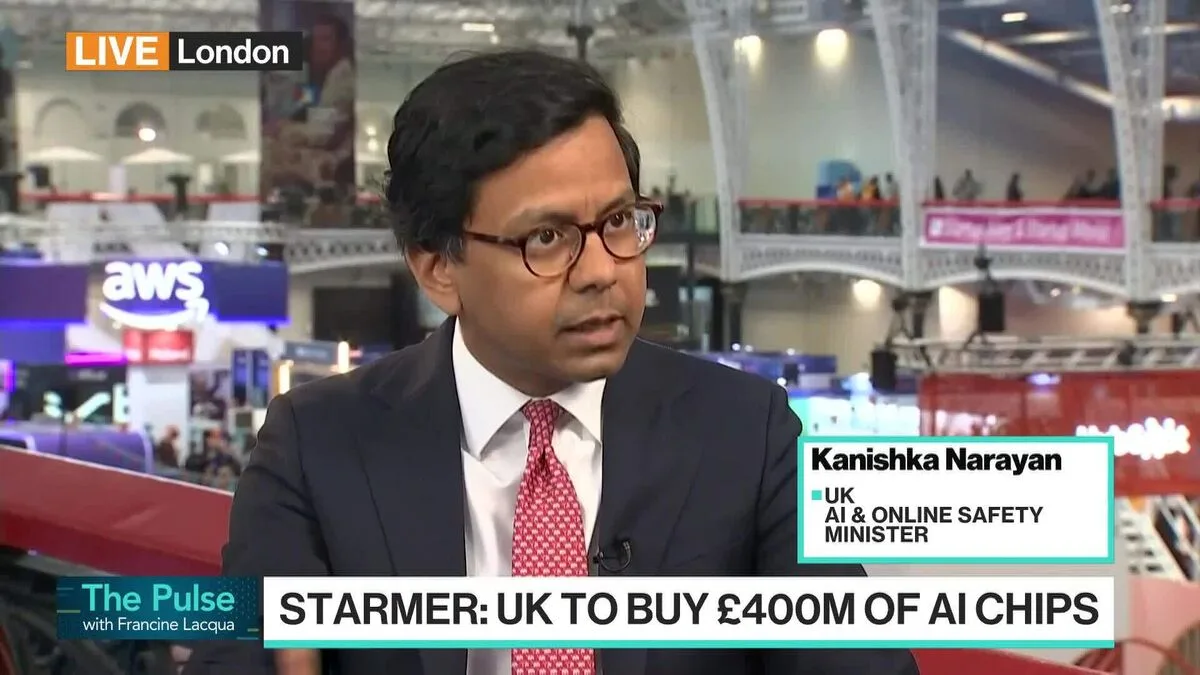
Look, I wanted to be excited about London Tech Week 2026. The UK has been making noise about becoming a serious player in AI and automation, and the event's opening day featured the country's AI & Online Safety Minister, Kanishka Narayan, doing the rounds on Bloomberg. But after watching the coverage and digging through the announcements, I'm left with more questions than answers, particularly on the hardware and industrial automation front.
The problem isn't that the conversations were bad. It's that they were almost entirely about software AI, online safety frameworks, and startup ecosystems. For those of us tracking where physical robots actually get built and deployed, the silence was notable.
Minister Narayan's Bloomberg appearance focused on the UK's broader AI strategy, though the specific policy details remain, well, vague. The interview was part of Bloomberg's The Pulse programming, and while I don't have a transcript of exact quotes, the framing was clearly about positioning London as a global tech hub rather than announcing concrete industrial policy.
Also making appearances: Euan Blair, CEO of Multiverse, discussing apprenticeship and workforce training, and Judith Dada, General Partner at Visionaries, talking venture investment trends. Both conversations were oriented toward the software and services side of tech. Neither touched on manufacturing capacity, automation deployment, or the kind of hardware infrastructure questions that would tell us whether the UK is serious about competing in robotics.
This isn't necessarily a criticism of the speakers. They're talking about what they know. But it does highlight a gap in the UK's tech week programming.
À lire aussi
More in Policy
Everyone's framing this as a Windows headache, but the real story is what it means for the billion-plus devices that nobody's going to patch in time.
Mark Kowalski · 25 Jun · 6 min
The billionaire chairman of Australian logistics software giant WiseTech is under scrutiny again, and this time investors appear to be running out of goodwill.
Sarah Williams · 22 Jun · 4 min
The ad-supported streaming wars just got a lot more expensive. Fox's blockbuster Roku deal is either a masterstroke or a very pricey panic move, depending on who you ask.
Mark Kowalski · 20 Jun · 7 min
The US government thinks it might have, and that's a very big deal for the future of AI hardware and anything built on top of it.
From my time building hardware at Fanuc, I learned that you can talk about AI strategy all you want, but the real test is whether you're investing in the physical infrastructure to deploy it. That means factories. That means supply chains for motors, sensors, and actuators. That means workforce training not just for software engineers, but for the technicians who maintain and operate automated systems.
The UK's position here is, to put it charitably, unclear. The country has some strong robotics research institutions (Bristol Robotics Laboratory, Edinburgh's robotics group), but the path from research to commercial manufacturing at scale has always been rocky. Germany has its Mittelstand industrial base. China has Shenzhen. The US has... well, it's trying to figure that out too, but at least there's visible investment in semiconductor fabs and battery plants.
What's the UK's equivalent? I genuinely don't know, and London Tech Week's opening day didn't provide an answer.
Judith Dada's appearance on Bloomberg's The Opening Trade presumably touched on where investment capital is flowing. Visionaries is a fund that's backed various European tech companies, and the general sentiment in European VC has been cautiously optimistic about AI infrastructure plays.
But here's the thing: venture capital for hardware is a different beast than VC for software. Hardware has longer development cycles, higher capital requirements, and narrower margins. I've seen enough pitch decks to know that investors love the idea of "AI-powered robotics" but get nervous when you start talking about the 18-month timeline to get tooling right or the 15% gross margins that are actually pretty good for industrial equipment.
It remains unclear whether the UK's investment ecosystem is genuinely prepared to fund hardware companies through the long, expensive process of getting to production volume. That's an ambitious goal for any country, and I haven't seen data suggesting the UK has cracked it.
If next year's London Tech Week wanted to signal serious intent on robotics and automation, here's what I'd want to see:
Specific deployment numbers: How many industrial robots were installed in UK factories last year? (For reference, Germany installed roughly 25,600 units in 2023, according to IFR data. The UK was around 2,600. That's a 10x gap.)
Manufacturing incentives: Tax credits, grants, or subsidies specifically for automation equipment purchases, not just R&D.
Supply chain commitments: Announcements from component manufacturers (motor makers, sensor companies) opening UK facilities.
Workforce training metrics: Not just "we're investing in skills" but actual numbers. How many automation technicians certified? How many apprenticeships in mechatronics?
None of that was present in the opening day coverage I reviewed. Maybe it's coming later in the week. I hope so.
Euan Blair's Multiverse focuses on apprenticeships as an alternative to traditional university education, which is genuinely relevant to the automation workforce question. The company has placed apprentices at major tech firms, and the model of learning-while-working makes sense for technical roles that require hands-on experience.
The question is whether that pipeline extends to hardware roles. Software engineering apprenticeships are well-established. Robotics technician apprenticeships are, in a way, trickier to scale because they require physical equipment, safety training, and partnerships with manufacturers who have actual robots to work on.
I don't have data on how many Multiverse apprentices end up in hardware-adjacent roles versus pure software. That would be a useful number to know.
I should be honest about the limitations here. The Bloomberg coverage I'm working from consists of video segments without full transcripts, so I can't quote specific policy commitments or investment figures that may have been mentioned. It's possible Minister Narayan announced something concrete about industrial automation that didn't make it into the segment descriptions.
If that's the case, I'll update this piece. But based on the available information, the opening of London Tech Week 2026 was heavy on AI optimism and light on hardware specifics.
The UK is in a genuinely difficult position when it comes to automation and robotics. It's a mid-sized economy with strong research institutions but a manufacturing base that's been shrinking for decades. The easy path is to focus on AI software, where you can build billion-dollar companies with relatively small teams and minimal physical infrastructure.
The hard path is to rebuild industrial capacity, which requires patient capital, long-term policy commitment, and a willingness to celebrate unsexy wins like "factory opened" and "production line upgraded" rather than "unicorn valuation achieved."
London Tech Week seems to be taking the easy path. I understand why. But if the UK wants to be a serious player in the robotics economy, not just a consumer of robots built elsewhere, it'll need to start talking about hardware with the same enthusiasm it brings to software AI.
For now, I'm watching and waiting. The numbers will tell the real story.