Crédit photo: Image via Bloomberg — Technology. Used under fair use for news commentary. · source
Why is the most important company in semiconductor manufacturing trading at a discount?
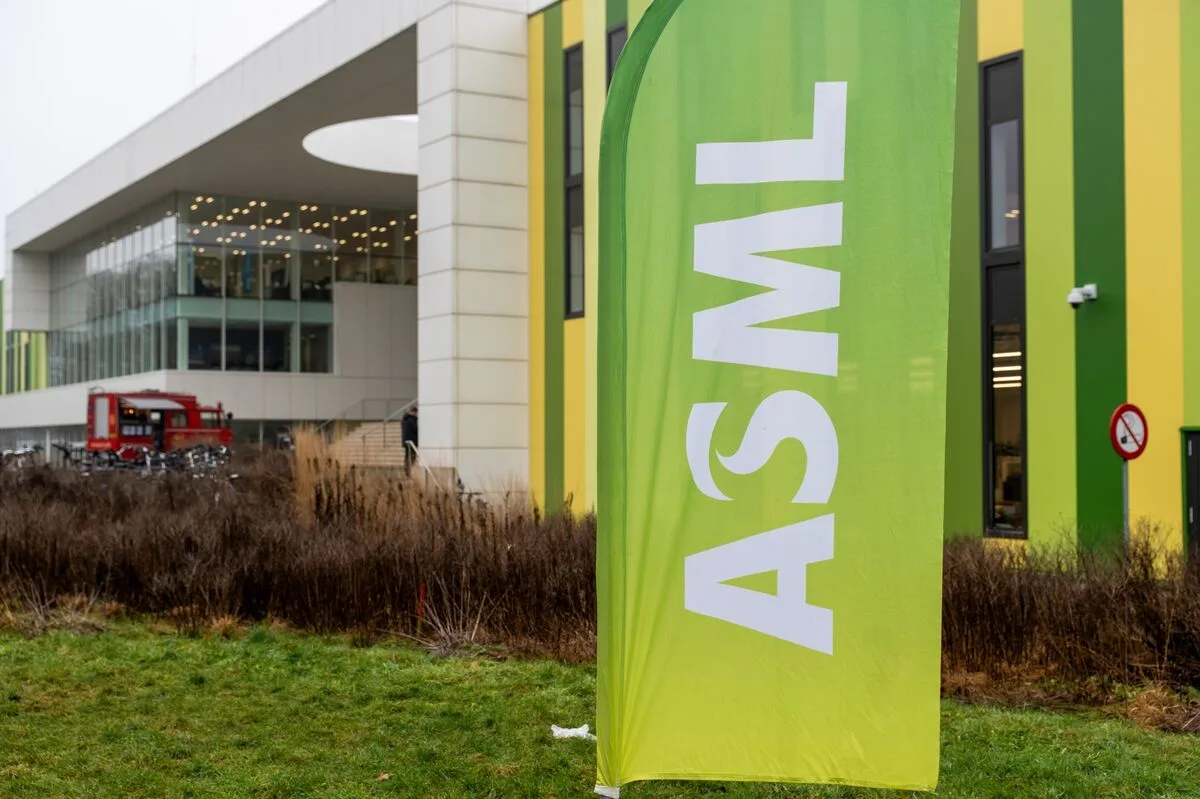
ASML Holding NV has been one of the brighter spots on European markets lately, pushing to fresh record highs in recent sessions. On the surface, that sounds like a clean win. But the valuation picture underneath is a lot messier, and it's the kind of thing that tends to get glossed over in the headline coverage.
According to Bloomberg, ASML's forward price-to-earnings ratio relative to its major peers has fallen to its lowest point in more than a decade. The stock is hitting record prices while simultaneously becoming, in relative terms, cheaper than it's been in years. Those two facts coexist, and they're worth sitting with for a moment.
The core tension here is straightforward. ASML's absolute share price is up. But when you compare its forward P/E to peer companies in the semiconductor equipment space, the gap has widened considerably in the wrong direction. ASML is, in relative terms, the cheapest it's been versus those peers in over ten years.
This isn't a small discrepancy. A decade is a long time in this industry. I've seen enough spec sheets and capital equipment cycles to know that valuation compression like this usually signals one of two things: either the market is genuinely worried about near-term earnings, or the peer group has re-rated upward so aggressively that even a strong performer gets left looking cheap by comparison. Both explanations are worth examining.
À lire aussi
More in Industrial
The Apple supplier priced its shares at the maximum and still had to turn away demand, which tells you something about where hardware money is flowing right now.
James Chen · 25 Jun · 5 min
Prime Day deals on Echos and Ring cameras are fine, but let's not confuse consumer gadgets with the serious robotics work happening in warehouses.
Robert "Bob" Macintosh · 25 Jun · 3 min
Amazon's CEO made his first India trip and left behind a $13 billion AI commitment and an aggressive quick-commerce expansion. The numbers are real. The execution is the hard part.
James Chen · 25 Jun · 6 min
A wave of arXiv preprints this week tackles one of manipulation's oldest problems: how do you get a robot to learn from imperfect, incomplete, or just plain missing data?
Bloomberg's reporting from Amsterdam flags this as a dynamic that ASML's headline surge is effectively masking. The record high is real. The relative discount is also real. Both things are true at once.
ASML occupies a position in semiconductor manufacturing that is, genuinely, unlike any other company on earth. It is the sole producer of extreme ultraviolet lithography machines, the EUV systems that chipmakers like TSMC, Samsung, and Intel depend on to manufacture the most advanced chips available. There is no substitute. There is no competitor at the leading edge. That's not marketing language; it's the actual supply chain reality.
Given that monopoly position, a relative valuation discount raises some legitimate questions. A few possibilities:
Export restrictions and geopolitical risk. ASML has faced significant pressure from the Dutch and US governments to limit shipments to Chinese customers. China represented a meaningful portion of ASML's revenue in recent years, and any sustained restriction on that market creates a real earnings headwind. The market may be pricing in continued or escalating restrictions.
Order timing and backlog visibility. Semiconductor equipment is a lumpy business. Orders get pulled forward, pushed back, and revised. If the market is uncertain about the shape of ASML's near-term order book, that uncertainty tends to compress multiples.
Peer re-rating. If companies like Applied Materials, Lam Research, or KLA have seen their multiples expand faster than ASML's, the relative gap widens even if ASML's own valuation is stable or growing.
It's too early to say which of these factors is doing the most work here. Probably some combination of all three, weighted differently depending on who you ask.
Here's the analytical wrinkle that I find most interesting. ASML's monopoly on EUV should, in theory, command a premium valuation. You're buying a company with no direct competition at the cutting edge, with customers who have no alternative and multi-year lead times on equipment. That's a remarkably durable competitive position.
Look, the fact that the market isn't pricing in that premium, at least not relative to peers, suggests either the market is wrong or ASML's near-term earnings trajectory is more constrained than the long-term thesis implies. The geopolitical exposure to China is the most obvious explanation. Restrictions on ASML's ability to ship its most advanced systems, and even some older deep ultraviolet systems, to Chinese customers represent a real ceiling on addressable revenue in the near term.
The real test, as always, is what the order book actually looks like over the next 12 to 18 months. ASML reports detailed backlog data in its quarterly earnings, and those figures will be more informative than any single valuation ratio.
ASML's valuation situation is, in a way, a proxy for how investors are thinking about the entire advanced semiconductor supply chain right now. The AI infrastructure buildout has been enormously positive for chip demand, and by extension for the equipment companies that make chip manufacturing possible. That tailwind is real and substantial.
But the geopolitical overlay complicates the picture in ways that are genuinely hard to model. Export controls are a policy instrument, which means they're subject to political decisions that don't follow clean economic logic. Companies can plan around tariffs; they can adjust supply chains over time. But a blanket restriction on selling your most important product to one of the world's largest chip markets is harder to route around.
The semiconductor equipment sector broadly has benefited from the AI capex cycle. ASML, despite its unique position, appears to be capturing less of that re-rating than some peers. Whether that's a valuation opportunity or a warning sign depends on how you assess the China risk and the durability of export restrictions going forward.
For context on why ASML's position is so entrenched, a few relevant data points:
ASML is the only company in the world that manufactures EUV lithography systems
A single high-NA EUV system costs roughly 350 million euros
ASML's 2025 revenue guidance was in the range of 30 to 35 billion euros, though the company has revised figures across reporting periods
Lead times on EUV systems can run to multiple years, meaning the backlog is a lagging indicator of demand
Those numbers matter because they frame the valuation question correctly. This is not a company with thin margins or commodity exposure. The discount, relative to peers, is somewhat counterintuitive given the fundamental business characteristics.
It remains unclear whether the current relative valuation gap will close as geopolitical pressures ease or whether it reflects a more durable reassessment of ASML's growth ceiling. The record share price suggests the market isn't bearish on ASML in absolute terms. But the peer comparison tells a more complicated story, and that's the one worth watching.
The headline is record highs. The actual story is the decade-low relative multiple sitting underneath them.