SpaceX Starship deploys mock satellites, but booster breakup raises questions
The rocket reached space and came back mostly intact. The booster didn't fare as well.
Crédit photo: Image via source article. Used under fair use for news commentary. · source
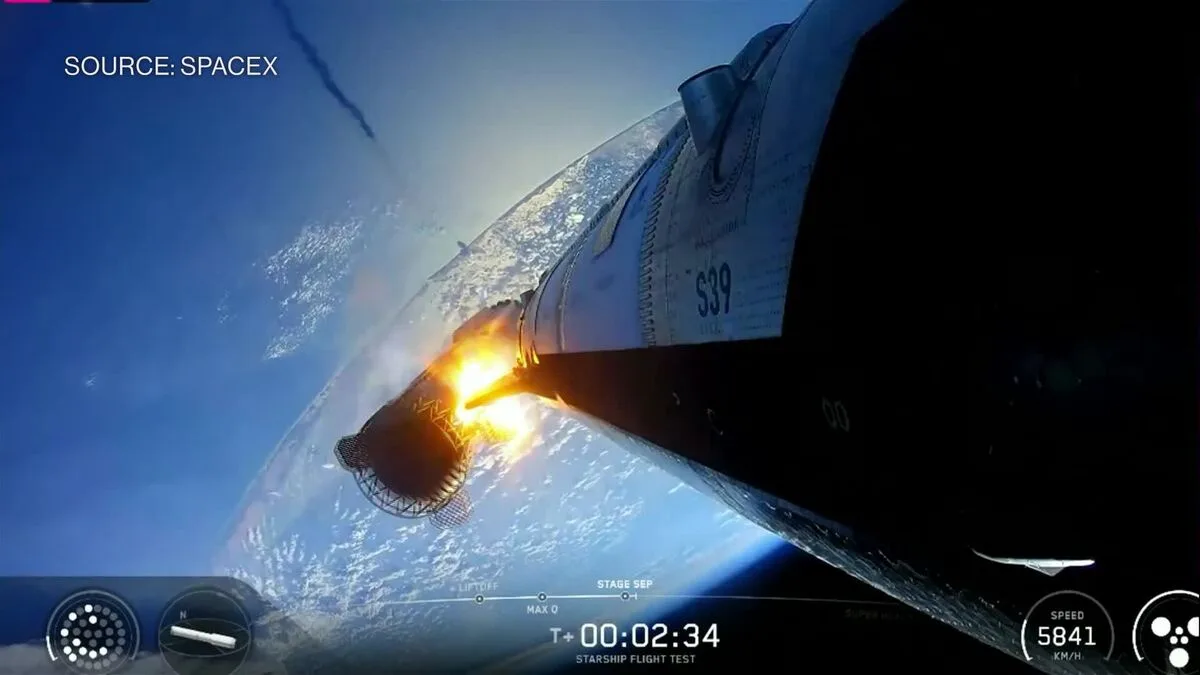
SpaceX's Starship reached orbit, deployed 20 dummy Starlink satellites, and returned to Earth largely unscathed on Thursday. The booster that got it there spun out of control over the Gulf of Mexico and broke apart.
That's the short version. The longer version involves parsing what "success" means when half your rocket system works beautifully and the other half ends up as debris.
What actually happened
The upgraded Starship lifted off from SpaceX's Texas facility and reached space within minutes. According to Bloomberg, the vehicle deployed 20 mock Starlink satellites, a key demonstration that the rocket can actually do useful work in orbit rather than just get there.
The Starship upper stage then returned to Earth "largely unscathed," which in rocket terms is a significant achievement. Reusability has always been the core promise of the Starship program, and bringing the vehicle back in one piece is table stakes for that vision.
But the Super Heavy booster, the massive first stage that provides the initial thrust, had a different outcome. It spun out of control and broke apart over the Gulf of Mexico. SpaceX has previously caught boosters using a "chopstick" mechanism at the launch tower, so losing one to an uncontrolled spin represents a step backward on that front.
The reusability math
Look, I've seen enough spec sheets and launch manifests to know that partial success is still progress in rocketry. But the economics of Starship depend entirely on reusing both stages. Losing a booster every flight doesn't work.
À lire aussi
More in Autonomy
A startup called REO says it will sell a pickup truck for $21,500. The price is striking. The evidence for it is less so.
Aisha Patel · 24 Jun · 9 min
Researchers are patching the 'trajectory scoring gap' in sidewalk robots with VLMs and human attention modeling. The ideas are clever. The caveats are real.
Mark Kowalski · 20 Jun · 6 min
Two new papers tackle one of robotics' most stubborn problems: getting a robot to figure out its location using LiDAR, without needing to have visited the place before.
Sarah Williams · 19 Jun · 5 min
The defense tech startup is moving from drones to full autonomous fighters, and it raises questions about where the line between AI autonomy and human oversight actually sits.