Is digital credit actually a $3 trillion market opportunity, or is this the kind of projection that looks compelling in a Bloomberg segment and dissolves under scrutiny?
That question matters more than usual right now, because several converging stories this week suggest the crypto-finance crossover is entering a genuinely new phase. Not a paradigm shift (I will not use that phrase), but a structural shift in who is building the infrastructure, and why. The players involved, including a former governor of New York, the owner of the New York Stock Exchange, and the CEO of a company whose core thesis is Bitcoin treasury accumulation, are not the usual cast of crypto evangelists. That alone is worth paying attention to.
Let me be precise, though: interesting participants do not validate a market thesis. So let's work through what we actually know.
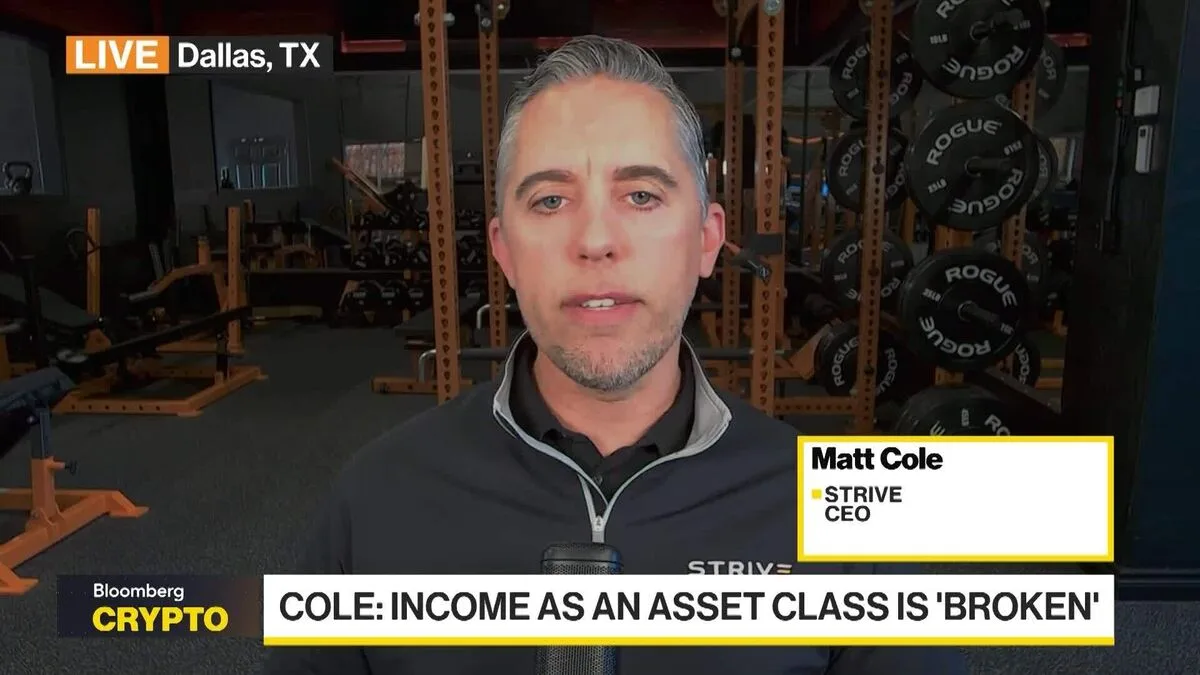
Matt Cole, CEO of Strive Asset Management, appeared on Bloomberg this week arguing that digital credit could represent a $3 trillion market. The segment aired on "Bloomberg Crypto," hosted by Scarlet Fu and Tim Stenovec. Cole's argument, as far as can be reconstructed from the available summary, centers on the idea that tokenizing credit instruments and moving them onto blockchain rails opens up a market currently inaccessible to most participants.
The $3 trillion figure is striking. It is also, as of this writing, unverified by any independent methodology I can locate. The company didn't disclose the assumptions underlying that estimate, and it's worth noting that market size projections in emerging asset classes have a poor track record of accuracy. (Recall the various multi-trillion-dollar projections for the metaverse economy circa 2021 to 2022, most of which have aged badly.)
Strive itself is a relatively young firm. Its founding thesis involves Bitcoin as a corporate treasury asset, which means Cole has a structural incentive to argue that digital asset markets are larger and more legitimate than skeptics believe. That doesn't make him wrong. It does mean the $3 trillion number deserves more scrutiny than a television segment allows.
Separately, and this is where it gets genuinely interesting, Bloomberg reported that former New York Governor Andrew Cuomo is partnering with OKX, one of the world's largest cryptocurrency exchanges, and Intercontinental Exchange, the parent company of the New York Stock Exchange, to build a new venture that explicitly attempts to merge digital and traditional finance markets. Bloomberg's Katherine Doherty covered the story.
This is a different kind of signal than a CEO making a market size claim on a video segment. ICE is not a speculative startup. OKX is a major exchange with significant institutional relationships. And Cuomo, whatever one thinks of his political history, has deep regulatory and governmental networks in New York, which remains the center of gravity for U.S. financial regulation. The combination of those three entities building something together suggests institutional capital is moving toward infrastructure, not just speculation.
At the same time, a third story from this week complicates the optimistic framing considerably. Bloomberg's Maria Clara Cobo reported on the unraveling of the crypto treasury company model, the business strategy of launching a public company specifically to accumulate Bitcoin or other digital assets on its balance sheet. The headline figure is stark: a 90% stock plunge for at least one company following this model.
The key points from that reporting:
- The business model of launching a public company to buy crypto is, in Cobo's framing, "falling apart"
- Companies in the queue to pursue this strategy through blank-check SPAC vehicles are facing investor pressure
- The market backdrop is described as "fiercely unfriendly" for this approach
- The pressure appears to be structural, not just a result of temporary price movements
This matters because it creates a tension at the heart of the current moment. On one side, you have serious institutional players (ICE, OKX, Cuomo's network) moving toward infrastructure that merges digital and traditional finance. On the other, the simpler version of that thesis, just put Bitcoin on a corporate balance sheet and watch the stock price follow, is visibly struggling.
Actually, the research on corporate treasury Bitcoin strategies is still thin. I am aware of only a small number of peer-reviewed analyses of MicroStrategy-style treasury accumulation as a corporate finance strategy, and most of what exists is either industry-produced or too recent to have been replicated. The sample sizes are small, the time horizons are short, and the market conditions during the adoption period were unusual. It's too early to say whether the 90% plunge represents a permanent verdict on the model or a cyclical correction.
But the direction of travel is not ambiguous. Blank-check companies chasing the same playbook are being told by investors that the window has closed, or at least narrowed significantly.
I want to be careful here not to bury the more structurally significant development under the noise of market price movements. The Cuomo-OKX-ICE venture is, to be precise, something we have not seen before in quite this configuration.
OKX is a major exchange with a genuinely global footprint. ICE built and operates the infrastructure underlying the New York Stock Exchange, one of the most regulated and scrutinized financial venues in the world. The fact that ICE is willing to put its name and presumably its capital behind a venture explicitly described as merging digital and traditional finance markets is not a trivial signal.
This is genuinely new, in the sense that prior attempts to bridge institutional finance and crypto tended to happen through one of two routes: either a crypto-native company trying to acquire legitimacy by hiring traditional finance veterans, or a traditional finance institution building a cautious, ring-fenced digital asset product. What's being described here is something more integrated, a joint venture between a crypto exchange and the NYSE's parent company, with a politically connected figure whose value is presumably regulatory navigation.
Whether that venture succeeds is a separate question, and remains unclear. Joint ventures in financial services have a mixed track record even when all parties are competent and well-resourced. The regulatory environment for crypto in the United States is still evolving rapidly, and a change in administration or enforcement priorities could reshape the landscape significantly.
The $3 trillion digital credit market claim, if it has any grounding, is probably best understood as a statement about the total addressable market for this kind of institutional bridge-building rather than a near-term revenue projection. Credit markets globally are enormous. Even tokenizing a small fraction of existing credit instruments would represent a large nominal number. The question is whether the infrastructure, legal, technical, and regulatory, exists to support that tokenization at scale. It does not yet, at least not in any jurisdiction I'm aware of.
I know I'm being picky here, but the coverage of this week's developments would benefit from a few things that are currently missing.
First, the $3 trillion market size claim needs a methodology. What instruments is Cole including? What assumptions about adoption rates, regulatory approval timelines, and infrastructure buildout underlie that number? Without that, it's a talking point, not an analysis.
Second, the Cuomo-OKX-ICE venture needs more structural detail. What is the legal entity? How is it capitalized? What specific products or services is it building? The coverage so far is at the announcement level, which is understandable given the timing, but the devil in these ventures is always in the structure.
Third, the crypto treasury story deserves a cleaner causal analysis. Is the 90% plunge the result of Bitcoin price movements, company-specific mismanagement, a general SPAC market correction, or something specific to the treasury accumulation thesis? The answer has different implications for what comes next. A SPAC market correction is cyclical. A fundamental investor rejection of the treasury thesis is not.
Finally, and this is perhaps the most important question the week's coverage raises, what does it mean for the broader digital asset ecosystem if institutional infrastructure (ICE, OKX, regulated bridges between markets) succeeds while retail-facing, speculation-driven models (crypto treasury SPACs, blank-check companies) fail? That would represent a maturation of the market in a specific direction, one that is more accessible to institutional capital and less accessible to retail participants. That raises questions about... well, multiple things, including who actually benefits from the next phase of crypto market development.
The honest answer is that we don't know yet. The institutional convergence story is real. The market size claims are plausible but unverified. The crypto treasury model is under genuine pressure. All three of those things can be true simultaneously, and they probably are.