China's Underwater Data Center and Amazon's Water Bill Reveal the Same Problem
Two stories about data center infrastructure landed this week, and together they say something uncomfortable about where AI's energy appetite is taking us.
Crédit photo: Image via WIRED — AI. Used under fair use for news commentary. · source
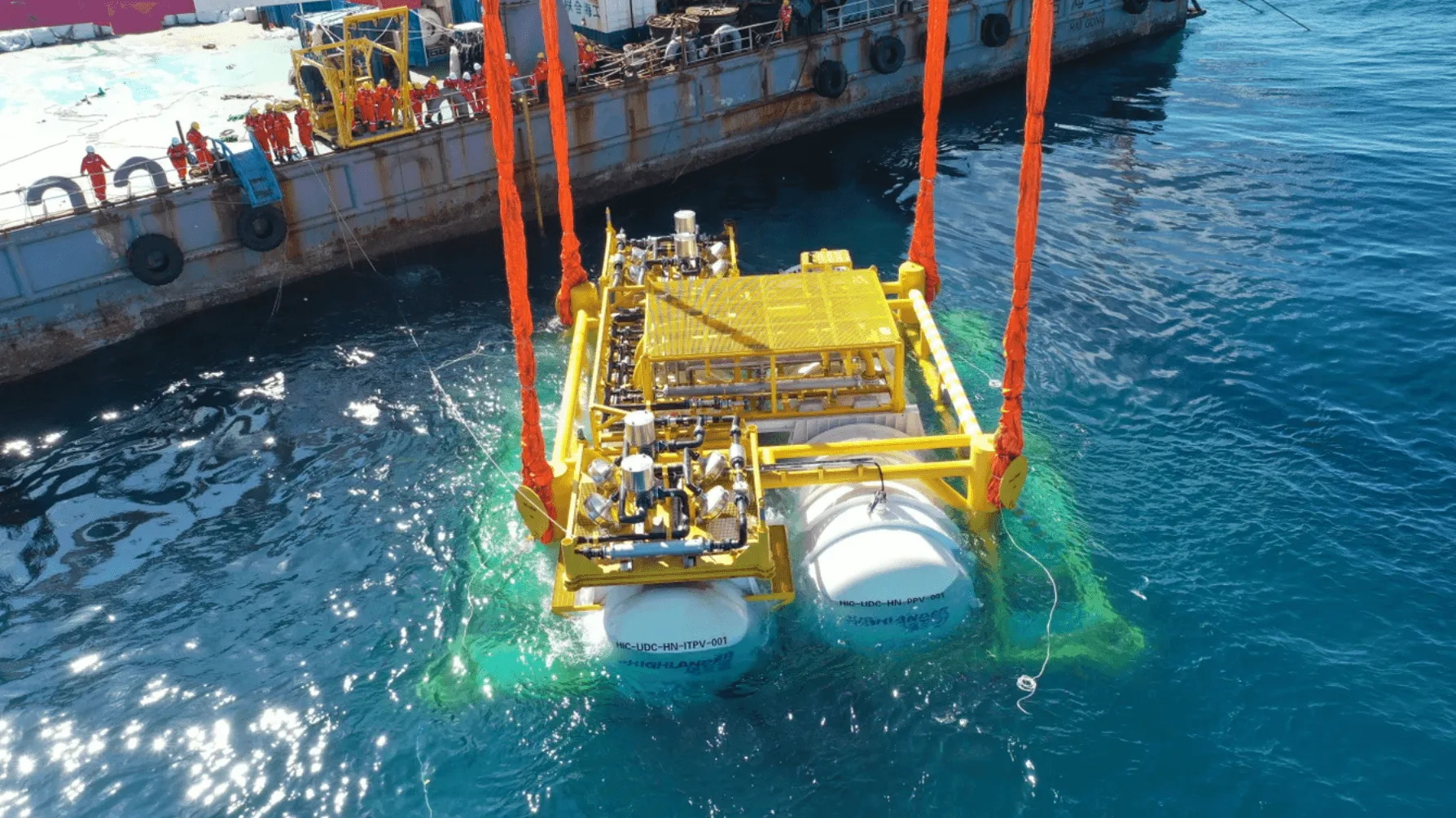
A data center sitting on the seafloor off the coast of China, cooled by the ocean itself, powered by offshore wind. It sounds like science fiction, or at least like a press release written by someone who really wanted to lead with a dramatic image. But it is real, and it is operating, and it is worth thinking carefully about what it actually represents.
This week, two pieces of infrastructure news arrived in close succession. WIRED reported that China has opened what it describes as the world's first wind-powered underwater data center, with an initial capacity of 24 megawatts, using seawater as its primary cooling mechanism. Almost simultaneously, The Verge reported that Amazon's data centers consumed 2.5 billion gallons of water in 2025, a figure the company disclosed, reportedly for the first time, just after Seattle enacted a one-year moratorium on new data center construction. Amazon claims its consumption rate was 0.12 liters per kilowatt-hour of electricity, down two percent from 2024, even as its operations expanded.
Read separately, these are two discrete infrastructure stories. Read together, they are a portrait of an industry that is genuinely struggling to reconcile the physical demands of computation with the limits of the planet's resources.
It is worth noting that the cooling problem in data centers is not new, and it is not subtle. Processors generate heat. That heat has to go somewhere. For decades, the dominant solution has been air cooling, which requires either cold ambient air (which is why data centers cluster in places like Iceland and the Pacific Northwest) or evaporative cooling systems that consume enormous quantities of fresh water.
À lire aussi
More in AI Models
Chipmakers swung wildly this week, from a Tuesday 'chip-wreck' to a Micron-led surge after hours. What's actually going on with AI's hardware backbone?
Sarah Williams · 26 Jun · 5 min
The original Creator Studio was shut down in 2023. Now it's back, rebuilt around an AI assistant that promises to grow your audience and reply to comments in your voice.
Sarah Williams · 26 Jun · 5 min
At its annual Config conference, Figma announced coding layers, AI-generated motion graphics, and a reimagined canvas that blurs the line between design and full-stack development.
Sarah Williams · 26 Jun · 5 min
Everyone talks about chips and models. The memory bottleneck is the part of the AI buildout that keeps getting underestimated, and Micron's latest earnings make that case hard to ignore.
The relationship between water and computation is, to be precise, a consequence of thermodynamics, not a design choice anyone made carelessly. When you run a large language model or train a neural network, you are doing billions of floating-point operations per second, each of which dissipates energy as heat. At scale, that heat load becomes an engineering constraint that shapes everything: facility location, energy sourcing, operational cost, and, increasingly, political viability.
Amazon's 2.5 billion gallon figure is striking not because it is surprising to anyone who has been watching this space, but because Amazon chose to publish it at all. The timing, immediately following Seattle's data center moratorium and pressure from Amazon's own employees, suggests the disclosure was not entirely voluntary in spirit, even if it was in form. The two percent efficiency improvement is real, but it is incremental over a baseline that was already very large, and the company did not disclose absolute figures in prior years, which makes trend analysis difficult. This is based on limited data in the sense that we have one year's confirmed number and no reliable historical comparison.
The Chinese underwater facility is genuinely different in kind, not just degree. Using seawater as a cooling medium eliminates the freshwater consumption problem almost entirely. The ocean is, functionally, an infinite heat sink. The offshore wind integration addresses the energy sourcing question simultaneously. If the engineering holds up at scale, this is not an incremental improvement over conventional data center design. It is a different design philosophy.
The 24-megawatt initial capacity is modest by hyperscale standards. For context, large cloud data centers routinely operate at hundreds of megawatts, and planned AI training facilities are being designed at gigawatt scale. So the Chinese facility is, at this stage, a proof of concept rather than a solution to the industry's aggregate problem. It is genuinely new as an operational system, but it is incremental over Microsoft's Project Natick, which demonstrated a sealed underwater data center at pilot scale in 2018 and retrieved it in 2020 with encouraging results on reliability and energy efficiency.
The key differences here are the wind power integration and the apparent commitment to commercial operation rather than research demonstration. Whether the seawater cooling approach introduces new problems, corrosion, marine biofouling, maintenance complexity, is not yet clear from the available reporting. The engineering literature on subsea infrastructure in oil and gas is extensive, but data centers have different failure mode profiles. It is too early to say whether this scales gracefully.
The reason both of these stories matter to anyone writing about AI and robotics research is that the computational substrate for modern AI is not abstract. It is physical. It consumes water. It consumes land. It generates political opposition in the communities where it is built.
Actually, the research shows this constraint is already affecting decisions about where and how AI models are trained. The concentration of training compute in specific geographic regions is partly a function of energy availability and partly a function of water availability. As models scale, these constraints become more binding, not less. A 2023 paper by Li et al. in the Proceedings of the ACM on Interactive, Mobile, Wearable and Ubiquitous Technologies estimated that training a large language model like GPT-3 consumed roughly 700,000 liters of fresh water for cooling, though the methodology for that estimate has been contested and the figure varies significantly depending on facility location and cooling design.
The Amazon disclosure, and the Seattle moratorium that preceded it, are early signals of a political dynamic that will intensify. Communities are beginning to ask whether the economic benefits of hosting data center infrastructure outweigh the costs in water consumption, grid load, and land use. This raises questions about, well, multiple things: where the next generation of AI training infrastructure gets built, who bears the environmental costs, and whether the efficiency improvements the industry is achieving are fast enough to stay ahead of the regulatory pressure.
There is a well-documented phenomenon in energy economics called the Jevons paradox, which holds that improvements in the efficiency of resource use tend to increase total consumption rather than decrease it, because efficiency reduces cost, which increases demand. Amazon's two percent water efficiency improvement is real. But Amazon's total data center footprint is also growing. The net effect on absolute water consumption is, by Amazon's own figures, a two percent reduction in total gallons. That is better than nothing. It is not a solution.
I know I am being picky here, but the framing of efficiency improvements as environmental progress deserves scrutiny when the underlying demand curve is steep and rising. The AI industry's energy and water consumption is growing faster than its efficiency improvements. That is not a criticism of any individual company's engineering decisions. It is a structural observation about what happens when you scale a compute-intensive technology rapidly.
The underwater data center approach, if it genuinely eliminates freshwater consumption and sources power renewably, addresses both sides of this equation differently. It does not make computation more efficient in the thermodynamic sense. It relocates the heat dissipation to a medium where the environmental cost is lower (or at least differently distributed). Whether the ocean is actually an appropriate heat sink at the scale AI infrastructure is heading toward is a separate question that marine scientists, not data center engineers, are better positioned to answer.
Several things remain unclear from the current reporting. On the Chinese facility: what are the maintenance procedures for a sealed underwater system, and what happens when hardware fails? What is the full lifecycle environmental assessment, including the materials and energy required to manufacture and deploy the underwater modules? How does the facility perform during severe weather events that affect offshore wind generation?
On Amazon's disclosure: why were 2025 figures the first published, and what does the historical trajectory actually look like? The two percent year-over-year reduction is presented as progress, but without a longer time series, it is impossible to evaluate whether this represents a genuine inflection or a single-year fluctuation. Amazon also claims greater efficiency than some Big Tech rivals, but the comparison methodology is not fully specified in the available reporting, and the sample size for that comparison is small.
More broadly: the relationship between AI scaling and infrastructure consumption is not well characterized in the public research literature. There are estimates and projections, but they vary widely and depend heavily on assumptions about model architecture, training efficiency improvements, and inference demand growth. This is an area where better empirical work would be genuinely useful.
The most useful thing the AI industry could do, from a research transparency perspective, is publish standardized infrastructure consumption data on a regular basis, with consistent methodology, so that independent researchers can track trends and evaluate claims. Amazon's disclosure is a step in that direction, but a single company publishing a single year's figure in response to political pressure is not the same as a systematic, industry-wide accounting.
On the engineering side, the Chinese underwater facility deserves serious independent evaluation. Microsoft's Project Natick generated a peer-reviewed paper (Cutler et al., 2020, in IEEE Spectrum) that examined reliability and energy use in detail. A similar rigorous evaluation of the commercial deployment, covering not just performance metrics but environmental impact, would be valuable.
The deeper question is whether the infrastructure problem is solvable within the current paradigm of centralized, large-scale training compute, or whether it pushes the field toward different architectural approaches: more efficient training methods, more aggressive use of federated and distributed computation, or fundamental changes in how models are designed. That is a research question as much as an engineering one, and it is one the field has not fully engaged with yet.