Crédit photo: Image via TechCrunch — AI. Used under fair use for news commentary. · source
Remember when every enterprise software vendor told you their product would "transform how your team collaborates"? Lotus Notes. SharePoint. Then Slack itself, actually, which genuinely did change things. Now Anthropic is betting that an AI that lives inside your Slack channels, reads your messages, remembers your context, and nudges your workflows forward is the next version of that story. Maybe they're right. But I've been around long enough to know the gap between a compelling demo and a tool people actually use six months later is enormous.
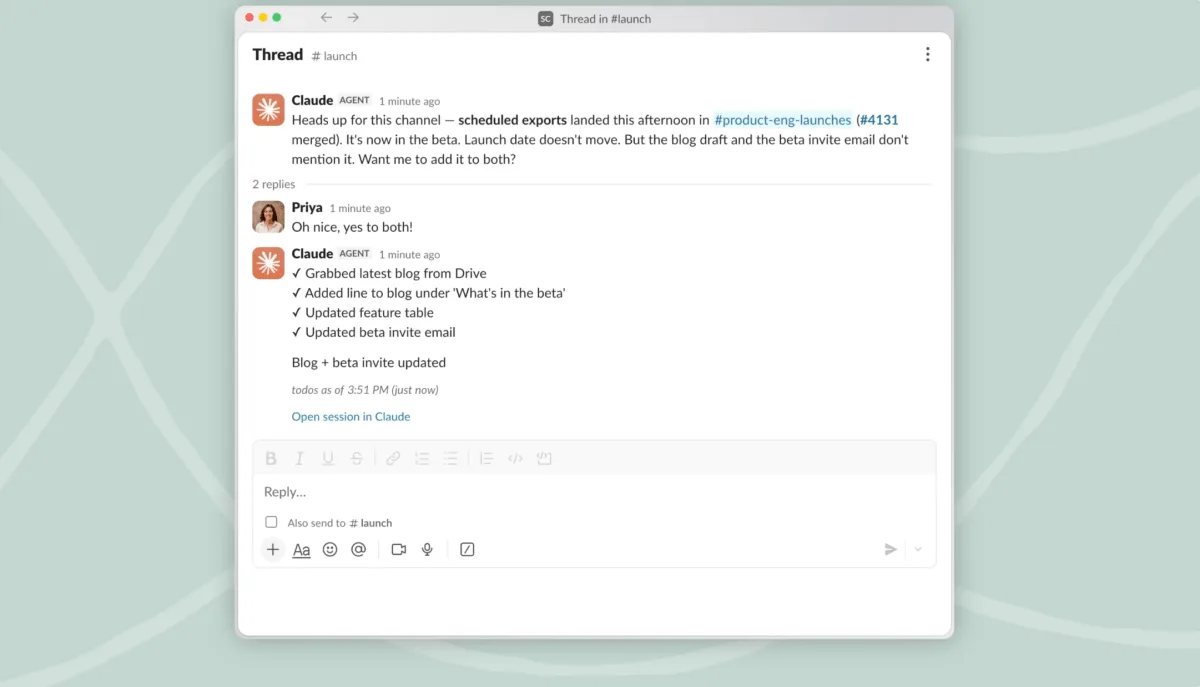
Anthropic this week rolled out Claude Tag, and the basic idea is straightforward enough: you can @-mention Claude directly inside Slack threads, and it shows up like a teammate. It reads the conversation, picks up context from prior messages, and helps move things forward. According to TechCrunch, the feature is designed not just as a productivity add-on but as a deliberate strategy to capture organizational context, institutional knowledge, and enterprise workflows over time. That last part is the part worth paying attention to.
ZDNet frames it as an "agentic AI coworker" that can read the room, join threads, and remember what your team has been working on. Agentic is doing a lot of work in that sentence. It's a word the industry loves right now, and it basically means the AI doesn't just answer questions, it takes initiative, follows up, acts on behalf of the team in some capacity. Whether that's actually happening here in a meaningful way or whether it's mostly a smart chatbot with memory remains a little unclear at this stage.
À lire aussi
More in AI Models
Chipmakers swung wildly this week, from a Tuesday 'chip-wreck' to a Micron-led surge after hours. What's actually going on with AI's hardware backbone?
Sarah Williams · 26 Jun · 5 min
The original Creator Studio was shut down in 2023. Now it's back, rebuilt around an AI assistant that promises to grow your audience and reply to comments in your voice.
Sarah Williams · 26 Jun · 5 min
At its annual Config conference, Figma announced coding layers, AI-generated motion graphics, and a reimagined canvas that blurs the line between design and full-stack development.
Sarah Williams · 26 Jun · 5 min
Everyone talks about chips and models. The memory bottleneck is the part of the AI buildout that keeps getting underestimated, and Micron's latest earnings make that case hard to ignore.
The core functionality isn't complicated to explain. You're in a Slack channel. You type @Claude. It responds. The difference from a basic chatbot integration is that Claude Tag is designed to persist across a conversation, meaning it's not just answering a single isolated question, it's reading the thread, understanding the history, and building up a picture of what your team is trying to accomplish.
The agentic angle, as described, means it can do things like summarize a long thread for someone who just joined, draft a response, flag action items, or help move a stalled decision forward. That's genuinely useful if it works. Most Slack channels I've ever seen are a mess of half-finished thoughts and buried decisions that nobody can find two weeks later. If Claude Tag can actually surface that stuff reliably, that's not nothing.
But here's the thing. The productivity pitch is the front door. The real architecture being built here is a data layer. Every time Claude Tag reads a thread, participates in a decision, or helps draft a document, Anthropic's system is learning how your organization talks, thinks, and operates. That's the strategic play TechCrunch is pointing at, and they're not wrong to flag it.
This raises questions about... well, multiple things, honestly. Enterprise data privacy. Vendor lock-in. Who owns the institutional knowledge that an AI system accumulates by sitting inside your communications for two years.
I've seen this movie before, though the last version starred a different cast. When companies started putting everything into cloud productivity suites, the same concerns came up. Who owns your documents? What happens when you switch vendors? What's the provider learning from your data? Most companies shrugged and signed the enterprise agreement anyway because the tools were genuinely useful and the alternatives were worse.
The same dynamic is probably going to play out here. If Claude Tag is good enough, and if it genuinely saves people time, companies will adopt it and figure out the data questions later. That's not cynicism, that's just how enterprise software adoption has always worked, call me old-fashioned.
What's different this time is the depth of what's being ingested. A cloud document storage system learns where your files are. An AI that lives in your Slack learns how your team argues, who the real decision-makers are, what projects are struggling, which relationships are strained. That's a fundamentally different kind of organizational intelligence, and it's not clear yet how Anthropic plans to handle it, what the retention policies look like, or what happens to that context if you cancel your subscription.
Probably, a little. Look, I don't want to be the guy who dunks on every new AI feature without giving it a fair shot. The kids building this stuff are genuinely talented and some of what they're shipping is legitimately impressive. But "agentic AI coworker" sets a very specific expectation: that this thing will act with something like judgment, initiative, and reliability. That's a high bar.
Right now, based on what's been reported, Claude Tag seems closer to a very capable, context-aware assistant than a true autonomous coworker. It responds when you call it. It remembers the conversation. It can help with drafting and summarizing. That's useful! But it's not the same as an agent that proactively identifies a problem in a thread and routes it to the right person before anyone asks. Whether Anthropic gets there, and how quickly, is genuinely hard to predict at this point. It's too early to say if the agentic framing is aspirational marketing or a near-term roadmap.
If you're running a team that lives in Slack and drowns in context-switching, the basic functionality of Claude Tag addresses a real problem. Slack is great for real-time conversation and genuinely terrible for preserving institutional knowledge or making sure decisions don't get lost in the scroll. An AI layer that helps with that has obvious value, and Anthropic is not the only company chasing this, Microsoft's Copilot is already embedded in Teams, Google has its own version in Workspace, so the competitive pressure is real and the category is clearly here to stay.
The thing I'd push back on is the framing that this is a neutral productivity tool with no strategic implications. It isn't. Anthropic is, quite deliberately, trying to make itself the layer that understands your organization better than any other vendor. That's a smart business strategy. It's also a significant commitment for any company that adopts it, because the more Claude Tag learns about how you work, the harder it becomes to switch to a competitor later. This is the platform lock-in dynamic, dressed up in new clothes.
I'm not saying don't use it. I'm saying know what you're signing up for. Read the data agreements. Ask the questions about retention and portability before you're two years in and Claude Tag knows more about your company than your own HR system does.
The productivity gains might well be worth it. The history of enterprise software suggests they usually are, which is exactly why the lock-in strategy works every single time. If you want to argue with me about that, my email's on the about page.