Crédito de imagen: Image via The Robot Report. Used under fair use for news commentary. · source
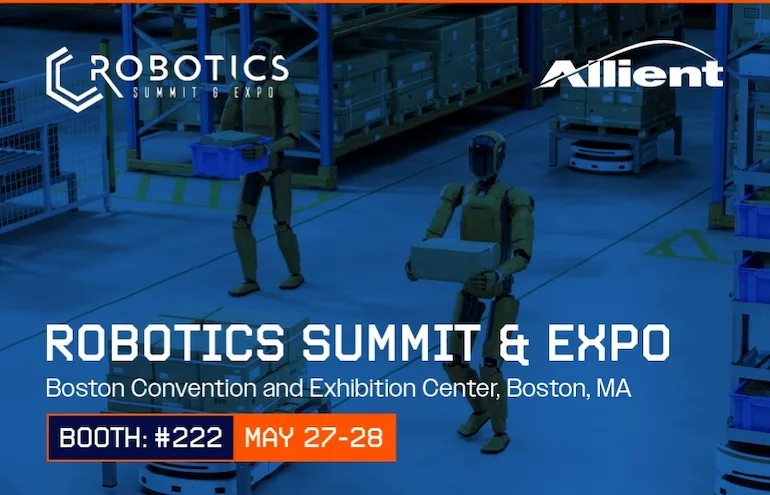
The 2026 Robotics Summit & Expo kicks off in Boston this week, bringing together what organizers describe as thousands of attendees and hundreds of exhibitors over two days.
I'll be honest: trade shows can be hit or miss. Sometimes you get genuine product announcements and interesting technical conversations. Sometimes you get a lot of booth swag and marketing speak. This one looks like it could lean toward the former, but I'm hedging until I see what actually gets demoed on the floor.
The Robot Report has been covering the lead-up pretty extensively, and based on their preview, the event seems weighted toward practical robotics applications rather than flashy concept demos. That's a good sign. The industry has enough concept videos. What we need is more "here's a thing that works in a warehouse right now."
One exhibitor I'm keeping an eye on is Allient, which will be showing off a range of motion and control technologies at the expo. If you're not familiar with them, they're one of those companies that makes the components other companies use to build robots. Not the sexy part of the supply chain, but arguably the more important one.
Motion control might sound boring (tbh, it kind of is until something goes wrong), but it's the foundation of basically everything in robotics that involves, well, movement. Which is most of robotics. The precision of a humanoid's hand, the reliability of a warehouse robot's wheels, the responsiveness of a surgical arm. All of that comes down to motors, drives, and the systems that coordinate them.
Cobertura relacionada
More in Industrial
The Apple supplier priced its shares at the maximum and still had to turn away demand, which tells you something about where hardware money is flowing right now.
James Chen · 25 Jun · 5 min
Prime Day deals on Echos and Ring cameras are fine, but let's not confuse consumer gadgets with the serious robotics work happening in warehouses.
Robert "Bob" Macintosh · 25 Jun · 3 min
Amazon's CEO made his first India trip and left behind a $13 billion AI commitment and an aggressive quick-commerce expansion. The numbers are real. The execution is the hard part.
James Chen · 25 Jun · 6 min
A wave of arXiv preprints this week tackles one of manipulation's oldest problems: how do you get a robot to learn from imperfect, incomplete, or just plain missing data?
I initially thought the motion control space was pretty commoditized at this point, but after reading more about what companies like Allient are doing, I'm less sure. The demands of newer robotic applications (especially humanoids and high-dexterity manipulation) seem to be pushing the boundaries of what existing components can do. Whether that translates into genuinely new products at this expo remains unclear.
What's actually on the schedule
The event runs over two days, with Day 1 focused on what The Robot Report describes as "insightful talks, hands-on robot demos, and interesting conversations." That's pretty vague, honestly. I couldn't find a detailed public schedule with specific session times and speakers, which is a little frustrating if you're trying to plan what to attend.
Here's what we do know:
Hundreds of exhibitors across industrial, consumer, and research robotics
Live demos on the expo floor (always more interesting than slide decks)
Networking opportunities (the real reason half the attendees show up, let's be honest)
Technical talks, though the specific topics weren't detailed in the sources I found
You might be wondering whether this is worth attending if you're not already in the industry. My take: probably not, unless you're actively looking to get into robotics or you're evaluating vendors for a specific project. Trade shows are expensive (travel, registration, time) and the information density isn't always great.
But if you're already working in the space, or you're a journalist trying to figure out what's actually happening versus what companies claim is happening, showing up in person still matters. You can learn more from watching someone struggle to demo their robot than you can from reading their press release.
The bigger picture
What I find interesting about events like this is what they tell us about where the industry thinks it's headed. The exhibitor mix, the topics people want to discuss, the demos that draw crowds. All of that is signal.
A few years ago, these events were dominated by industrial automation. Pick and place robots, welding arms, conveyor systems. Important stuff, but not exactly exciting. More recently, there's been a shift toward mobile robots, autonomous systems, and (yes) humanoids.
I'm curious whether this year's expo reflects that shift or whether the industrial automation crowd is pushing back. There's a real tension in the industry between the "boring but profitable" camp and the "ambitious but unproven" camp. Both have valid points, and events like this are where those arguments play out.
One thing I should note: I only found three sources covering this event in detail, and they're all from the same publication. That's not a criticism of the coverage, but it does mean I'm working with limited information here. If other outlets have more detailed previews, I haven't seen them yet.
What I'm watching for
If I were attending (I'm not, unfortunately), here's what I'd be looking for:
First, actual working demos. Not videos, not simulations, not "we'll have this ready by Q3." Show me the robot doing the thing.
Second, conversations about failure. The most honest people in robotics are the ones willing to talk about what didn't work. If everyone's just pitching their products, that's a red flag.
Third, the component suppliers. Companies like Allient don't get the headlines, but they're often better indicators of where the industry is actually headed. What are they building, and who's buying it?
The Robotics Summit & Expo runs through the end of the week in Boston. I'll be following the coverage and will write more if anything genuinely newsworthy comes out of it. For now, this is mostly a "here's what's happening" piece rather than a "here's what it means" piece. Sometimes that's all you can do before the event actually happens.