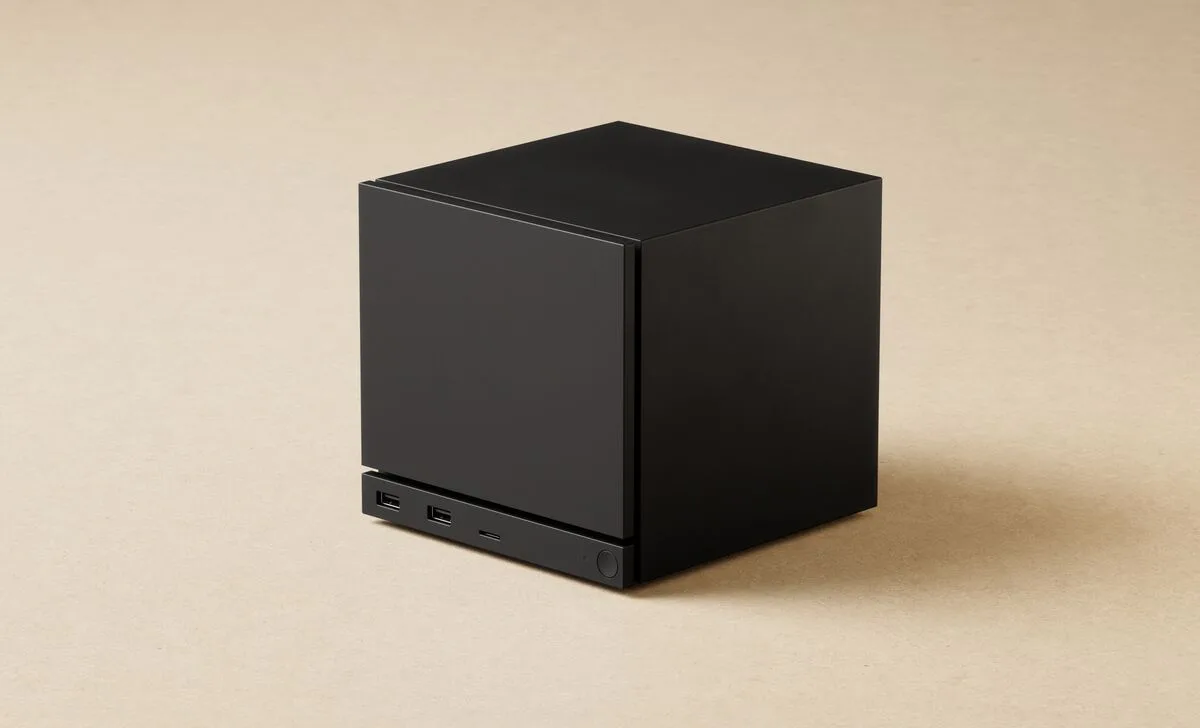
Crédito de imagen: Image via Bloomberg — Technology. Used under fair use for news commentary. · source
Over $1,000. That's what Valve is asking for the Steam Machine, its long-awaited cube-shaped gaming console. For context, a PlayStation 5 launched at $499. A Nintendo Switch 2 just came in at $449. So when Bloomberg reported the Steam Machine's price point this week, citing component shortages around memory, SSDs, and other parts as the culprit, a lot of people had questions.
I did too. Honestly, I cover humanoids and embodied AI for a living, so gaming hardware isn't exactly my beat. But the Steam Machine story keeps pulling me back in, because underneath the console pricing drama is something I think matters a lot to anyone watching the robotics and AI hardware space: what happens when the global component crunch hits products that were already trying to do too much at once.
If you blinked during the last few years of gaming news, you might be wondering how we got here. Valve, the company behind the Steam gaming platform and the Steam Deck handheld, has been working on a living-room console that runs on Linux. The Steam Machine is that device, a compact cube form factor designed to bring PC gaming to your TV without requiring you to actually own a PC.
The release has already been pushed back several months, and the pricing volatility around components is the reason Valve is giving publicly. Whether that's the whole story remains unclear, but the component explanation is at least plausible given what's been happening across the semiconductor supply chain.
Cobertura relacionada
More in Industrial
The Apple supplier priced its shares at the maximum and still had to turn away demand, which tells you something about where hardware money is flowing right now.
James Chen · 25 Jun · 5 min
Prime Day deals on Echos and Ring cameras are fine, but let's not confuse consumer gadgets with the serious robotics work happening in warehouses.
Robert "Bob" Macintosh · 25 Jun · 3 min
Amazon's CEO made his first India trip and left behind a $13 billion AI commitment and an aggressive quick-commerce expansion. The numbers are real. The execution is the hard part.
James Chen · 25 Jun · 6 min
A wave of arXiv preprints this week tackles one of manipulation's oldest problems: how do you get a robot to learn from imperfect, incomplete, or just plain missing data?
ZDNet has a more optimistic take, framing the Steam Machine as a potential breakthrough for Linux gaming. The argument is basically that Valve's SteamOS has matured enough that this could finally be the moment Linux becomes a real option for mainstream gamers, not just enthusiasts who enjoy troubleshooting drivers on a Saturday afternoon.
That argument has some merit. But it also assumes people will pay $1,000-plus to find out.
I initially thought the $1,000 price tag was mostly a PR problem, something Valve would quietly adjust before launch. But after reading through the Bloomberg report more carefully, I think the component issue is more structural than that.
Memory and SSD pricing has been volatile for a while now, and it's not just affecting gaming hardware. Anyone building a physical product with compute inside, whether that's a game console, a robot, or an AI inference device, is navigating the same turbulent supply chain. The Steam Machine is in some ways a canary here. It's a relatively high-volume consumer product that needs specific components at specific price points to hit a specific retail number, and right now that math isn't working.
For the robotics and embodied AI world I usually cover, this is worth paying attention to. Humanoid robots are already extraordinarily expensive to produce, and a lot of the optimism around cost curves coming down depends on component prices behaving. If memory and SSD costs stay elevated, or get worse, that timeline gets pushed out. The Steam Machine situation is a small but real data point in that direction.
Honestly, it might be both, and that's sort of the tension at the heart of this story.
The Linux angle is genuinely interesting. Valve has spent years improving SteamOS compatibility, and the Steam Deck proved that Linux-based gaming hardware can actually work in the real world. If the Steam Machine lands and works well, it could normalize Linux as a gaming platform in a way nothing has before. That's not nothing.
But $1,000 is a hard ask in a console market where the psychological ceiling has historically been around $500. Some argue the Steam Machine is competing more with gaming PCs than with consoles, in which case $1,000 is actually reasonable. Others counter that positioning it as a living-room console and then pricing it like a mid-range PC is a category error that will confuse consumers and limit adoption.
I lean toward the second camp, tbh. The form factor and the marketing both say "console." The price says "PC." That's a confusing place to be.
Valve has opened a waitlist, so we'll get some signal on demand soon enough. Whether the company adjusts pricing before the actual launch is one of the bigger open questions. It's too early to say whether this becomes a cult hit for Linux enthusiasts or a cautionary tale about launching hardware in a bad component environment.
What I keep coming back to, though, is the broader pattern. Hardware is hard. It was hard before the supply chain got weird, and it's harder now. Valve is a software company at its core, one of the best in the world at what it does, and even they are getting squeezed by the physical reality of building things.
For anyone building embodied AI systems or humanoid robots, that's a useful reminder. The software can be brilliant. The vision can be compelling. And then you find out what NAND flash is trading at this quarter, and suddenly your roadmap looks different.
I don't want to overread a gaming console story into a robotics thesis. But the underlying dynamics are the same, and right now they're pointing in a direction that should make hardware builders nervous.