Is your warehouse smarter than it was five years ago, or just more complicated?
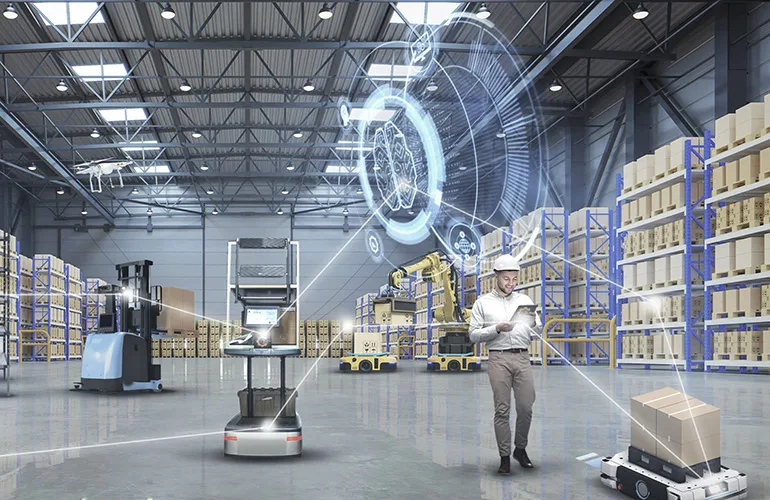
That's the question I keep coming back to after watching the logistics automation space for the better part of this decade. Companies spent billions, bought AMRs from a dozen vendors, bolted on conveyor systems, hired integrators, and ended up with something that looks like automation but runs like a traffic jam. The robots are fast. The coordination is a disaster.
I've seen this movie before. Different industry, same plot. In the late nineties, every enterprise bought a different ERP system, hired a different consulting firm, and then spent the next decade trying to get the pieces to talk to each other. The technology worked fine in isolation. The problem was always integration. Always. And here we are again, except this time the things that can't talk to each other are physically moving through the same building at the same time.
The warehouse automation industry has a multi-vendor problem, and it's not a small one.
Here's how it typically goes. A retailer or 3PL operator starts automating. They buy autonomous mobile robots from one vendor because that vendor had the best demo. They buy a warehouse management system from another vendor because that's what their ERP integrates with. They add some goods-to-person picking stations from a third vendor because a consultant recommended them. And then they hire human workers who are supposed to weave through all of this somehow.
None of these systems were designed to work together. They each have their own logic, their own task queues, their own definitions of what a "zone" or a "pick" or a "priority order" means. Getting them to cooperate requires custom middleware, expensive professional services engagements, and a lot of patience. And even then, the integration is fragile. Update one vendor's firmware, and suddenly the whole choreography breaks.
This is the problem that companies like Roboteon are trying to solve at a platform level. According to Mobile Robot Guide, Roboteon is showing at Automate how its AI platform synchronizes multi-vendor robotics and human workers to maximize warehouse productivity. The pitch is essentially an orchestration layer that sits above all the individual systems and coordinates them, including the humans, as a unified operation.
That's not a new idea. What's changed is that AI-driven orchestration is finally mature enough to handle the complexity in something close to real time, rather than relying on static rules that someone programmed in 2019 and nobody's touched since.
GreyOrange has been making a version of this argument for years. The Robot Report covered Akash Gupta's vision for what AI-driven warehouse software can actually become, and it's ambitious. The framing is that warehouses shouldn't be thought of as physical infrastructure with software bolted on, but as dynamic, predictive ecosystems where the software is the actual product and the robots are just the execution layer.
That's a meaningful reframe. And honestly, it's probably the right one. The robot hardware is commoditizing fast. AMRs from half a dozen vendors are now roughly comparable on specs. The differentiation is increasingly in the software: how well it predicts demand, how efficiently it routes tasks, how gracefully it degrades when something goes wrong, how quickly it adapts when you add a new robot type or change your SKU mix.
The companies that figure out orchestration at scale are going to have a serious competitive moat. The companies that don't are going to keep buying robots and wondering why their throughput numbers aren't improving.
Now, I'll be honest, this is based on a limited number of sources and I haven't seen Roboteon's platform in a live deployment. What exactly the AI is doing under the hood, and how well it actually handles edge cases in a real facility with 300 SKUs and a holiday peak season bearing down, remains unclear. Vendor demos are vendor demos. Call me old-fashioned, but I want to see the failure modes before I believe the pitch.
Here's the part that actually interests me most, and that most coverage of warehouse automation handles badly. These orchestration platforms aren't just coordinating robots. They're coordinating humans and robots together, in the same space, doing complementary tasks.
That's genuinely hard. Robots are predictable. Humans are not. A human worker might take a longer path to avoid a coworker, or stop to fix a mislabeled pallet, or call in sick and leave a zone understaffed. A static rules engine can't handle that gracefully. A well-designed AI orchestration layer, theoretically, can. It should be able to dynamically rebalance task assignments when human capacity changes, reroute robots around areas where workers are concentrated, and flag bottlenecks before they cascade into missed shipments.
Whether the current generation of platforms actually delivers on that in practice, in messy real-world warehouses rather than controlled pilots, is something we don't know yet. The honest answer is it's too early to say. The technology is promising. The deployments are still relatively early. The case studies tend to come from controlled conditions.
Some argue that the human-robot coordination problem is basically solved at this point, that the AI is good enough and the interfaces are mature enough that integration is now an engineering problem rather than a research problem. Others counter that the long tail of edge cases in real warehouse environments is still brutal, and that most platforms are more brittle than their marketing suggests. I've heard both from people who work in this space, and I don't think either side is entirely wrong.
I want to zoom out for a second because I think the warehouse automation space is actually a useful test bed for something bigger.
The multi-vendor coordination problem isn't unique to logistics. It's going to show up everywhere robots get deployed at scale. Manufacturing floors. Hospitals. Construction sites. Anywhere you have multiple autonomous systems from different vendors operating in shared physical space, you have the same fundamental problem: who's in charge, how do tasks get allocated, how do you prevent conflicts, how do you handle failures gracefully?
The companies solving this in warehouses right now are essentially building the playbook for every other sector. That's not nothing. Warehouses are actually a pretty good training ground because the environment is semi-structured, the tasks are relatively well-defined, and the stakes are high enough that operators have real incentive to make things work. It's harder than a lab, easier than a hospital, and the volume of deployments means you accumulate real-world data fast.
So when I watch Roboteon and GreyOrange and the handful of other companies working on multi-agent orchestration, I'm not just thinking about shipping boxes faster. I'm thinking about what the coordination layer for a world full of autonomous systems actually needs to look like. And the answer is increasingly clear: it needs to be software-first, AI-driven, vendor-agnostic, and capable of treating humans as first-class participants rather than afterthoughts.
The hype around warehouse robots has been thick for years, and a lot of it was deserved and a lot of it was nonsense. The honest picture is that the hardware got ahead of the software, operators bought more robots than they could effectively manage, and the industry is now in a consolidation and integration phase that's less exciting to write about but probably more important.
Orchestration platforms are the unglamorous but necessary infrastructure that makes the expensive hardware actually work. The young founders building these things don't always get the press coverage that humanoid robot companies do, and that's a shame, because the coordination problem is arguably harder than the locomotion problem at this point.
I've been covering tech long enough to know that the boring infrastructure layer is usually where the real value ends up. It happened in cloud computing. It happened in mobile. It's going to happen in robotics too. The platform that owns orchestration across a heterogeneous fleet, including the humans, is going to be worth a lot more than the robot that carries the box.
Whether Roboteon or GreyOrange or someone we haven't heard of yet wins that market, I genuinely don't know. But the problem they're solving is real, and it's not going away. If anything, it gets harder as more robots get deployed, more vendors enter the market, and the operational complexity keeps compounding.
Someone has to untangle this. Might as well be the people who've been thinking about it longest.