Crédito de imagen: Image via Source article. Used under fair use for news commentary. · source
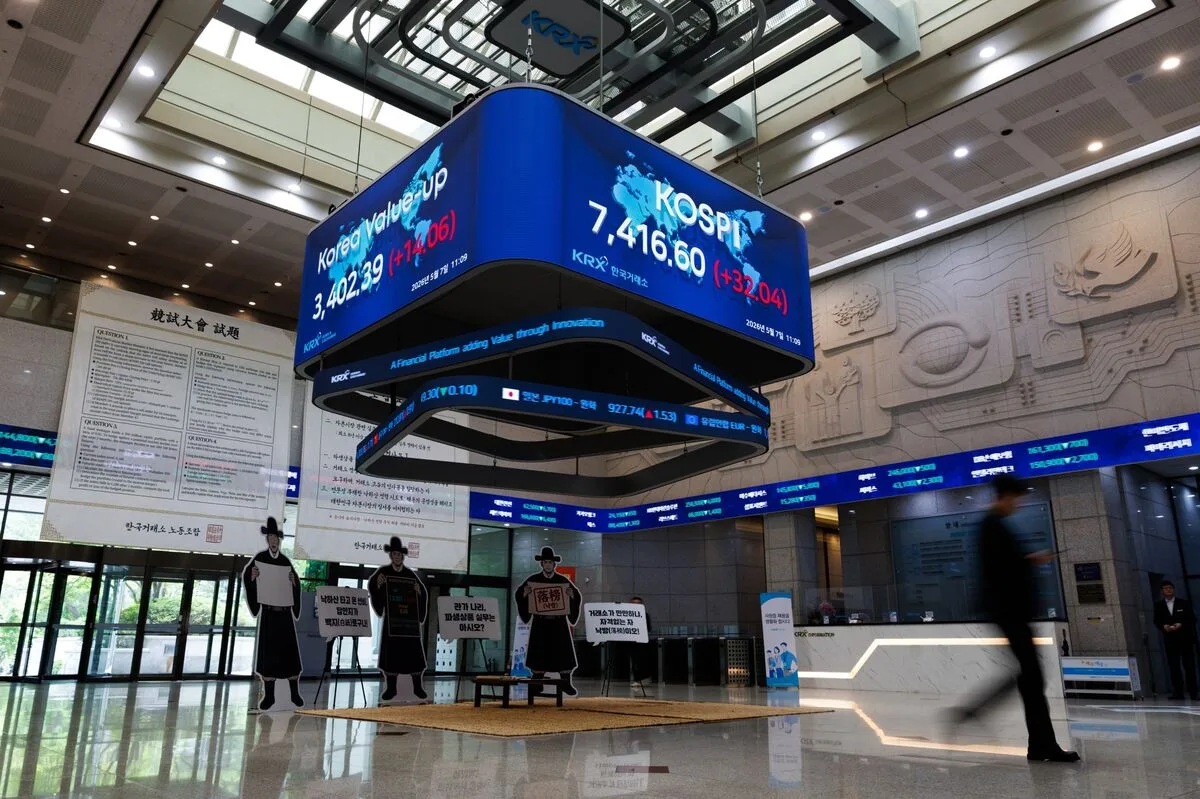
South Korea's equity market is now the sixth largest in the world, having just surpassed India. The driver isn't K-pop or electric vehicles. It's semiconductors, specifically the chips powering the global AI buildout.
According to Bloomberg, Korean chip heavyweights have pushed the country's market cap past India's in a surge that shows no signs of slowing. A separate Bloomberg analysis suggests Korean listed companies are now on track to generate more earnings than their Japanese counterparts this year.
For anyone covering robotics and automation, this isn't just a markets story. It's a supply chain story.
Look, I spent enough years sourcing components to know that market valuations eventually translate into R&D budgets, fab capacity, and product roadmaps. When Samsung and SK Hynix are riding a valuation wave, that money flows somewhere.
The AI chip demand fueling this surge is the same demand that's reshaping what's possible in robotics. High-bandwidth memory (HBM), advanced packaging, and inference-optimized silicon are all areas where Korean manufacturers have been investing heavily. SK Hynix, for instance, has been a key supplier of HBM for Nvidia's data center GPUs.
Here's what the numbers suggest:
Korean market cap has grown enough to leapfrog India (a country with 28x the population)
Earnings projections for Korean firms now exceed Japan's leading companies
Cobertura relacionada
More in Industrial
The Apple supplier priced its shares at the maximum and still had to turn away demand, which tells you something about where hardware money is flowing right now.
James Chen · 25 Jun · 5 min
Prime Day deals on Echos and Ring cameras are fine, but let's not confuse consumer gadgets with the serious robotics work happening in warehouses.
Robert "Bob" Macintosh · 25 Jun · 3 min
Amazon's CEO made his first India trip and left behind a $13 billion AI commitment and an aggressive quick-commerce expansion. The numbers are real. The execution is the hard part.
James Chen · 25 Jun · 6 min
A wave of arXiv preprints this week tackles one of manipulation's oldest problems: how do you get a robot to learn from imperfect, incomplete, or just plain missing data?
The primary driver is AI semiconductor demand, not diversified growth
That concentration is worth noting. This isn't broad industrial strength. It's a bet on one sector continuing to expand.
This is where things get more speculative, and I'll be honest, the data here is limited. But the logic chain isn't complicated.
When chip manufacturers are flush with capital and facing sustained demand, they expand production capacity. Samsung announced plans last year to increase advanced packaging output. SK Hynix has been scaling HBM production. These investments take 18 to 24 months to come online, but they're happening.
For robotics companies, this could mean:
Better availability of AI inference chips in the 2027-2028 timeframe
Continued pressure on legacy chip production as fabs prioritize advanced nodes
Potential price stabilization for edge AI components as supply catches up
The flip side is that memory and compute for non-AI applications might see less investment priority. If you're building industrial automation that doesn't need cutting-edge AI silicon, you might actually face tighter supply as older production lines get less attention.
I've seen this pattern before from my time in hardware. When one segment gets hot, resources shift. The question is whether Korean manufacturers will maintain enough legacy capacity for the broader automation market, or whether everyone gets pushed toward AI-capable (and AI-priced) components.
That's an ambitious question, and honestly, it's too early to say with confidence.
The bull case is straightforward: AI training and inference demand continues growing, data centers keep expanding, and Korean chipmakers remain essential suppliers. The earnings projections Bloomberg cites suggest analysts believe this trajectory holds through at least the end of the year.
The bear case involves the usual suspects. Geopolitical risk (Korean fabs aren't immune to regional tensions), cyclical semiconductor downturns, or a slowdown in AI infrastructure spending if the ROI story doesn't materialize for enterprise customers.
What I find interesting is the Japan comparison. Korean companies are now projected to out-earn Japanese peers, which represents a meaningful shift. Japan has historically dominated in industrial automation, precision manufacturing, and robotics. Korea's strength has been consumer electronics and memory chips.
If Korean earnings power translates into expanded industrial ambitions, we might see more competition in automation hardware. Samsung already makes industrial robots, though they're not a major player globally. Hyundai's acquisition of Boston Dynamics a few years back was an early signal of Korean interest in the space.
But let me be clear: market cap doesn't equal robotics capability. These are different competencies. The surge is about semiconductors, not mechanical engineering or control systems.
Capital allocation decisions. When chip profits roll in, where do Korean conglomerates invest? More fab capacity? Acquisitions? Diversification into adjacent hardware markets?
Memory pricing for edge devices. As HBM production scales, does that free up DRAM and NAND capacity for robotics applications? Or does everything get pulled toward data center demand?
Japanese competitive response. Tokyo has been pushing semiconductor subsidies and trying to rebuild domestic chip capacity. If Korean dominance accelerates, expect more aggressive Japanese industrial policy, which could benefit robotics manufacturers sourcing locally.
The market story is clear enough. Korea is having a moment, and it's built on AI chip demand. What remains unclear is whether that moment becomes a structural shift in Asian industrial power, or whether it's a cyclical peak that normalizes as supply catches up to demand.
For robotics hardware, the honest answer is: this matters, but indirectly. Better-funded chip manufacturers should eventually mean better components at better prices. But the timeline is uncertain, and the benefits aren't automatic.
I'll be watching the fab expansion announcements more closely than the stock tickers. That's where the real hardware story will play out.