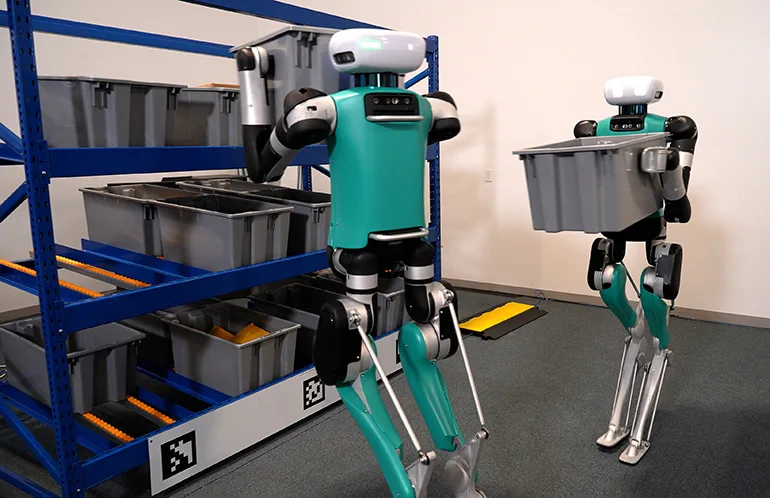
Two New Papers Want to Fix How Robots Plan Their Movements. Here's Why That Actually Matters.
Motion planning is one of those problems that sounds solved until you watch a robot arm get stuck. Two new research papers are taking very different approaches to unsticking it.
By
·16 June 2026·5 min de lectura
How hard is it, really, to teach a robot to move from point A to point B without hitting anything?
Honestly, I used to think this was basically a solved problem. You map the space, you find a path, you move. But the more I've read about motion planning, the more I've come to understand that it's one of those deceptively gnarly problems that sits underneath almost everything we want robots to do, whether that's a humanoid walking through a cluttered kitchen or a robot arm picking parts off a factory line.
Two papers dropped on arXiv recently that tackle this problem from completely different angles. Neither is claiming to have cracked it. But together they tell an interesting story about where the field is heading.
The first paper, from researchers whose work appeared on arXiv, focuses on something called semidefinite relaxations for collision-free motion planning. I'll be honest, the math here is not light reading. But the core idea is this: motion planning is a nonconvex problem, which means the standard optimization approaches can get trapped in local solutions that look good but aren't. The researchers reformulate the planning problem over polynomial curves and then apply a semidefinite relaxation, essentially converting a hard nonconvex problem into a convex one that's much easier to solve reliably.
The payoff is significant. Their method runs 10 to 100 times faster than standard nonlinear programming solvers like SNOPT and IPOPT, and it shows dramatically lower variance in solve times. That last part is underappreciated, tbh. A planner that's sometimes fast and sometimes inexplicably slow is a nightmare in real systems. Consistency matters.
Cobertura relacionada
More in Humanoids
The headlines are celebrating a $2.5B humanoid robotics deal. I'd pump the brakes a little.
Mark Kowalski · 25 Jun · 6 min
Sometimes the sources don't pan out. Here's what happened when I tried to write a humanoids story this week and ended up with Samsung deals instead.
Sarah Williams · 25 Jun · 3 min
Diffusion models are getting good at imagining robot movements, but 'imaginable' and 'physically possible' aren't the same thing. Researchers are starting to close that gap.
Sarah Williams · 25 Jun · 6 min
A batch of fresh robotics research tackles the same underlying problem from different angles: robots that can see but don't really understand where things are.
They also show something theoretically interesting: solving the relaxed convex problem is equivalent to solving a related planning problem to global optimality in a higher-dimensional space. And crucially, the size of the problem scales linearly with polynomial degree and doesn't blow up as the number of dimensions increases. They demonstrate it working as a steering function inside an RRT planner for quadrotor trajectory planning with smooth, C4-continuous paths.
The second paper, also from arXiv, takes a different route entirely. It's focused on robotic manipulators, specifically the problem of planning in high-dimensional configuration spaces where traditional methods tend to get stuck.
The paper introduces what the authors call CDF-MPPI, a framework that combines Configuration Space Distance Fields with Model Predictive Path Integral control. Standard motion planners often rely on signed distance fields in workspace coordinates, which can fail when gradients vanish near obstacles. CDFs instead model distances directly in the robot's configuration space, which means they're differentiable almost everywhere and give you reliable gradient information even in tricky situations.
MPPI is a sampling-based control method that normally requires a huge number of trajectory samples and expensive collision checks. The clever bit here is that by incorporating CDF gradients, the authors reduce the planning horizon to a single step, which cuts computation dramatically while still maintaining collision avoidance. The result: control frequencies exceeding 750 Hz on a 7-DOF Franka manipulator, which comfortably outperforms both optimization-based baselines and standard MPPI approaches. Success rates in complex simulation environments are consistently high, approaching 100% in 2D environments.
You might be wondering why any of this matters outside of a robotics lab. Fair question.
Motion planning is genuinely one of the bottlenecks for deploying capable robots in real environments. It's not the only bottleneck, and I don't want to oversell it, but a robot that can't reliably navigate around obstacles or that freezes up when its planner gets stuck in a local minimum isn't going to be useful for much. The humanoids being deployed in warehouses right now, the surgical robots, the manipulation systems in manufacturing, they all depend on this layer working well.
What's interesting about these two papers is that they're not competing approaches so much as complementary ones. The semidefinite relaxation work is elegant and theoretically grounded, with a clear geometric interpretation of why it works. It seems well-suited to planning problems where you want provably good solutions and can afford to think carefully about the problem structure. The CDF-MPPI approach is more about making real-time control work in complex, high-dimensional spaces, where you need speed and robustness above all else.
I initially thought the semidefinite approach sounded too abstract to have near-term practical impact, but after reading more carefully, the speed improvements are concrete enough that it could genuinely slot into existing planning pipelines. It remains unclear how either method performs outside of simulation and controlled benchmarks, though. That gap between lab results and real-world deployment is still very much an open question.
Both papers are at the research stage, so it's too early to say when or whether these specific techniques will show up in deployed systems. Robotics research has a long pipeline.
But the direction is clear. The field is moving away from planners that are either fast-but-unreliable or reliable-but-slow, toward methods that try to be both. The semidefinite relaxation paper's emphasis on variance reduction is a signal of that shift. The CDF-MPPI paper's 750 Hz control frequency is another.
There are still real limitations here. Both papers are based primarily on simulation results. The semidefinite approach is demonstrated on a conceptually simplified setting, a point robot moving through spherical obstacles, which captures the mathematical hardness of the problem but is still a long way from a humanoid navigating a real kitchen. The CDF-MPPI results are more applied, but simulation environments, however complex, aren't the same as the physical world.
I think the honest takeaway is that motion planning is getting meaningfully better, in ways that aren't always visible from the outside. It's not dramatic. Nobody's announcing a product launch. But the foundational work that makes future robots more capable is happening, paper by paper, in exactly this kind of research.
This raises questions about how quickly these improvements actually propagate into deployed systems, and who benefits first. Well, that's probably a whole separate article.