Two New Papers Show Why Humanoid Robots Still Can't Carry Your Groceries (And What Might Fix That)
Researchers are finally tackling the boring-but-brutal problem of making robots handle heavy stuff without falling over.
By
·4 June 2026·5 min de lectura
Here's a question I've been sitting with lately: why can a toddler carry a gallon of milk from the fridge to the table, but a million-dollar humanoid robot struggles with the same task?
Two papers dropped this week that actually try to answer this, and honestly, they reveal just how far we still have to go before humanoids can do useful work in our homes and warehouses.
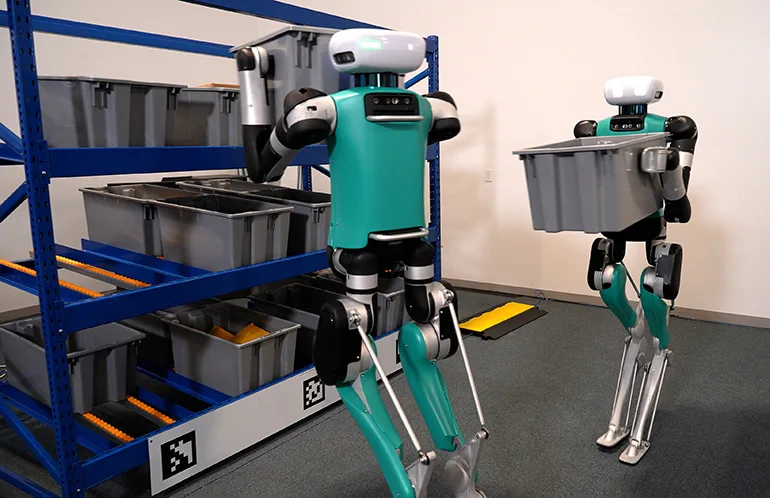
The heavy lifting problem is harder than it looks. The first paper, SplitAdapter from researchers on arXiv, tackles something called "loco-manipulation" (walking while carrying stuff, basically). The issue isn't just that robots need to balance. It's that the weight of what they're carrying changes everything about how they need to move, and current AI systems kind of... panic when conditions shift.
I initially thought this was a solved problem. Like, we have Boston Dynamics videos of robots doing backflips, right? But there's a huge gap between a choreographed demo and a robot that can pick up a 2kg box, then a 6kg box, then put them on shelves at different heights, all without retraining. That gap is what SplitAdapter is trying to bridge.
The clever bit here is something called "factorized adaptation." Instead of cramming all the robot's situational awareness into one neural network blob (which is what most systems do), they split it into separate modules. One tracks the object and its weight. Another tracks the robot's own body dynamics. The paper claims this separation is what lets the system handle heavier loads without degrading, which makes intuitive sense. You don't solve two different problems with one tool.
Cobertura relacionada
More in Humanoids
The headlines are celebrating a $2.5B humanoid robotics deal. I'd pump the brakes a little.
Mark Kowalski · 25 Jun · 6 min
Sometimes the sources don't pan out. Here's what happened when I tried to write a humanoids story this week and ended up with Samsung deals instead.
Sarah Williams · 25 Jun · 3 min
Diffusion models are getting good at imagining robot movements, but 'imaginable' and 'physically possible' aren't the same thing. Researchers are starting to close that gap.
Sarah Williams · 25 Jun · 6 min
A batch of fresh robotics research tackles the same underlying problem from different angles: robots that can see but don't really understand where things are.
In their tests, SplitAdapter showed the biggest improvements under heavy-load conditions (6kg objects at 60cm placement height). The base policy they compared against basically fell apart at those weights. I should note that "heavy" here means 6 kilograms, roughly 13 pounds. That's a bag of flour. We're not talking about moving furniture.
The data problem underneath everything. The second paper is more ambitious and, tbh, more interesting to me. LDA-1B is trying to build what the authors call a "robot foundation model" by ingesting basically every kind of robot and human movement data they could find.
You might be wondering why robots need to learn from human videos. The answer is that robot training data is incredibly expensive to collect. Every hour of a robot trying and failing to pick up cups costs real money in hardware, supervision, and time. Human videos are basically free by comparison, and humans are really good at manipulating objects.
The problem is that human bodies and robot bodies are, well, different. You can't just show a humanoid robot a YouTube video of someone folding laundry and expect it to figure things out. The dynamics don't transfer cleanly.
LDA-1B's approach is to learn in what they call a "structured DINO latent space" (DINO being a self-supervised vision model). The idea is to strip away the pixel-level details that don't matter (what color is the cup, what's the background) and focus on the underlying physics of how objects move and interact. This lets them train on a dataset they assembled called EI-30k, which contains over 30,000 hours of human and robot trajectories.
Thirty thousand hours. That's about 3.4 years of continuous video. And they're claiming this is still not enough for truly general manipulation.
What actually improved. The results are interesting but need context. LDA-1B reportedly outperformed prior methods (including π₀.₅, which was a previous state-of-the-art system) by:
21% on contact-rich tasks
48% on dexterous tasks
23% on long-horizon tasks
Those percentages sound impressive, but I couldn't find absolute success rates in the abstract. A 48% improvement over a baseline that succeeds 20% of the time is still only around 30% success. That's not good enough for real deployment. The paper might have better numbers buried in the full text, but this is based on limited data from what's publicly available.
One thing that did catch my attention: they claim LDA-1B can actually use low-quality training data that other systems would have to throw away. Specifically, they saw a 10% improvement by incorporating trajectories that were "typically harmful and discarded." If that holds up, it could meaningfully reduce the cost of training these systems.
The sim-to-real gap remains unclear. Both papers mention sim-to-real transfer, which is the process of training a robot in simulation and then deploying it on physical hardware. This is where a lot of impressive-looking research falls apart.
SplitAdapter claims "real-world deployment" but the details on how well it actually works on a physical robot are sparse in the abstract. LDA-1B mentions "experiments in simulation and the real world" but again, I'd want to see the full breakdown before getting excited.
Honestly, I'm not sure either of these papers represents a breakthrough. What they do represent is incremental progress on problems that need to be solved before humanoids can do anything useful. The manipulation problem isn't glamorous. It doesn't make for good demo videos. But it's the reason your Optimus robot isn't folding your laundry yet.
Where this leaves us. I think we're in a weird moment for humanoid robotics. The hardware is arguably good enough for basic tasks. The control systems for walking and balancing have improved dramatically. But the manipulation piece, actually doing useful work with hands, remains stubbornly difficult.
These papers suggest the path forward involves both better architectures (like SplitAdapter's factorized approach) and better data utilization (like LDA-1B's universal ingestion). Neither is sufficient alone. You need robots that can adapt to varying conditions AND you need enough diverse training data to cover those conditions.
The timeline for when this all comes together? Remains unclear. I've seen estimates ranging from two years to never, depending on who you ask. What I can say is that the research community is at least working on the right problems now, even if the solutions aren't here yet.
That toddler with the milk jug is still winning, for now.