Robots Are Learning to Wave Their Hands When They Talk. Here's Why That's Harder Than It Sounds.
Two new papers tackle the problem of getting humanoid robots to gesture naturally during speech. It's a genuinely hard problem, and the solutions are more clever than the demos let on.
By
·18 June 2026·6 min de lectura
Picture a humanoid robot standing in front of you, explaining something. It's talking. The words are fine. But the arms hang there like wet laundry, or worse, they flail at completely the wrong moments, emphasizing syllables that don't need emphasizing, frozen when the sentence peaks. You notice it immediately. It's wrong in a way that's hard to articulate but impossible to ignore.
That's the gesture synchronization problem, and two research groups just published papers trying to solve it. I've been covering tech since the nineties and I've watched a lot of "natural interaction" promises come and go, but I'll give these teams credit: they're working on something genuinely difficult, and the approaches are worth understanding.
When humans talk, we gesture constantly, and those gestures aren't random. They peak, physically, at the exact moment of speech emphasis. You don't raise your hand after you say the important word. You raise it with the word, or just before. This is called co-speech gesture synchronization, and it happens unconsciously in humans after years of embodied social learning.
For robots, this is a coupled problem: you need to know which words matter (semantics), you need to plan a gesture that fits those words (motion planning), and you need to execute that gesture so it peaks at exactly the right millisecond (timing), all while the robot's actual physical body is imposing hard limits on how fast and how far it can move. A virtual avatar can cheat. A physical robot with joint torque limits and collision constraints cannot.
Two papers, both out on this week, attack this from different angles.
Cobertura relacionada
More in Humanoids
The headlines are celebrating a $2.5B humanoid robotics deal. I'd pump the brakes a little.
Mark Kowalski · 25 Jun · 6 min
Sometimes the sources don't pan out. Here's what happened when I tried to write a humanoids story this week and ended up with Samsung deals instead.
Sarah Williams · 25 Jun · 3 min
Diffusion models are getting good at imagining robot movements, but 'imaginable' and 'physically possible' aren't the same thing. Researchers are starting to close that gap.
Sarah Williams · 25 Jun · 6 min
A batch of fresh robotics research tackles the same underlying problem from different angles: robots that can see but don't really understand where things are.
The first paper, from the PAIRS Lab, introduces a framework called WaveSync. The core idea is elegant. A large language model reads the dialogue response and does two things: it breaks the text into what the authors call a "structured semantic schema," and it assigns importance weights to individual words. Those weights form what they call a Semantic Importance Wave, basically a continuous curve that rises and falls with the emphasis structure of the sentence.
Gesture trajectories are then shaped using Dynamic Movement Primitives, a well-established technique in robotics for generating smooth, parameterizable motions. The trick is aligning the peaks of the gesture trajectory with the peaks of the Semantic Importance Wave, which is the "Wavefront Optimization" step. When the alignment still violates kinematic constraints (which it often does), the system compresses gesture duration and propagates those adjustments forward through the sequence.
They tested across five dialogue scenarios and compared against three baselines. WaveSync outperformed all three on both objective synchronization metrics and subjective human evaluations. That's a solid result, though I'll note that five scenarios is a limited sample and it remains unclear how the system scales to longer, more complex conversations with rapidly shifting topics.
Code and videos are up on GitHub, which I appreciate. Put your work out there. Let people poke at it.
The second paper takes a different route, and in some ways a more pragmatic one. The team integrated ChatGPT directly into SoftBank's Pepper robot to generate co-speech gestures from natural language at runtime. No pre-baked animation library, no expert-authored motion sequences. Just the LLM generating gesture code on the fly.
The catch, which the authors are upfront about, is that the baseline LLM-generated gestures were stiff and unnatural. So they layered in an iterative reinforcement learning from human feedback system, RLHF, where users evaluated Pepper's gestures and that feedback was used to fine-tune the generation over multiple rounds. The results showed meaningful improvement in perceived expressiveness and fluidity.
This is the second arXiv paper this week on the topic, and it's worth reading alongside WaveSync because the philosophies are different. WaveSync is more engineered, more structured, more top-down. The Pepper paper is more adaptive, more data-driven, more willing to let human preferences guide the output. Both have tradeoffs.
The RLHF approach is genuinely interesting because it sidesteps the problem of defining "naturalness" formally, which is actually very hard to do. But it also raises questions about... well, multiple things: whose preferences are being encoded, how many feedback iterations you need before you've overfit to a small evaluator pool, whether the improvements generalize beyond the specific scenarios users rated.
Here's where I'll get a little grumpy, because I've seen this movie before. Gesture generation for social robots has been a research topic for at least fifteen years. Papers come out, demos look impressive, and then the robots show up in the real world and people stop noticing the gestures within about forty seconds because they're trying to actually accomplish a task.
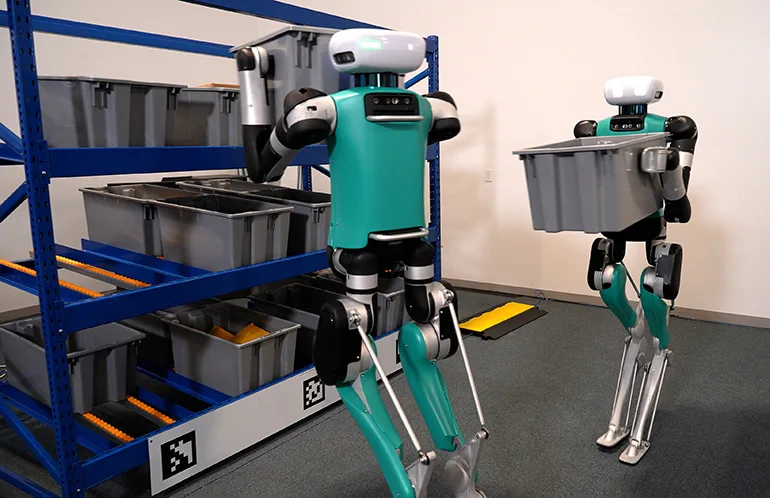
That said, I think the timing is different now, and not just because LLMs make the semantic analysis dramatically better than it was in 2010. The actual deployment context is changing. Humanoid robots are showing up in warehouses, retail environments, care settings, places where sustained human-robot interaction over extended periods is actually happening, not just in controlled lab demos. In those settings, gesture naturalness probably does affect long-term acceptance and trust in ways that matter.
The WaveSync paper is particularly relevant here because it takes hardware constraints seriously from the start. It's not generating gestures for an avatar and hoping a robot can execute them. It's designing the whole pipeline around kinematic feasibility. That's the right instinct for anyone who actually wants to see this work in the field.
The RLHF approach on Pepper is interesting in a different way. Pepper is, let's be honest, a fairly limited platform with a small number of degrees of freedom, and getting natural gesture generation on a constrained robot is arguably more practically useful right now than getting it working on a highly capable humanoid that most organizations can't afford or maintain.
No. Not even close, call me old-fashioned, but I think the honest answer here is that we're making real progress on a genuinely hard subproblem while the larger problem of natural human-robot interaction remains stubbornly difficult.
Both papers are good work. WaveSync's peak-to-peak synchronization approach is clever and the results are convincing within their scope. The RLHF paper on Pepper demonstrates that iterative human feedback can meaningfully improve LLM-generated motion, which is a useful finding that probably generalizes beyond just gestures.
What neither paper fully addresses is the question of gesture diversity over long interactions. Humans don't repeat the same gesture shapes over and over during a conversation. We vary. We adapt to the listener. We do things that are slightly idiosyncratic and personal. Getting robots to do that, at the level where it doesn't feel repetitive across a thirty-minute interaction, is still an open problem, and it's too early to say whether LLM-based approaches will crack it or just make the repetition feel slightly more varied.
But these are young researchers working on the right problems with better tools than anyone had a few years ago. I can be skeptical about the hype cycle and still respect the work. Both things are true.
If you want to argue about it, my email's on the about page.