NEURA Robotics Raises $1.4B Series C, But the Real Story Is What 'Physical AI' Actually Means
The headlines are fixating on Tether's involvement. The more interesting question is whether NEURA's platform ambitions are genuinely novel or just well-funded incrementalism.
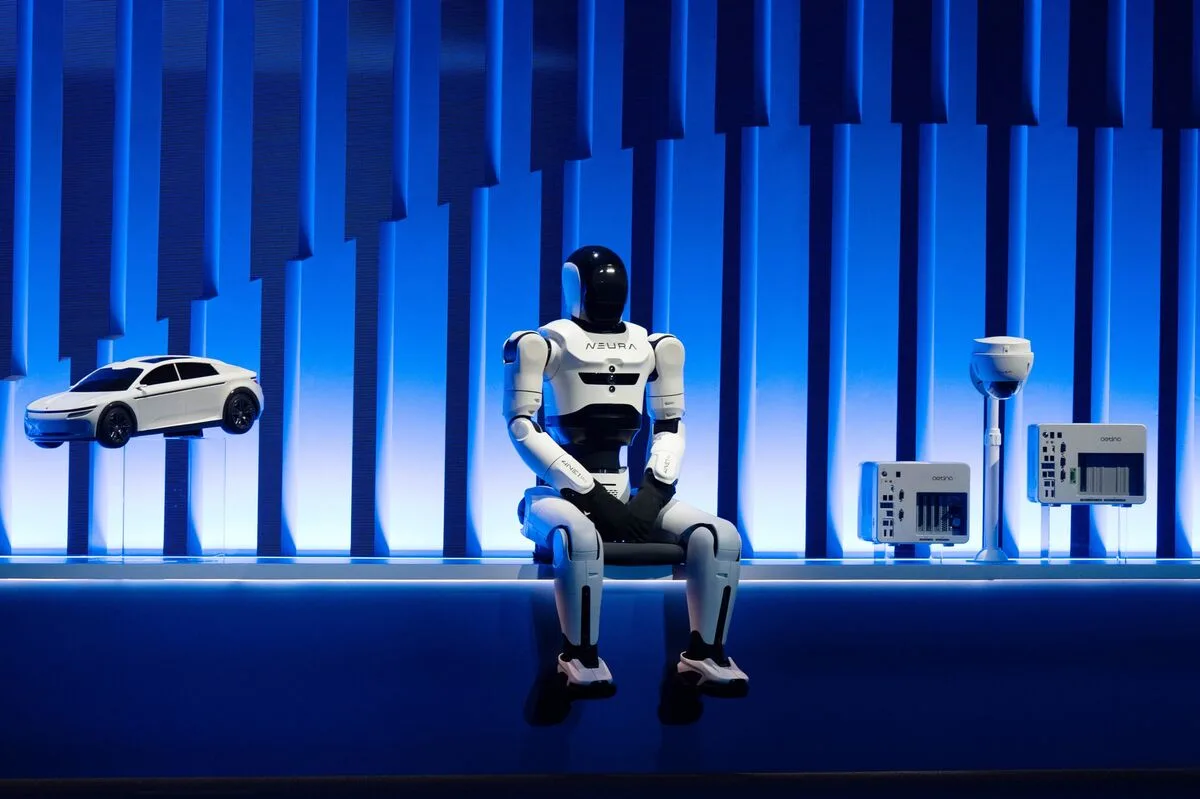
Crédito de imagen: Image via Bloomberg — Technology. Used under fair use for news commentary. · source
Most of the coverage of NEURA Robotics' latest funding round has led with the Tether angle. A stablecoin issuer backing a German humanoid robotics startup is, admittedly, a strange enough pairing to generate clicks. But fixating on the investor obscures the more substantive question: what exactly is NEURA building, and does the "physical AI" framing represent something genuinely new, or is it a repackaging of ideas that have been circulating in the robotics research community for several years now?
To be precise, this distinction matters enormously. At this scale of capital, $1.4 billion according to both The Robot Report and Bloomberg, the framing is not just marketing. It shapes what gets built, what gets prioritized in the research pipeline, and ultimately whether the field moves forward or just moves money around.
The phrase "physical AI" has been gaining traction in industry communications over the past 18 months or so, and NEURA is not alone in using it. NVIDIA has leaned heavily on the term in the context of its robotics platform work. The basic idea is that intelligence should be embodied and grounded in physical interaction with the world, rather than operating purely in the symbolic or language domain.
This is not, it should be said, a new idea. Rodney Brooks was making essentially this argument in the late 1980s with his subsumption architecture work, and the embodied cognition literature in cognitive science predates the current wave of foundation models by decades. What is arguably new, or at least newer, is the combination of large-scale learned representations with physical robotic systems that can act in unstructured environments. The question is whether NEURA's specific approach adds something meaningful to what Boston Dynamics, Figure, 1X, Agility, and a growing list of others are already pursuing.
Cobertura relacionada
More in Humanoids
The headlines are celebrating a $2.5B humanoid robotics deal. I'd pump the brakes a little.
Mark Kowalski · 25 Jun · 6 min
Sometimes the sources don't pan out. Here's what happened when I tried to write a humanoids story this week and ended up with Samsung deals instead.
Sarah Williams · 25 Jun · 3 min
Diffusion models are getting good at imagining robot movements, but 'imaginable' and 'physically possible' aren't the same thing. Researchers are starting to close that gap.
Sarah Williams · 25 Jun · 6 min
A batch of fresh robotics research tackles the same underlying problem from different angles: robots that can see but don't really understand where things are.
The company's stated focus on robot learning platforms and global production of humanoids and other systems (the "other systems" framing is worth noting, since it suggests they are not purely committed to the humanoid form factor) positions them somewhere between a hardware manufacturer and a platform company. That is a difficult position to occupy. It requires excellence in both domains simultaneously, and the history of robotics is littered with companies that were reasonably good at one and struggled badly with the other.
This raises questions about... well, multiple things. Tether Holdings, the issuer of the USDT stablecoin, is not a typical deep tech investor. The company has faced persistent scrutiny over the years regarding its reserve auditing practices and regulatory standing in various jurisdictions. Whether that history is relevant to NEURA's technical trajectory is debatable, but it is not irrelevant to questions about governance, long-term stability of the funding relationship, and the strategic motivations behind the investment.
It remains unclear what Tether's specific strategic rationale is here. Bloomberg's reporting confirms the backing but does not provide much detail on board representation, follow-on commitments, or what Tether expects to get from the relationship beyond financial returns. That opacity is not unusual for early-stage funding rounds, but at $1.4 billion, this is not a seed check. The terms matter, and we do not have them.
I am not suggesting there is anything improper about the arrangement. I am suggesting that the robotics press should probably be asking harder questions about it than most outlets currently are.
This is where I have to be honest about the limits of what is publicly available. NEURA's technical publications are sparse compared to, say, the research output coming out of groups affiliated with Figure or the academic labs that feed into 1X. The company has demonstrated its MAiRA humanoid platform, and there is publicly available video of the robot performing manipulation tasks, but peer-reviewed documentation of the underlying learning architecture is, to my knowledge, limited.
It's worth noting that this is not unique to NEURA. The entire humanoid robotics space has a significant gap between what companies demonstrate in controlled environments and what they publish in venues where methodology can be scrutinized. The demonstrations are often compelling. The papers that would let researchers evaluate the generalization claims, the data requirements, the failure modes, are frequently absent or delayed.
The "robot learning platforms" framing in NEURA's expansion plans is interesting because it suggests they want to be infrastructure, not just a product company. If they are building something analogous to what DeepMind's robotics team has been pursuing with data collection and model training pipelines, or what Physical Intelligence (Pi) is doing with policy learning across diverse robot morphologies, that would be genuinely significant. Platform plays in robotics are hard but potentially more durable than single-product plays. But the sample size of companies that have successfully executed on that vision is small, and none of them have done it at the scale NEURA appears to be targeting.
The global production ambition is also worth scrutinizing. Scaling humanoid manufacturing is a problem that combines all the difficulty of precision hardware production with the additional complication that the software and hardware are deeply co-dependent in ways that make iteration expensive. Tesla's struggles with Optimus production timelines, which have been well-documented even within the company's own communications, are instructive here. Capital helps, but it does not solve the fundamental engineering and supply chain challenges.
Probably both, and it is worth separating the two.
At the field level, a $1.4 billion Series C for a humanoid robotics company reflects a broader pattern of very large capital flows into the space. Figure raised $675 million in early 2024. 1X Technologies closed a $100 million Series B. Physical Intelligence raised $400 million. The aggregate numbers are substantial, and they suggest that institutional and strategic investors have, for now, concluded that humanoid robotics is approaching a threshold where commercial deployment is plausible within a five to ten year horizon.
Whether that conclusion is correct is genuinely uncertain. The optimistic case rests on the idea that foundation models trained on internet-scale data can be adapted for physical manipulation with relatively modest amounts of robot-specific training data, and that this adaptation problem is now tractable in ways it was not five years ago. There is some evidence for this view, particularly from work on vision-language-action models like RT-2 from Google DeepMind and subsequent work building on that architecture. The pessimistic case, which I find myself partially sympathetic to, is that the gap between laboratory manipulation performance and reliable real-world deployment remains much larger than the funding rounds imply, and that the current investment wave is partly driven by FOMO dynamics rather than a clear-eyed assessment of technical readiness.
At the NEURA-specific level, the round is a signal that the company has convinced sophisticated (or at least well-resourced) investors that its approach is credible. That is meaningful, but it is not the same as technical validation. Investors are not peer reviewers.
I know I am being picky here, but this is precisely the kind of question the field needs to ask more consistently. A few things would substantially increase my confidence in NEURA's platform ambitions.
First, published methodology on their learning architecture. Specifically, how are they handling the distribution shift problem between training environments and deployment environments? This is one of the central unsolved challenges in robot learning, and the approaches vary significantly in their scalability and robustness. Are they using simulation-to-real transfer? If so, what is their sim-to-real gap, and how are they measuring it? Are they doing large-scale real-world data collection? If so, what does that infrastructure look like, and how does it compare to what groups like Chelsea Finn's lab at Stanford or Sergey Levine's group at UC Berkeley have published on scalable robot learning?
Second, independent replication or at least third-party evaluation of their manipulation benchmarks. The robotics community has made progress on standardized evaluation through efforts like the Open X-Embodiment dataset and associated benchmarks, and it would be useful to see how NEURA's systems perform on those.
Third, more transparency on the "other systems" beyond humanoids. If NEURA is genuinely building platform infrastructure that generalizes across morphologies, that is a harder problem than humanoid-specific learning, but also potentially more valuable. What does that generalization actually look like in practice?
None of this is to say that NEURA is not doing interesting work. It may well be. The company has been operating since 2019, has a team with apparent depth in both hardware and software, and has secured enough capital to pursue ambitious research programs. The German engineering ecosystem it is embedded in has real strengths in precision manufacturing and systems integration.
But "physical AI" as a term does a lot of work to suggest a conceptual breakthrough that may or may not be present in the underlying technical approach. The research community has seen this pattern before. Large funding rounds, compelling demonstrations, ambitious platform rhetoric, followed by a slower and more incremental reality once the engineering constraints assert themselves. That is not a prediction about NEURA specifically. It is a description of how the field tends to develop.
The $1.4 billion will buy NEURA significant runway to prove the thesis. Whether they use it to produce research that advances the field's understanding of physical AI, or whether it produces a well-funded product company that eventually finds a niche without reshaping the underlying science, is a question that will take several years to answer. It is too early to say which trajectory is more likely.