SpaceX's $75 Billion IPO Is the Biggest Ever. Wall Street's Getting Paid Anyway.
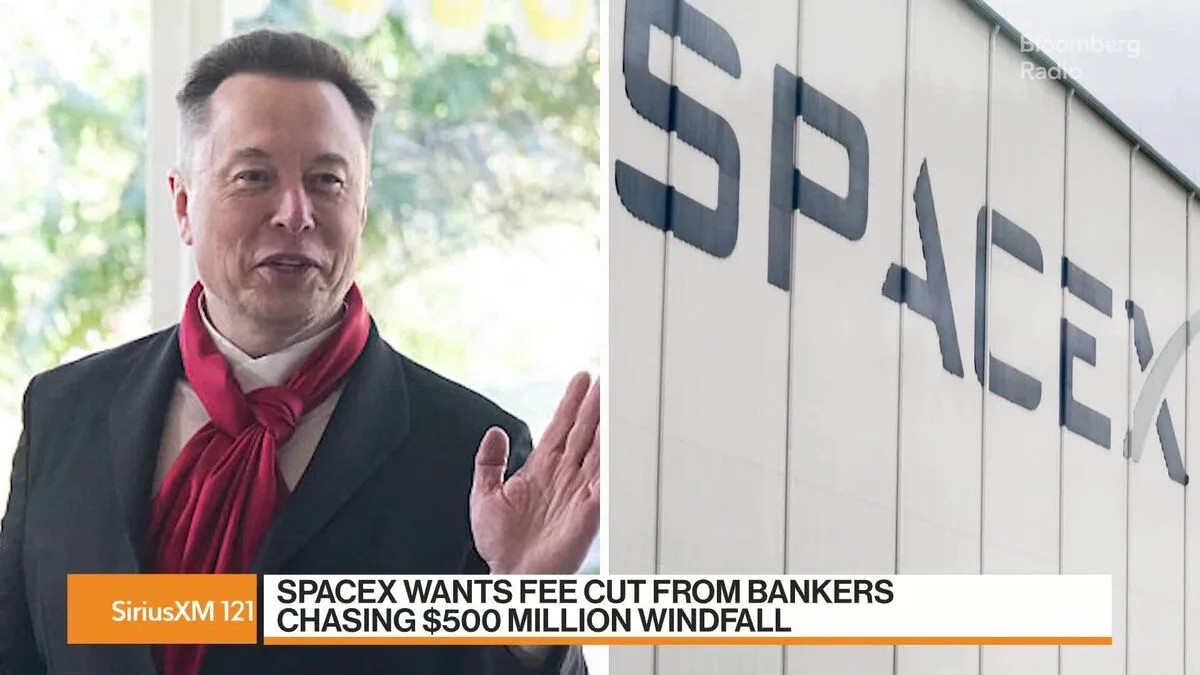
Musk is squeezing bankers on fees, but when you're raising this much money, even crumbs add up to $500 million.
Crédito de imagen: Image via Source article. Used under fair use for news commentary. · source
I've been watching tech IPOs since the dot-com days, back when we thought Pets.com was going to revolutionize how Americans buy kibble. And I'll tell you something: I've never seen anything quite like what SpaceX is pulling right now.
The company, which at this point is really a rocket-satellite-AI conglomerate wearing a spacesuit, is planning to raise $75 billion in what would be the largest initial public offering in history. That's not a typo. Seventy-five billion dollars. They're pricing shares at $135 apiece, planning to sell about 555.6 million of them, and they've decided to skip the whole song-and-dance where bankers spend weeks "discovering" what price the market will bear.
Musk just told them the price. Take it or leave it.
The fee fight
Here's where it gets interesting, at least if you find Wall Street fee structures interesting (and if you don't, well, you probably stopped reading already). According to Bloomberg, SpaceX is negotiating to pay less than 0.75% to the banks handling this deal. That's razor-thin by industry standards.
But here's the thing about percentages: when the underlying number is enormous, even a sliver becomes a feast. At 0.75% of $75 billion, we're talking about roughly $500 million flowing to Goldman Sachs, Morgan Stanley, and the 21 other banks who've attached themselves to this rocket. Goldman and Morgan, as lead underwriters, will take the biggest chunks.
So yes, Musk is squeezing them. And yes, they're still going to make a fortune. Call me old-fashioned, but I find something almost comical about bankers complaining about fee compression while they're splitting half a billion dollars for what amounts to, well, making phone calls and sending PDFs.
Cobertura relacionada
More in Autonomy
The defense startup is betting big on autonomous aircraft and strike systems, but the real question is whether it can actually deliver at scale.
James Chen · 18 hours ago · 4 min
Two new papers show how BEV-based odometry could solve some of the hardest problems in planetary and terrestrial robot navigation.
James Chen · Yesterday · 4 min
Researchers are finding ways to squeeze LiDAR-quality 3D detection out of cheap, weather-proof radar sensors. The results are promising, but production-ready is another story.
James Chen · Yesterday · 3 min
Research from separate teams tackles the same problem: when standard cameras fail, robots need backup plans that actually work in the real world.