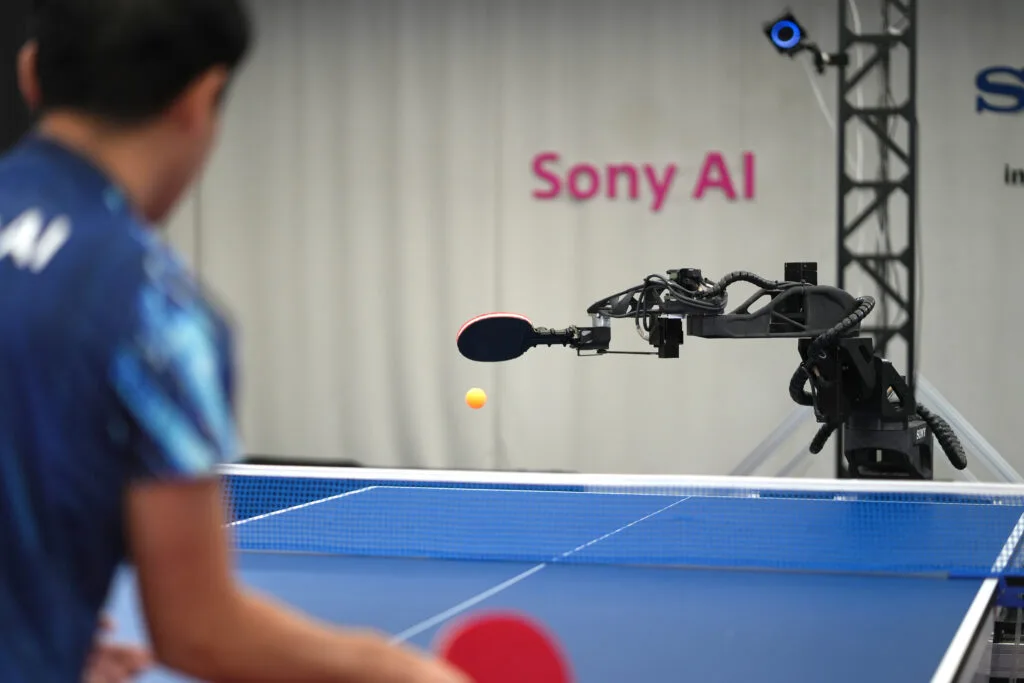
Sony's table tennis robot just beat elite human players. Here's why that actually matters.
Ace isn't just a party trick — it's a glimpse at how robots might finally learn to handle the messy, unpredictable physical world.
Bildnachweis: Image via Robohub. Used under fair use for news commentary. · source
Remember when DeepMind's AlphaGo beat Lee Sedol in 2016? The whole world lost its collective mind. A machine had conquered one of humanity's most complex strategic games. But here's the thing I kept thinking at the time: Go is a board game. The pieces don't move on their own. There's no wind, no wobble, no opponent faking you out with body language. The physical world? That's a whole different beast.
So when I read that Sony AI's table tennis robot, Ace, just beat elite human players in competitive matches, my first reaction wasn't "cool demo." It was "wait, how?"
The gap between digital and physical AI has always been enormous. Chess engines have been superhuman for decades. Large language models can write poetry and debug code. But ask a robot to fold a towel? Catch a ball thrown at an unexpected angle? We've been stuck on that stuff for years. The physical world is messy, fast, and unforgiving in ways that simulations can never fully capture.
Table tennis sits right at the intersection of everything that's hard about embodied AI. The ball travels at speeds up to 9 meters per second. You've got maybe 200 milliseconds to perceive, decide, and act. And unlike chess, you can't pause to think. The physics are chaotic (spin, anyone?), and your opponent is actively trying to deceive you.
Ace, according to the Nature paper published this week, didn't just play competently. It won against players ranked in the top 0.01% globally. We're talking about people who've dedicated their lives to this sport.
I initially thought this might be another case of cherry-picked demos, tbh. You know the drill: robot does impressive thing under perfect lab conditions, falls apart the moment something unexpected happens. But the evaluation setup here seems more rigorous than usual. The matches happened in December 2025 against multiple elite players, including Yamato Kawamata, under what appear to be standard competitive conditions.
Verwandte Beiträge
More in Humanoids
The headlines are celebrating a $2.5B humanoid robotics deal. I'd pump the brakes a little.
Mark Kowalski · 25 Jun · 6 min
Sometimes the sources don't pan out. Here's what happened when I tried to write a humanoids story this week and ended up with Samsung deals instead.
Sarah Williams · 25 Jun · 3 min
Diffusion models are getting good at imagining robot movements, but 'imaginable' and 'physically possible' aren't the same thing. Researchers are starting to close that gap.
Sarah Williams · 25 Jun · 6 min
A batch of fresh robotics research tackles the same underlying problem from different angles: robots that can see but don't really understand where things are.