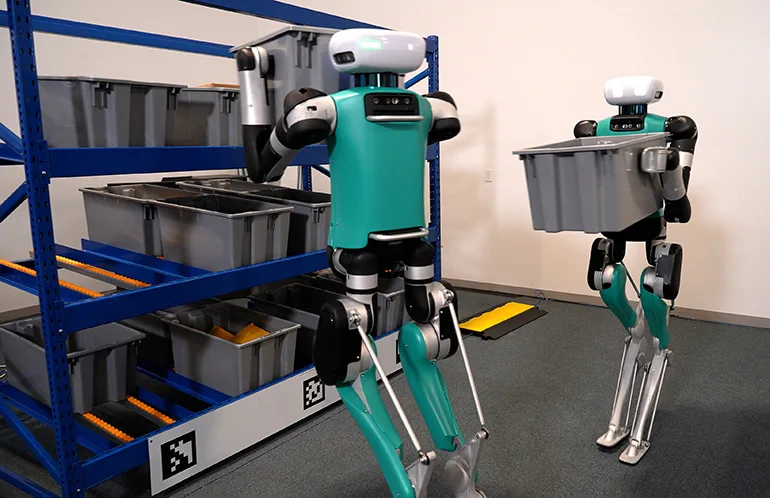
Humanoids Are Finally Learning to Pick Themselves Up. About Time.
Two new papers show robots recovering from falls on rough terrain. I've been waiting 15 years for this.
By
Is anyone else tired of watching humanoid demos where the robot only walks on perfectly flat concrete?
I'll be honest, when I was at Kuka we used to joke that bipedal robots were "demo queens." They'd strut around a trade show floor, maybe wave at the camera, then get packed back in foam before anyone could see them trip on a cable. The real world has gravel. It has slopes. It has that weird transition between carpet and tile that somehow defeats half the mobile platforms I've ever worked with.
So when two papers dropped this month showing humanoids actually recovering from falls on mixed terrain, I sat up. This is the kind of work that matters.
The Kuka Days and Why Falls Matter
Back in maybe 2014, I watched a colleague spend three months on fall detection for a mobile manipulator. Not recovery, mind you, just detection. The idea of actually getting back up was, well, we didn't talk about it much. The assumption was always that a human would intervene. That's fine in a factory with operators on every shift. It's useless if you're trying to deploy these things in warehouses, construction sites, or anywhere that isn't a controlled environment.
The first paper, from a team working with Unitree's G1, tackles what they call "Phase-Terrain Decoupled Learning" (arXiv). The basic idea is that you train the robot to handle different surfaces (flat ground, gravel, slopes up to 20 degrees) but you don't tell the deployed policy which surface it's on. It has to figure that out from proprioception alone. No cameras, no terrain classification, just the robot feeling its way back to standing.
Verwandte Beiträge
More in Humanoids
The headlines are celebrating a $2.5B humanoid robotics deal. I'd pump the brakes a little.
Mark Kowalski · 25 Jun · 6 min
Sometimes the sources don't pan out. Here's what happened when I tried to write a humanoids story this week and ended up with Samsung deals instead.
Sarah Williams · 25 Jun · 3 min
Diffusion models are getting good at imagining robot movements, but 'imaginable' and 'physically possible' aren't the same thing. Researchers are starting to close that gap.
Sarah Williams · 25 Jun · 6 min
A batch of fresh robotics research tackles the same underlying problem from different angles: robots that can see but don't really understand where things are.