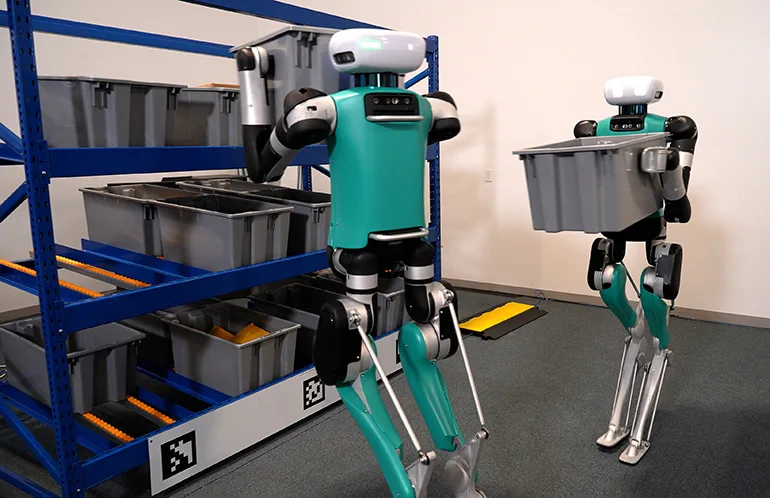
FedEx has launched a pilot program at its Memphis facility that directly compares humanoid robot pickers against conventional goods-to-person automation systems, according to reports from IFR and Bloomberg. The early results are mixed, raising questions about when (or whether) humanoid robots will prove their worth in real logistics operations.
The Memphis pilot places humanoid robots and established automated systems in the same warehouse environment, performing comparable picking tasks. This side-by-side approach is notable because it moves beyond the typical demonstration video or controlled lab test. FedEx is measuring how humanoids perform against systems that already work at scale.
Goods-to-person systems, the incumbent technology in this comparison, use mobile robots to bring shelving units or totes directly to human workers at picking stations. These systems have been deployed for years and have well-understood performance characteristics. The humanoid robots, by contrast, are being asked to navigate warehouse environments and manipulate items much like a human worker would.
The pilot has not produced a clear winner. This outcome is actually informative. It suggests humanoid robots can function in a real warehouse setting, which is itself a milestone. But it also indicates they have not yet demonstrated the decisive advantages that would justify replacing proven automation.
The challenge for humanoids in logistics comes down to reliability and speed. Picking items from bins requires handling enormous variety: different shapes, weights, packaging types, and orientations. Conventional automation solves this by simplifying the problem, bringing standardized containers to fixed stations. Humanoids attempt to solve it by replicating human dexterity, a harder technical path that promises more flexibility but demands more sophisticated hardware and software.
FedEx handles millions of packages daily, and its Memphis hub is one of the largest sorting facilities in the world. A company of this scale does not run pilots for publicity. It runs them to gather data for capital allocation decisions.
If humanoids eventually prove competitive, they could handle tasks that current automation cannot easily address, such as picking from irregular shelving or working in facilities not designed for robots. If they fall short, it signals that the technology needs more development time before enterprise customers will commit serious budgets.
The pilot will likely continue for several months as FedEx collects performance data across different conditions and item types. The key metrics to watch are picks per hour, error rates, and system uptime. Humanoid robots need to approach parity with existing systems on these measures before they become attractive at scale.
For humanoid robot developers, this trial represents both opportunity and risk. A strong showing could accelerate adoption across logistics. A disappointing result could reinforce skepticism that the technology is still too immature for demanding industrial applications.
The Memphis experiment may not settle the humanoid debate, but it will produce some of the most rigorous real-world data the industry has seen.