Bildnachweis: Image via DroneDJ. Used under fair use for news commentary. · source
So here's the thing everyone who flies drones professionally has been complaining about since roughly forever: the connection dies at the worst possible moment. You're flying a survey mission over a construction site, or running an inspection along a power line corridor, and the signal gets chewed up by interference or terrain or just plain distance, and suddenly your expensive drone is doing things you didn't tell it to do. Or worse, it's not doing anything at all.
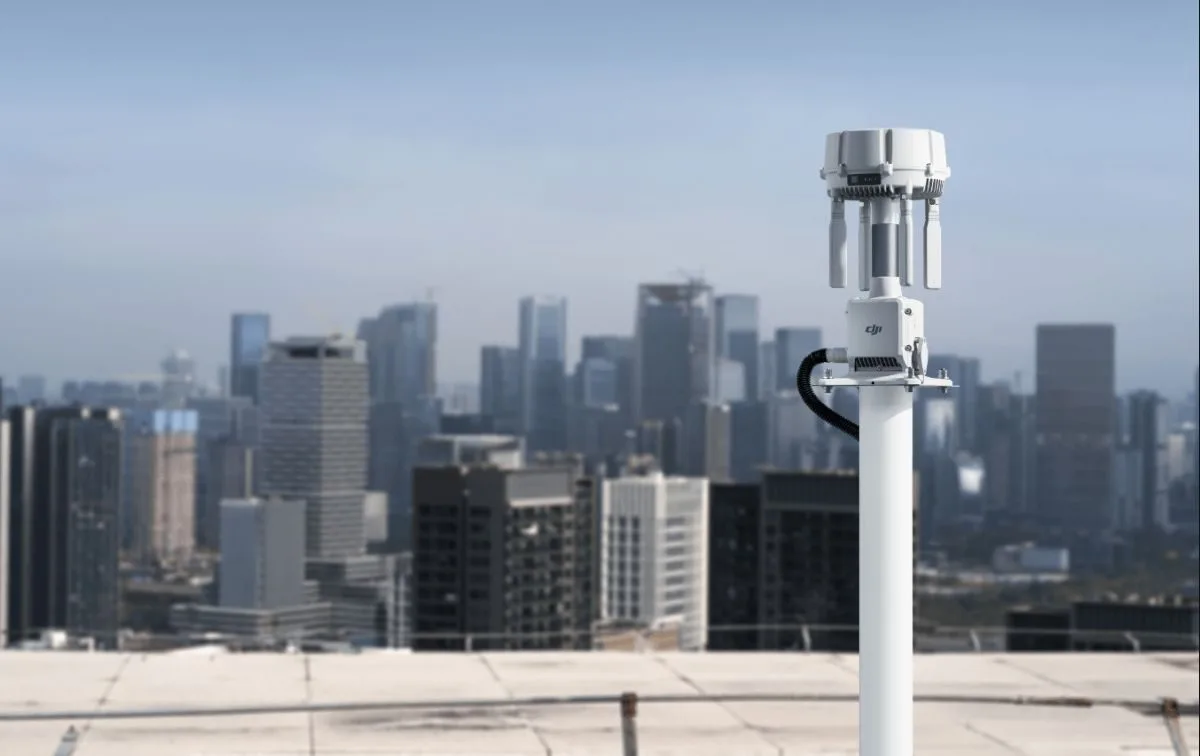
DJI apparently decided to do something about that. The company has unveiled the DJI O4 Ground Station, a new transmission system built specifically to extend drone communications and shore up reliability in the kinds of environments where pilots have historically had to cross their fingers and hope for the best. Dense urban areas with RF interference everywhere, industrial sites full of metal structures, wide-open agricultural land where the drone is just too far out. The O4 Ground Station is aimed squarely at all of those scenarios.
I've seen this movie before, of course. Every few years somebody announces a breakthrough in wireless range or reliability and the press release is full of superlatives and then the product ships and it's... fine. Sometimes better than fine. Occasionally it actually changes how people work. I'm not going to tell you which category this falls into yet, because it's genuinely too early to say. The O4 Ground Station is new enough that real-world operator feedback is still thin on the ground, and I only found two sources covering the launch in any depth.
But here's why I think this one is worth paying attention to anyway. DJI didn't just drop a piece of hardware and call it a day. Within roughly 24 hours of the O4 Ground Station announcement, the company pushed a firmware update for its Dock 3 and Matrice 4D series ecosystem that adds native support for the new system. That kind of tight integration suggests this isn't a one-off accessory. It looks more like DJI is building toward something, extending the operational envelope of its autonomous dock-based missions in a deliberate, layered way.
Verwandte Beiträge
More in Drones
A pair of arXiv preprints tackle the same hard problem in drone control from very different angles. The results are promising, but the gap between 'outdoor experiment' and 'deployed system' remains large.
Aisha Patel · 25 Jun · 9 min
The Air 3S discount is real, but the urgency behind it has less to do with Amazon's sale and more to do with where DJI hardware might be headed.
Mark Kowalski · 23 Jun · 6 min
Procurement is the easy headline. Actually building enough drones, fast enough, with American parts, is the problem nobody's solved yet.
Mark Kowalski · 20 Jun · 7 min
The FCC just removed a narrow category of toy drones from its Covered List. It's a small move, but it tells you something about where the regulatory wind is blowing.
The Dock 3 context matters here. The DJI Dock 3 is the company's latest drone-in-a-box solution, designed for fully automated, remote operations where a drone launches, completes a mission, and returns to its dock without a human anywhere nearby. These systems are increasingly attractive to enterprise customers in utilities, public safety, and infrastructure inspection, sectors where sending a person out to fly manually is expensive and sometimes dangerous. The promise of dock-based autonomy is real. The limitation has always been range and signal reliability, and that's exactly what the O4 Ground Station is targeting.
According to DroneDJ, the O4 Ground Station is designed to dramatically extend drone communications while improving reliability in areas where signal interference, obstacles, or distance can disrupt operations. The follow-up piece from DroneDJ confirms that the Dock 3 firmware update brings support for the new station, pushing remote drone operations farther than before. What remains unclear is exactly how much farther, under what conditions, and how the system performs when things get complicated, which they always do in the field.
That's not a knock on DJI specifically. It's just the nature of signal propagation and real-world RF environments. Marketing specs and field performance are different animals, and any operator who's been doing this for more than a year knows that. The specs will come out, the early adopters will test it, and we'll know more in a few months. That's how this always goes.
What I find genuinely interesting, and what I think gets undersold in the coverage so far, is the broader trajectory this represents. The drone industry has been inching toward fully autonomous, remotely managed operations for years now, and the bottleneck has consistently been communication infrastructure. Better cameras, better obstacle avoidance, better batteries, all of that has improved steadily. But if you can't maintain a solid link between your ground station and your aircraft at the distances and in the environments where the real work happens, none of the other improvements matter as much as they should.
This is, sort of, the same problem that plagued early cellular networks. The hardware got better faster than the infrastructure could support it. Phones were capable of more than the towers could deliver. The solution wasn't one dramatic leap, it was a long series of incremental improvements to the underlying connectivity layer until the infrastructure caught up with the devices. Drone operations are going through something similar right now, and the O4 Ground Station looks like one more step in that incremental march.
Call me old-fashioned, but I think incremental and reliable beats flashy and fragile every time. The young founders pitching AI-powered autonomous drone platforms at every conference I've attended in the past three years would probably disagree with that framing. They want the big story. DJI, whatever you think of the company and its complicated geopolitical situation (which is a whole separate conversation), tends to ship things that actually work. That's worth something.
The Matrice 4D series is already a capable platform for serious commercial work. Adding reliable extended-range connectivity through the O4 Ground Station, assuming the real-world performance holds up, makes the dock-based autonomous mission profile substantially more viable for operators who need to cover more ground or work in trickier RF environments. Utilities companies inspecting transmission lines across rural terrain. Emergency management agencies running reconnaissance in disaster zones. Agricultural operations covering thousands of acres. These are the customers DJI is clearly thinking about here.
The firmware update piece is also worth noting on its own terms. DJI rolling out Dock 3 support this quickly after the O4 Ground Station announcement either means the two products were developed in parallel with integration planned from the start, or DJI has gotten very good at rapid ecosystem updates. Either way, it's a sign that the company is thinking about these products as a system rather than as individual SKUs. That's how you build infrastructure, not just gadgets.
I don't want to oversell this. We're talking about a signal-boosting ground station for drones, not some fundamental reinvention of how aerial robotics works. The O4 Ground Station is a tool, and like any tool its value depends entirely on whether it does what it claims to do in the conditions where operators actually need it. This is based on limited data and early coverage, and the real test will come from the operators who deploy it in the field over the next several months.
But the direction is right. Extending reliable communications range for autonomous dock-based missions is exactly the kind of unglamorous infrastructure problem that needs solving before the broader vision of scalable drone operations can actually happen. DJI is doing the work. Whether the O4 Ground Station is the piece that moves the needle in a meaningful way, or just another incremental step in a long series of them, we'll find out soon enough.