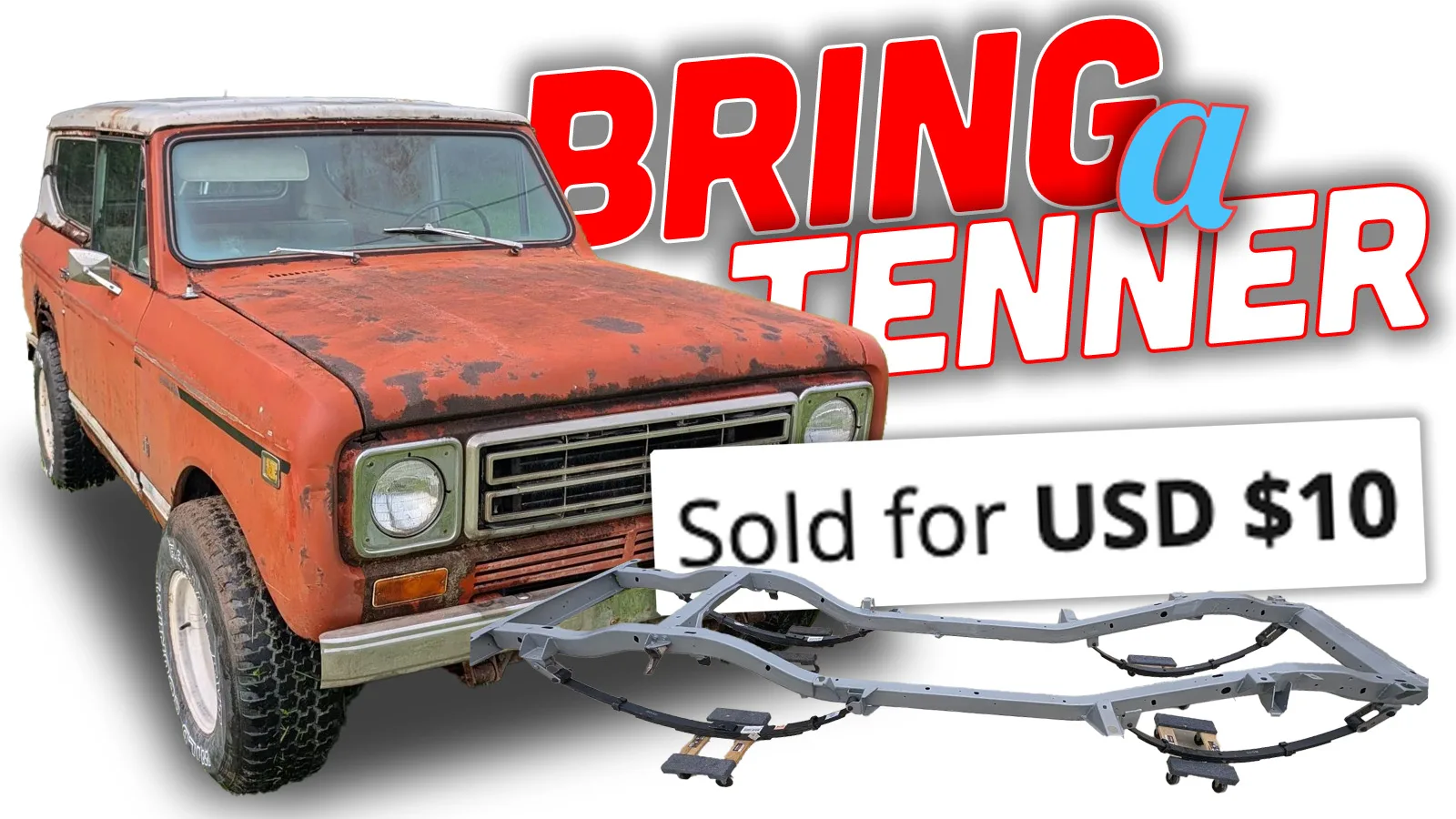
An International Scout, or what remained of one, sold on Bring a Trailer last week for exactly $10. To be precise, that's less than the cost of two gallons of gasoline in most American cities. The vehicle in question was, by any reasonable metric, not a vehicle at all. It was a collection of rusted panels, a deteriorated frame, and the faint suggestion that someone once drove this thing.
I'm bringing this up not because Centre Robotics has pivoted to covering classic car auctions (we haven't), but because this sale crystallizes something I've been thinking about regarding autonomous vehicle valuations and the broader robotics investment landscape.
According to The Autopian, the Scout in question was listed as a "project vehicle," which is generous terminology for something that would need its own donor car before it could even accept parts from a donor car. The winning bid was $10. The listing fees and administrative costs almost certainly exceeded the sale price.
What's genuinely interesting here isn't the absurdity of the price point. It's the psychology of the buyer. The Autopian's follow-up coverage explored exactly this question: who purchases something that is, functionally, a liability? The answer, based on reader responses, appears to be someone who sees latent value invisible to the broader market. Someone who believes the brand name "Scout" carries enough weight to justify years of restoration work and thousands of dollars in parts.
This hasn't been replicated in any formal study, obviously. We're working with anecdotal data from car enthusiasts on the internet. But the pattern is instructive.
I know I'm being picky here, but the parallels to autonomous vehicle companies are hard to ignore.
Over the past eighteen months, we've watched AV valuations undergo what can only be described as a correction. Argo AI shut down entirely in late 2022. Embark, which went public via SPAC at a valuation exceeding $5 billion, sold its assets to Applied Intuition for what reports suggest was a fraction of that figure. Motional, the Hyundai-Aptiv joint venture, laid off a significant portion of its workforce earlier this year (the company didn't disclose exact figures, but reporting from TechCrunch suggested roughly 550 people).
The question I keep returning to is this: at what point does an AV company become a $10 Scout? When does the accumulated technical debt, the regulatory uncertainty, the burn rate, and the distance to actual revenue make the entity worth less than its administrative overhead?
It's worth noting that this framing might be too pessimistic. Waymo continues to expand its robotaxi service. Cruise, despite its well-publicized incident in San Francisco and subsequent operational pause, remains backed by GM's balance sheet. The technology works, in controlled conditions, for specific use cases. But the gap between "works in controlled conditions" and "generates sustainable revenue" remains unclear.
The Autopian piece raised a point that stuck with me: the $10 Scout needs a donor car. But any donor car suitable for this project would itself need to be in reasonable condition, which means it would be worth more than $10. The economics are circular. You need to spend significantly more than the purchase price just to make the purchase price make sense.
This is, actually, the research shows, exactly the situation facing several autonomous vehicle programs. The core technology stack (the sensors, the compute, the ML models) represents years of R&D investment. But deploying that technology requires regulatory approval (which requires safety data), operational infrastructure (which requires capital), and customer acquisition (which requires a working service). Each dependency requires resources that exceed what the core technology is worth in isolation.
I've seen this pattern before in robotics research. A team develops a genuinely novel manipulation algorithm. The paper gets accepted to ICRA or RSS. The demo videos look impressive. But commercializing that algorithm requires hardware integration, reliability engineering, safety certification, and customer development, none of which were part of the original research scope. The algorithm, like the Scout, needs its own donor car.
If I were advising an AV company right now (I'm not, to be clear, and I'd probably be terrible at it), I'd want to see three things:
First, honest accounting of the donor car problem. What infrastructure, regulatory approvals, and operational capabilities are missing? What would it cost to acquire them? The sample size here is small, but the companies that have survived the current correction seem to be the ones with realistic assessments of their gaps.
Second, clarity on the actual addressable market. "Autonomous vehicles" is not a market. Robotaxis in geofenced urban areas are a market. Autonomous trucking on specific highway corridors is a market. Last-mile delivery in controlled environments is a market. These are different businesses with different unit economics. Conflating them, which was common during the hype cycle, leads to valuation disconnects.
Third, some acknowledgment of what we don't know yet. The long-tail safety problem in autonomy remains genuinely hard. Edge cases multiply. Sensor degradation in adverse weather conditions persists. Human-robot interaction in mixed traffic environments is still poorly understood. Any company claiming they've "solved" autonomy is, in my experience, either lying or defining the problem narrowly enough to make the claim technically true.
So what happens to the AV companies that can't find a buyer at any price? This is where the Scout analogy breaks down somewhat. A rusted Scout can sit in a field indefinitely. Its carrying costs are minimal (property taxes, maybe some HOA complaints). An AV company burning $50 million per quarter cannot sit indefinitely. The clock runs out.
We've already seen some outcomes. Embark's assets went to Applied Intuition, which is building simulation and development tools rather than deploying vehicles. This seems like a reasonable outcome: the technical work has value, just not in its original form. It's like parting out the Scout for its engine and transmission rather than attempting a full restoration.
Other outcomes remain unclear. What happens to the sensor data collected by defunct AV programs? What about the trained models? The annotated datasets? There's genuinely novel research embedded in these companies, but extracting it requires someone willing to do the donor car work.
I don't have a clean conclusion here. The autonomous vehicle industry is not dead. It's also not healthy. It's in a period of consolidation that will probably, in a way, result in fewer but more sustainable companies. The $10 Scout will either get restored by someone with more patience than economic sense, or it will rust further until even the brand name can't save it.
The same is true for AV startups. Some will find their restorer. Others will become parts cars. And a few, the ones that never should have been funded in the first place, will simply dissolve, their components too corroded to salvage.
(I realize I've written 1,200 words about a car auction to make a point about autonomous vehicles. This is, I acknowledge, somewhat excessive. But the metaphor holds, and sometimes the best way to understand an industry is to look at something adjacent to it.)