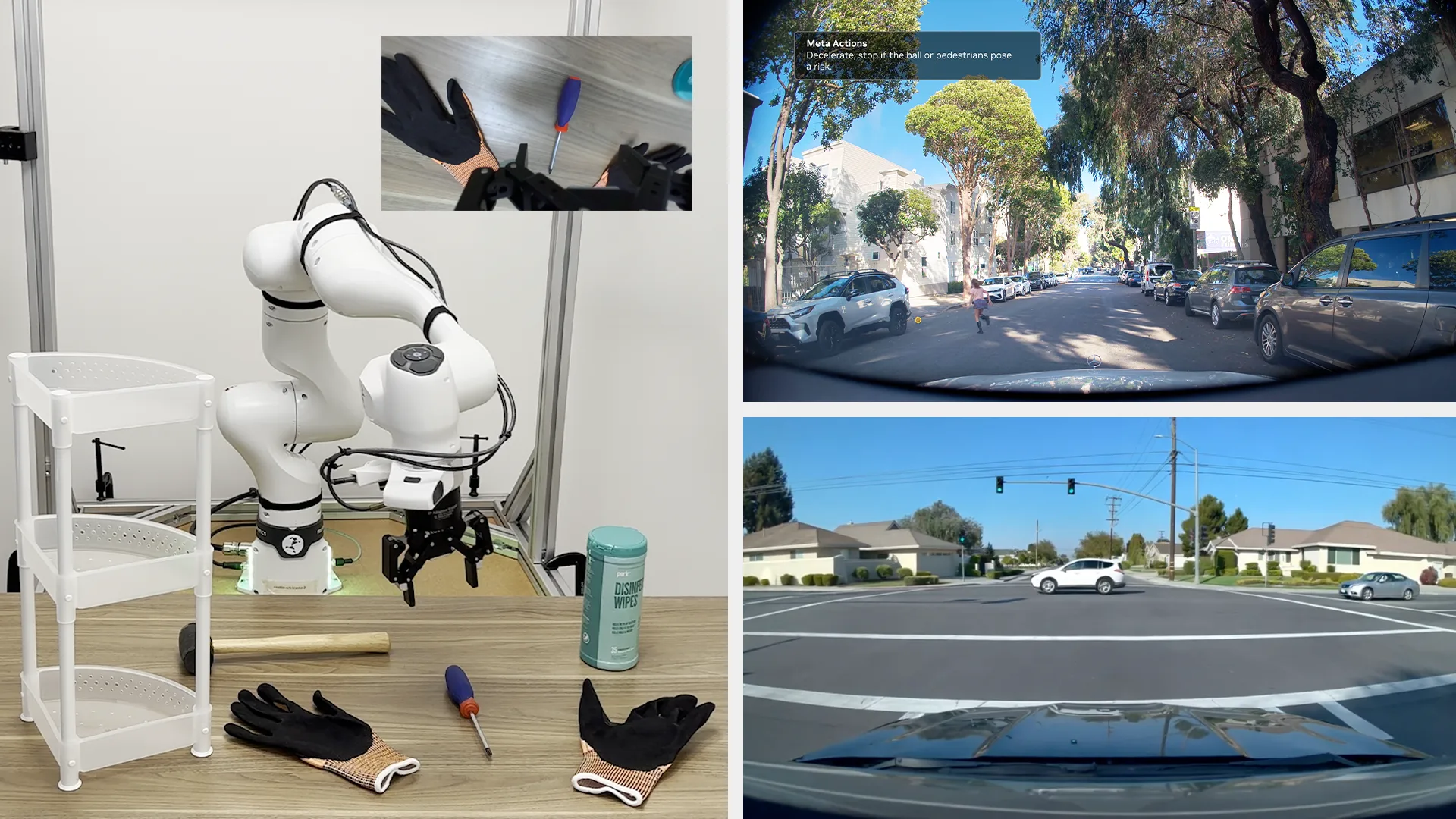
Five modalities. One model. That's the pitch from NVIDIA this week with Cosmos 3, and if you've been around long enough, you're probably already reaching for the salt shaker.
The company is calling it the first "omnimodal world model for Physical AI," which is a mouthful that basically means: this thing can process and generate text, images, video, audio, and robot actions all within the same architecture. According to the technical paper published on arXiv, Cosmos 3 "effectively subsumes vision-language models, video generators, world simulators, and world-action models into a single framework." That's a big claim! Let's talk about what it actually means and why I'm both impressed and, well, skeptical.
The core idea here is something called a "mixture-of-transformers architecture" that handles what NVIDIA calls "highly flexible input-output configurations." In plain English: you can feed it video and get robot actions out, or feed it text and get video out, or various combinations thereof. The modularity is genuinely interesting from an engineering standpoint.
The benchmarks are strong, I'll give them that. According to the paper, Cosmos 3 was ranked as the best open-source text-to-image and image-to-video model by Artificial Analysis, and the best policy model by something called RoboArena (at the time the technical report was written, they're careful to note). The models are being released under the Linux Foundation's OpenMDW-1.1 license, which means researchers can actually poke around inside.
This matters because the robotics field has been drowning in proprietary systems that nobody can replicate or verify. NVIDIA putting the code, model checkpoints, and even curated synthetic datasets out there is, genuinely, a good thing for the research community. Call me old-fashioned, but I think science works better when you can see the work.
Here's where I get grumpy.
I've seen this movie before. Not once, not twice, but at least four or five times since the late 90s. A big company announces a unified architecture that will consolidate multiple capabilities into one system, the press releases flow, the demos look incredible, and then... reality sets in. The unified system turns out to be worse at each individual task than specialized tools. Or it works great in the lab and falls apart in deployment. Or the compute requirements make it impractical for anyone who isn't running a data center.
The paper claims Cosmos 3 "establishes a new state-of-the-art across a diverse suite of understanding and generation tasks." Maybe it does! But state-of-the-art on benchmarks and state-of-the-art in the real world are different things, and anyone who's watched the self-driving car industry knows how wide that gap can be. We were supposed to have Level 5 autonomy by 2020, remember?
What remains unclear is how these models perform on the messy, unpredictable tasks that actual robots face. The paper talks about "embodied agents" but the evaluation suite, as far as I can tell from the abstract, focuses on standard generation and understanding benchmarks. That's fine for a technical report, but it doesn't tell me much about whether this thing can help a robot navigate a cluttered warehouse or handle a package that's been taped shut wrong.
Look, I don't want to be entirely cynical here. The underlying research is substantial, the open-source release is commendable, and the idea of a unified backbone for Physical AI is probably the right direction for the field. Having one model that can reason about video, generate plausible futures, and output robot actions, that's the dream, and NVIDIA has the resources to actually pursue it seriously.
But I've watched too many "revolutionary" systems get quietly shelved when the next thing comes along. The young founders I talk to are all excited about omnimodal this and foundation model that, and I get it, the technology is genuinely advancing. What I don't see enough of is the boring, unglamorous work of making these systems reliable in deployment, handling edge cases, dealing with hardware failures, all the stuff that separates a demo from a product.
The paper mentions that Cosmos 3 is designed to be a "general-purpose backbone for embodied agents." That's a reasonable goal. Whether it actually becomes that, or whether it's another stepping stone that gets superseded in 18 months, remains to be seen. NVIDIA's got the compute, they've got the talent, they've got the money. What they're competing against is the fundamental difficulty of making robots work reliably in unstructured environments, and that problem has humbled a lot of smart people over the years.
The models are available now on GitHub and Hugging Face, so we'll start seeing independent evaluations pretty quickly. That's the nice thing about open releases, you don't have to take the company's word for it. I'm particularly curious to see how the robotics community responds, whether this becomes a standard foundation that people build on, or whether it's too resource-intensive for practical use.
My guess? It'll be useful for large-scale simulation and synthetic data generation, which is where NVIDIA's strengths lie anyway. Whether it actually makes robots more capable in the real world, I think that's a 2-3 year question at minimum. But what do I know, I still prefer email to Slack.
If you want to argue about any of this, my email's on the about page. I actually read it, unlike certain messaging platforms I could name.