MoneyGram Launches Its Own Stablecoin, MGUSD, Targeting Latin America First
The payments company is betting a dollar-pegged token can get it into markets where traditional rails are slow and expensive. Whether that logic holds up is another question.
Picture a remittance worker in Houston trying to send $200 to a family member in Guatemala. The fee is somewhere between $8 and $15. The transfer takes one to three business days. The recipient may or may not have a bank account. This is the problem MoneyGram has been selling solutions to for decades, and it is, to be precise, the same problem the company is now invoking to justify launching its own stablecoin.
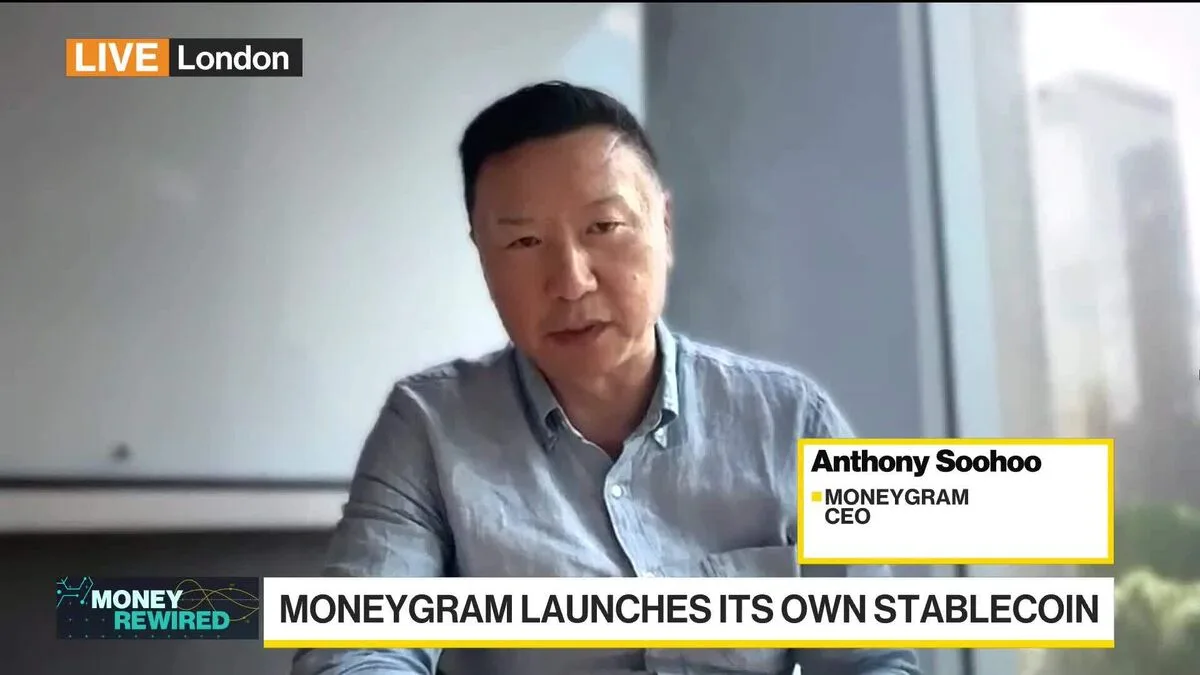
On June 9, 2026, MoneyGram CEO Anthony Soohoo appeared on Bloomberg alongside Delta Blockchain Fund founder Kavita Gupta, DTCC Digital Assets' global head Nadine Chakar, and Securitize CEO Carlos Domingo. The occasion was "Bloomberg Crypto," the network's dedicated crypto coverage block. The substance was an announcement: MoneyGram has launched MGUSD, a dollar-pegged stablecoin, and the company's first target market is Latin America.
Soohoo also joined Katie Greifeld and Isabelle Lee separately on "Bloomberg Crypto" the same day, discussing the company's ambitions for global adoption. The framing was consistent across both appearances. MGUSD is not just a product; it is, according to Soohoo, a platform for reaching the unbanked and underbanked at scale.
MoneyGram operates in more than 200 countries and territories and processes billions of dollars in transfers annually. The company didn't disclose exact figures for anticipated MGUSD transaction volume at launch, which is worth noting because volume projections are typically where stablecoin pitches either gain credibility or collapse into hand-waving.
Verwandte Beiträge
More in AI Models
Chipmakers swung wildly this week, from a Tuesday 'chip-wreck' to a Micron-led surge after hours. What's actually going on with AI's hardware backbone?
Sarah Williams · 26 Jun · 5 min
The original Creator Studio was shut down in 2023. Now it's back, rebuilt around an AI assistant that promises to grow your audience and reply to comments in your voice.
Sarah Williams · 26 Jun · 5 min
At its annual Config conference, Figma announced coding layers, AI-generated motion graphics, and a reimagined canvas that blurs the line between design and full-stack development.
Sarah Williams · 26 Jun · 5 min
Everyone talks about chips and models. The memory bottleneck is the part of the AI buildout that keeps getting underestimated, and Micron's latest earnings make that case hard to ignore.
What we do know is this: Latin America is a well-chosen initial market on paper. Remittance inflows to the region are substantial. The World Bank has tracked Latin America and the Caribbean receiving over $145 billion in remittances annually in recent years, with Mexico alone accounting for more than $60 billion. Fees on those transfers have been declining but remain above the UN Sustainable Development Goal target of 3 percent for many corridors.
Stablecoins, in theory, address the fee problem by removing correspondent banking intermediaries. This is not a new argument. Circle's USDC and Tether's USDT have both been used for cross-border transfers in Latin America for years, with varying degrees of uptake. The actual research on whether stablecoin-based remittances deliver meaningfully lower costs to end users, after accounting for on-ramp and off-ramp fees, is thinner than the marketing suggests. I am only aware of a handful of peer-reviewed studies on this specific question, and none of them cover the full cost stack from sender to recipient in a way that would let you make a clean comparison.
MGUSD enters a market with established competitors. Tether's USDT dominates stablecoin usage in Latin America by a wide margin. Circle has been making deliberate infrastructure investments in the region. A MoneyGram-branded stablecoin needs a reason to exist beyond brand recognition, and it remains unclear from the Bloomberg appearances what the technical or economic differentiation is.
Here is where I want to be careful not to be unfair to what MoneyGram is actually doing, because there is something genuinely interesting buried in the announcement, even if the press framing obscures it.
MoneyGram is not a crypto-native company trying to build a payments network from scratch. It is a payments network with existing regulatory licenses, existing agent networks, and existing customer relationships in the very corridors where stablecoin adoption is supposed to matter. That is a real asset. The company already operates in Mexico, Colombia, Guatemala, El Salvador, and other high-remittance markets. It has the compliance infrastructure to operate legally in those jurisdictions. That is not nothing.
The question is whether MGUSD is the right product for that infrastructure, or whether MoneyGram is essentially bolting a stablecoin onto an existing rails business and calling it innovation. Actually, the research on this kind of hybrid approach is sort of mixed. There is reasonable evidence that incumbent payment providers who adopt blockchain-adjacent rails can reduce settlement costs internally, but the benefits to end consumers depend heavily on whether those savings are passed through or absorbed as margin.
It is worth noting that the Bloomberg panel included Nadine Chakar from DTCC Digital Assets, which is a meaningful signal about where institutional infrastructure is heading. DTCC has been building digital asset settlement capabilities for several years, and its presence in a conversation about stablecoins suggests the institutional plumbing is being taken seriously by people who are not ideologically committed to crypto. That is a different audience than the retail crypto community, and MoneyGram appears to be pitching to both simultaneously, which is a difficult balance to maintain.
The involvement of Securitize CEO Carlos Domingo in the same broadcast is also interesting context. Securitize focuses on tokenized real-world assets, and while Domingo was presumably there in his own capacity, the proximity of that conversation to MoneyGram's stablecoin launch hints at the broader ecosystem MoneyGram is trying to position itself within. Whether that positioning translates into actual product integration is unclear.
Several things would need to be true for MGUSD to become a meaningful product rather than a press cycle.
First, the on-ramp and off-ramp problem needs a real solution in each market. Stablecoins are only useful for remittances if the person sending money can convert dollars to MGUSD cheaply, and the person receiving it can convert MGUSD back to local currency cheaply. MoneyGram's agent network could theoretically handle this. Whether it will, and at what fee structure, is not yet public.
Second, regulatory clarity matters enormously in Latin America. Mexico, Brazil, and Argentina have taken meaningfully different approaches to stablecoin regulation, and what works in one corridor may not be legal in another without significant compliance overhead. MoneyGram's existing licenses help, but stablecoin-specific regulation is still evolving in most of these markets.
Third, and I know I am being picky here, but the question of MGUSD's reserve structure and attestation schedule matters. Not all stablecoins are created equal. USDC publishes monthly attestations from a major accounting firm. Tether's reserve disclosures have historically been a source of controversy. Where MGUSD sits on that spectrum is not yet clear from publicly available information, and it is a basic due diligence question that any serious institutional partner would ask.
What I would want to see next is a published reserve attestation framework, a clear breakdown of the fee structure for end users in at least one specific corridor, and some independent assessment of whether the product actually reduces costs relative to MoneyGram's existing wire transfer products. Without those, the announcement is, in essence, a direction of travel rather than a product launch in any meaningful sense.
The broader context here is that 2026 is shaping up to be the year when stablecoin infrastructure goes from crypto-adjacent to genuinely mainstream financial plumbing. The U.S. GENIUS Act, which would create a federal regulatory framework for payment stablecoins, has been moving through Congress. If that legislation passes in a form close to its current draft, it would create the kind of regulatory certainty that large incumbents like MoneyGram need to commit significant capital to stablecoin infrastructure. Soohoo's timing on this announcement may be deliberately aligned with that legislative moment.
Whether MGUSD becomes a real product or a placeholder in a larger strategic story is too early to say. MoneyGram has the distribution advantage. It does not yet have the track record in crypto infrastructure to suggest it can execute on the technical side without significant partnership support. The company didn't disclose which blockchain or settlement layer MGUSD runs on, which is, again, a basic question that the Bloomberg appearances left unanswered.
For now, file this under: credible incumbent making a plausible move in a direction that makes strategic sense, execution unproven, differentiation unclear. That is not a dismissal. It is just an accurate description of where things stand.