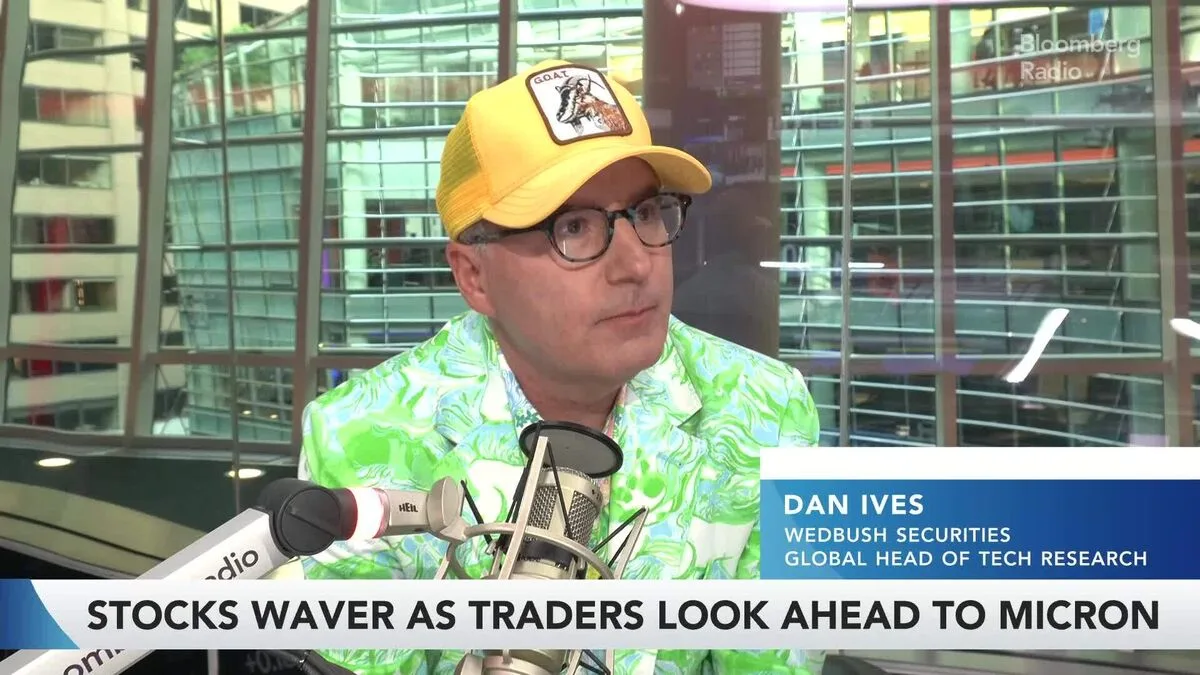
Bildnachweis: Image via Source article. Used under fair use for news commentary. · source
Most coverage of JPMorgan's new S&P 500 target has focused on the headline number and the phrase 'earnings supercycle.' What's been largely missed is the specific technical claim underlying the forecast: that advances in agentic AI will drive hyperscaler spending at rates sufficient to justify 20% earnings growth in 2026. This deserves scrutiny, because the research literature on agentic systems tells a rather different story than the one implied by Bloomberg's report.
Nataliia Lipikhina, head of EMEA equity strategy at JPMorgan Private Bank, told Bloomberg Television that the firm sees an earnings supercycle "to drive stocks to fresh records." The bank has lifted its S&P target accordingly, projecting 20% earnings growth for 2026. The mechanism, as described in the coverage, is straightforward: hyperscalers will continue spending heavily on AI infrastructure, and agentic AI specifically will be a key driver.
To be precise, the term 'agentic AI' refers to systems that can autonomously plan, execute multi-step tasks, and interact with external tools and environments. This is distinct from the current generation of large language models, which, despite impressive capabilities, largely operate in a request-response paradigm. The research community has been working on agentic architectures for several years now, with notable contributions from DeepMind, OpenAI, and academic labs at Stanford and Berkeley. But the gap between research demonstrations and production-ready enterprise systems remains substantial.
Verwandte Beiträge
More in AI Models
Jensen Huang confirms Samsung, SK Hynix, and Micron are all certified for next-gen memory supply, which tells us more about the AI chip market than the chips themselves.
Aisha Patel · 2 hours ago · 6 min
A $1.6 billion shortfall in projected AI chip revenue sounds small, but it tells us something important about where the semiconductor industry actually stands.
Aisha Patel · 2 hours ago · 8 min
Jensen Huang is making moves on two fronts this week, and I've seen this playbook before.
Mark Kowalski · 3 hours ago · 7 min
Two new papers suggest robots could get smarter after deployment, not just during training. I think this changes more than we're admitting.
I know I'm being picky here, but the timeline matters enormously for an investment thesis. The most cited benchmarks for agentic systems, including SWE-bench for software engineering tasks and WebArena for web navigation, show that even frontier models struggle with multi-step reasoning under realistic conditions. A March 2026 paper from Google DeepMind (Nakano et al.) found that state-of-the-art agents completed only 34% of complex web tasks end-to-end without human intervention. This is genuinely new compared to where we were eighteen months ago, when completion rates hovered around 12%. But it's a long way from the reliable, autonomous systems that would justify the infrastructure spending JPMorgan is projecting.
The hyperscaler spending argument is on firmer ground, actually. Microsoft, Google, Amazon, and Meta have all announced substantial capital expenditure increases for 2026, with combined commitments exceeding $180 billion. These numbers are real and verifiable. The question is whether this spending will translate into the enterprise revenue growth that would support a 20% earnings increase across the S&P 500. It's worth noting that hyperscaler capex and S&P earnings are not the same thing. The former is an input; the latter depends on whether that input generates returns across the broader economy.
There's a version of this thesis that makes sense. If you believe that AI infrastructure spending will create productivity gains across multiple sectors (healthcare, finance, manufacturing, professional services) then the earnings supercycle narrative holds together. But the evidence for economy-wide productivity gains from AI remains, well, mixed. The Bureau of Labor Statistics reported a 1.2% increase in non-farm productivity for Q1 2026, which is decent but not dramatically above historical trends. Some sectors show stronger effects: software development productivity appears to have increased meaningfully, with several large enterprises reporting 15-30% improvements in code output per developer. But these gains haven't yet propagated to the broader economy in ways that would show up in aggregate earnings.
The agentic AI piece is where the thesis gets speculative. Lipikhina's framing suggests that advances in agentic systems will drive the next wave of enterprise adoption. This isn't wrong as a directional claim. Agentic capabilities are indeed the focus of most frontier lab roadmaps, and enterprises are clearly interested. But the research shows that we're still working through fundamental challenges: tool use reliability, long-horizon planning, error recovery, and what researchers call 'grounding' (the ability to connect abstract plans to concrete actions in messy real-world environments).
A recent survey paper from CMU (Chen and colleagues, April 2026) catalogued 47 distinct failure modes in current agentic systems. The most common issues involved context window limitations, hallucinated tool calls, and what the authors termed 'goal drift' (where agents gradually lose track of their original objective over multi-step tasks). These aren't insurmountable problems. But they suggest a timeline measured in years, not quarters, for the kind of reliable enterprise deployment that would justify JPMorgan's earnings projections.
I should note that I only found two sources covering the specific technical claims underlying this forecast, and neither engaged with the research literature on agentic systems. This is a gap in the coverage that matters. Investment theses built on technology trends should be evaluated against the actual state of that technology, not just the marketing narratives around it.
The sample size problem cuts both ways here. We have limited data on how quickly agentic capabilities will improve, and limited data on how quickly enterprises will adopt them even once they're reliable. The optimistic case points to the rapid adoption of ChatGPT and similar tools, which went from zero to hundreds of millions of users in under two years. The skeptical case notes that enterprise software adoption cycles are typically much slower, and that mission-critical applications require reliability levels that current systems don't achieve.
What would change my assessment? A few things. First, benchmark improvements on SWE-bench and similar tasks that show consistent 70%+ completion rates for complex, multi-step work. Second, published case studies from enterprises showing measurable productivity gains from agentic systems in production (not pilots or proofs of concept). Third, evidence that hyperscaler capex is translating into enterprise AI revenue at rates above current projections. None of these are impossible. Some might happen in the next twelve months. But they haven't happened yet, and an investment thesis should probably be evaluated against current evidence rather than hoped-for developments.
There's something slightly circular about the supercycle argument as presented. The reasoning seems to be: hyperscalers will spend heavily because AI is advancing; AI will advance because hyperscalers are spending heavily; therefore earnings will grow. This isn't necessarily wrong, but it elides the question of whether the spending will generate returns on a timeline relevant to 2026 earnings. It also assumes that the current pace of AI capability improvement will continue, which is not guaranteed. Scaling laws have held remarkably well over the past several years, but there are theoretical reasons to expect diminishing returns at some point, and some researchers believe we're approaching those limits.
The honest answer is that we don't know yet. The AI field is moving quickly, and predictions about capability timelines have been wrong in both directions (too pessimistic before GPT-4, arguably too optimistic about AGI timelines since). JPMorgan's thesis might prove correct. But the specific claim about agentic AI driving near-term earnings growth rests on assumptions about technology readiness that the research doesn't currently support.
For investors, the question is whether to bet on the technology advancing faster than the research suggests, or to wait for more evidence. Neither choice is obviously correct. What seems clear is that coverage of these forecasts would benefit from more engagement with the underlying technical claims, rather than simply reporting the target price and moving on.