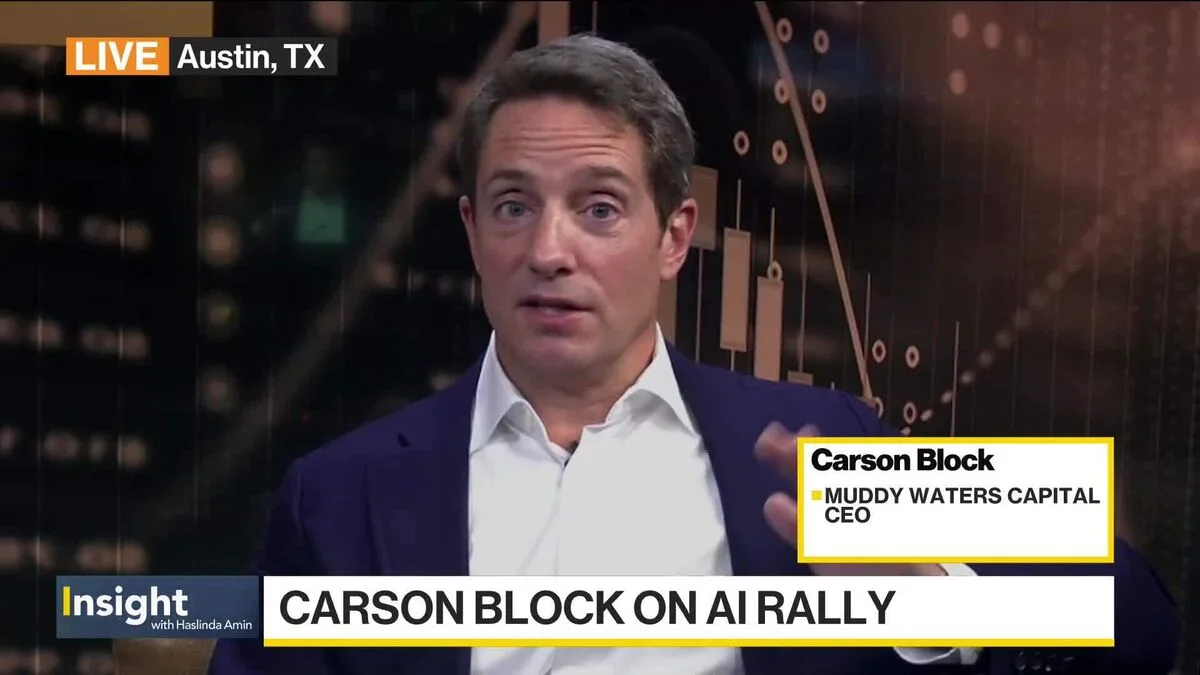
Carson Block is spooked by AI, and that should probably concern more people than it currently does.
The Muddy Waters Research CEO, known for his forensic approach to corporate accounting and his willingness to bet against overvalued companies, announced this week that his firm is reconsidering plans for a long-short equity fund focused on India. The reason? Artificial intelligence and its potential to reshape labor markets in ways that make traditional emerging market investment theses look increasingly fragile.
Block told Bloomberg that Muddy Waters Capital is "going back to the lab" on the India fund idea. That's a telling phrase from someone who built his reputation on doing homework that other investors skip. When Block goes back to the lab, it usually means he's found something that doesn't add up.
Look, I've spent enough time around industrial automation to know that labor displacement fears tend to be overstated in the short term and understated in the long term. The robots-are-coming narrative has been wrong about timing for decades. But Block isn't making a prediction about next quarter. He's questioning whether the fundamental assumptions behind investing in labor-cost-arbitrage economies still hold over a five to ten year horizon.
The India investment thesis has always been straightforward: massive, young, educated, English-speaking workforce; wages significantly below Western equivalents; growing middle class creating domestic consumption. Foreign capital pours in, companies scale up, everyone profits. It's the same playbook that worked in China, with different characteristics.
But that playbook assumed something that AI is now challenging: that certain categories of knowledge work would remain resistant to automation for the foreseeable future. Software development, customer service, back-office processing, legal research, financial analysis. These were supposed to be the safe harbors, the jobs that required human judgment and couldn't be easily replicated by machines.
The numbers are starting to suggest otherwise. I don't have precise figures on AI-driven job displacement in India's services sector (nobody does yet, and anyone claiming certainty is selling something), but the directional indicators are concerning. Major IT services firms have slowed hiring. Consulting companies are experimenting with AI tools that reduce the need for junior analysts. Customer service operations are increasingly automated.
None of this is news to anyone following the space. What's notable is that a prominent short-seller, someone whose job is literally to identify overvalued assets, is publicly saying the AI risk is significant enough to pause a major strategic initiative.
Block's track record isn't perfect, but it's better than most. He made his name exposing accounting fraud at Chinese companies when few Western investors were paying attention. He's been wrong on some calls, sometimes badly wrong, but his methodology is sound: find the gap between what companies claim and what the evidence shows.
So what does he see that's making him hesitate on India?
The interview with Bloomberg focused on two related concerns. First, the sustainability of the current AI rally in US markets. Block appears skeptical that valuations can be justified by near-term earnings, which is a reasonable position given how much AI enthusiasm has been priced in. Second, and more relevant to the India decision, the potential for AI to fundamentally alter the competitive dynamics that made emerging market labor arbitrage profitable.
This second point is where it gets interesting. The traditional emerging market investment case assumed that wage gaps between developed and developing economies would close gradually over decades, generating returns along the way. But AI introduces the possibility of a step-function change. If AI tools can perform tasks previously done by low-cost offshore workers, the wage arbitrage disappears almost overnight.
I should be clear about the limitations here. Block didn't provide specific projections or detailed analysis in the Bloomberg interview. We don't know exactly what scenarios Muddy Waters is modeling or what assumptions they're stress-testing. "Going back to the lab" could mean anything from a minor adjustment to a complete abandonment of the India strategy.
What we do know is that Block is taking AI labor displacement seriously enough to publicly discuss it as a factor in investment decisions. That's significant coming from someone who typically focuses on accounting irregularities and corporate governance failures rather than macroeconomic trends.
The broader question this raises, and one I don't think anyone has a good answer to yet, is how investors should price AI disruption risk across different markets and sectors. Traditional valuation models weren't built for this kind of uncertainty. You can model a recession, a currency crisis, a regulatory change. Modeling the pace and scope of AI-driven labor market transformation is basically impossible with current tools.
From my time in hardware engineering, I learned that the most dangerous assumptions are the ones you don't realize you're making. Everyone building robots in the 2010s assumed that manipulation and mobility were the hard problems, and that cognitive tasks were safe from automation. That assumption turned out to be exactly backwards. Large language models arrived before humanoid robots became practical, which is not what anyone in the industry expected.
The same kind of assumption inversion might be happening in global labor markets. The conventional wisdom held that manufacturing jobs in developed economies would be automated first, followed eventually by some service jobs, with knowledge work remaining largely human. Instead, we're seeing AI tools that can write code, analyze documents, and generate content before we've figured out how to build robots that can reliably fold laundry.
This matters for India specifically because the country's growth strategy was heavily weighted toward services exports. Unlike China, which built its economy on manufacturing, India bet on IT services, business process outsourcing, and knowledge work. That bet looked brilliant for two decades. It might look considerably less brilliant if AI tools can perform those tasks at a fraction of the cost.
I want to be careful not to overstate this. India has other growth drivers: domestic consumption, infrastructure investment, a manufacturing sector that's growing (albeit slowly), a startup ecosystem that's produced some genuinely innovative companies. The country isn't going to collapse because of AI. But the specific investment thesis that Block was apparently pursuing, presumably focused on companies that benefit from labor cost advantages, may be more vulnerable than it appeared.
The honest answer is that we don't know yet how this plays out. AI capabilities are advancing rapidly, but deployment in production environments is slower and messier than the demos suggest. Enterprises are experimenting with AI tools, but most haven't fundamentally restructured their operations around them. The gap between what AI can theoretically do and what it actually does in practice remains substantial.
Block seems to be betting that this gap will close faster than the market expects, at least fast enough to make traditional emerging market labor arbitrage a risky proposition. That's an ambitious prediction, but it's not an unreasonable one.
What I find most interesting about this situation is what it reveals about how sophisticated investors are thinking about AI risk. The public conversation tends to focus on either utopian scenarios (AI solves everything) or dystopian ones (AI destroys everything). The actual investment community is asking more mundane but practical questions: which business models become obsolete, which geographies lose their competitive advantages, which sectors face margin compression.
Block isn't predicting the end of work or the collapse of India's economy. He's saying that the assumptions underlying a specific investment strategy need to be re-examined in light of AI developments. That's a much more measured position than the discourse around AI usually produces.
It's also a reminder that AI's economic impact will be highly uneven. Some regions, sectors, and companies will benefit enormously. Others will face existential challenges. The distribution of those impacts is what investors like Block are trying to figure out, and the fact that he's publicly acknowledging uncertainty suggests the answers aren't obvious.
For now, Muddy Waters is going back to the lab. The rest of us might want to do the same.