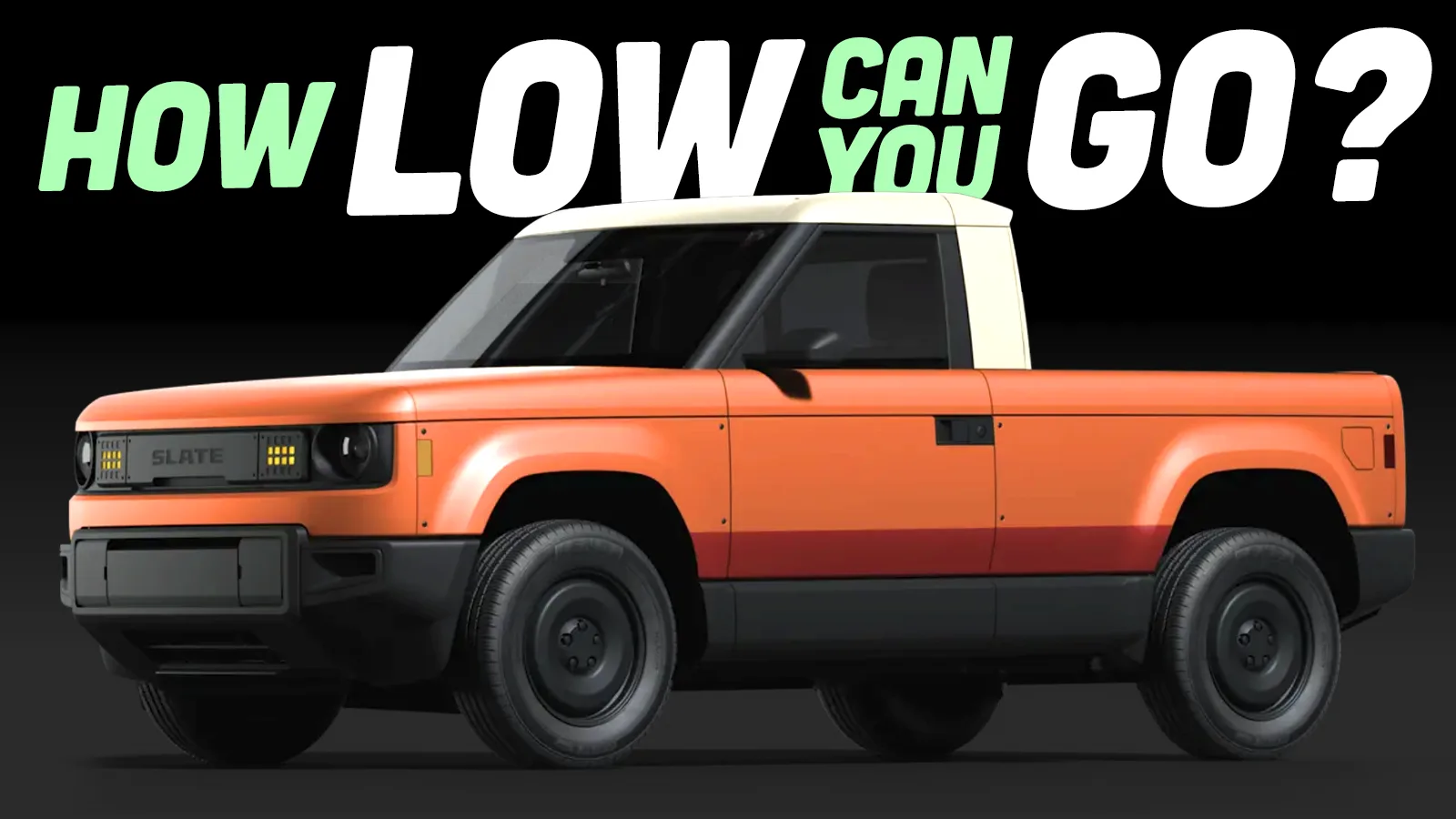
Slate's $24,950 EV Truck Is Interesting, But Let's Not Get Carried Away
A leaked price tag has everyone excited about Slate's bare-bones pickup. Bob's been around long enough to know that cheap and competitive aren't always the same thing.
Image credit: Image via The Autopian — Autonomy. Used under fair use for news commentary. · source
The Slate truck is going to be cheap. Good. That's actually what the market needs right now, and I'll say that plainly before I complicate it.
Somebody poking around Slate's website apparently found a price buried in the code: $24,950. The Autopian broke the story, crediting a reader who likes looking under the hood of websites rather than engines, which is either charming or a sign of the times depending on your disposition. Slate is set to make the official announcement on June 24th, so take the leaked figure with a grain of salt. But it's close enough to credible that people are running with it, and honestly, I don't blame them.
That number matters because Ford is apparently coming to market with a Universal EV pickup somewhere around $30,000 with a claimed 300-mile range. The Autopian has spy shots and has been tracking that story too. So suddenly you've got two trucks in roughly the same space, and Slate is priced five grand lower, at least on paper. Five thousand dollars is real money. Anyone who's ever had to justify a capital equipment purchase to a plant manager knows that.
Here's the thing though: I spent twelve years at Kuka, and one thing you learn fast in manufacturing is that the sticker price is almost never the whole story. We used to joke that the robot was the cheap part. It's the integration, the tooling, the training, the service contracts, the spare parts sitting on a shelf somewhere that'll eat your lunch. Now, a consumer truck isn't an industrial robot arm, but the principle holds. What does Slate's service network look like? What's the range? What are you giving up to get to $24,950?
Related coverage
More in Autonomy
A startup called REO says it will sell a pickup truck for $21,500. The price is striking. The evidence for it is less so.
Aisha Patel · 24 Jun · 9 min
Researchers are patching the 'trajectory scoring gap' in sidewalk robots with VLMs and human attention modeling. The ideas are clever. The caveats are real.
Mark Kowalski · 20 Jun · 6 min
Two new papers tackle one of robotics' most stubborn problems: getting a robot to figure out its location using LiDAR, without needing to have visited the place before.
Sarah Williams · 19 Jun · 5 min
The defense tech startup is moving from drones to full autonomous fighters, and it raises questions about where the line between AI autonomy and human oversight actually sits.