SpaceX's Debt Is Already a Star. What That Means for Its IPO.
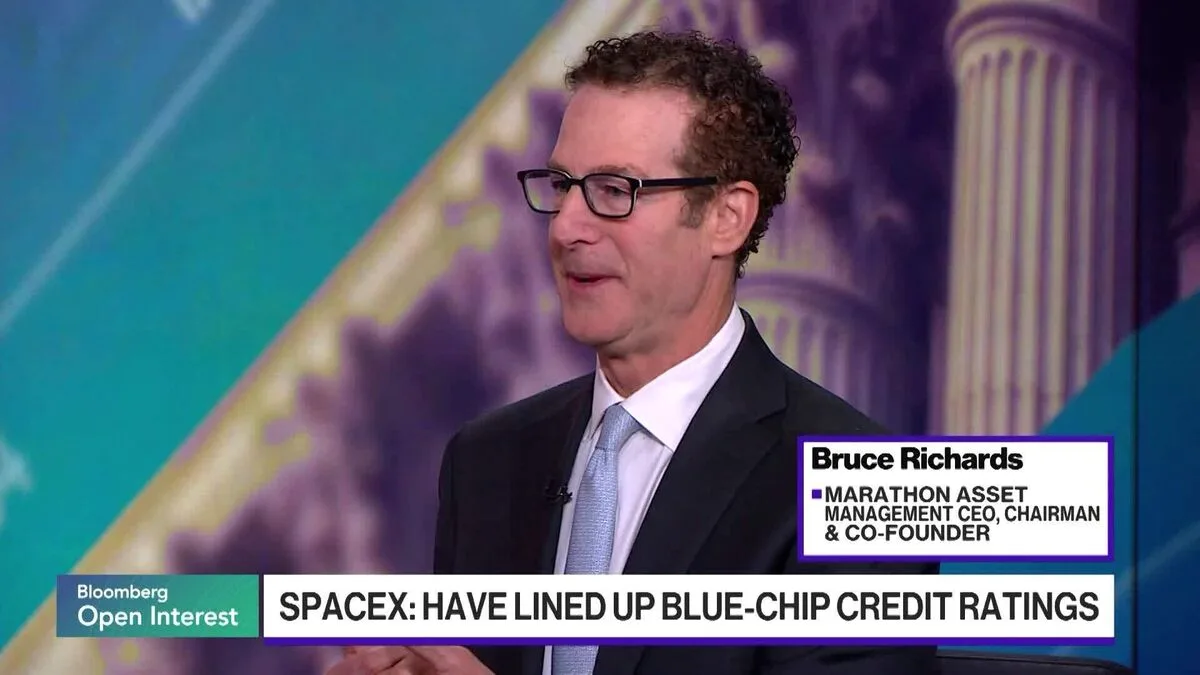
Marathon Asset Management's Bruce Richards called SpaceX the 'biggest rising star of all time' in credit. That's a bold claim, and it tells us something interesting about where this IPO is heading.
Image credit: Image via Bloomberg — Technology. Used under fair use for news commentary. · source
Picture a credit analyst sitting across from you, completely unbothered, telling you that a company carrying significant debt ahead of one of the largest IPOs in history is, actually, fine. More than fine. A star.
That's basically what happened this week when Bruce Richards, chairman and co-founder of Marathon Asset Management, went on Bloomberg and called SpaceX the "biggest rising star of all time" in credit markets. His argument: the debt levels SpaceX is carrying right now are normal for a company at this stage, and the business is, in his words, "very well positioned across the board."
I'll be honest, I'm not a credit markets person. My beat is humanoids and embodied AI, and SpaceX doesn't exactly build bipedal robots. But this story caught my attention because of what it suggests about how the financial world is thinking about deep-tech companies with enormous capital needs, and that has real implications for the robotics and AI hardware space I do cover.
Richards spoke on "Bloomberg Open Interest," and his position was pretty clear: SpaceX's debt load isn't a red flag, it's a feature of a company scaling at an extraordinary pace. Marathon Asset Management, for context, is a global credit-focused alternative investment firm. These are people whose entire job is evaluating whether debt is scary or sensible.
Related coverage
More in AI Models
Chipmakers swung wildly this week, from a Tuesday 'chip-wreck' to a Micron-led surge after hours. What's actually going on with AI's hardware backbone?
Sarah Williams · 26 Jun · 5 min
The original Creator Studio was shut down in 2023. Now it's back, rebuilt around an AI assistant that promises to grow your audience and reply to comments in your voice.
Sarah Williams · 26 Jun · 5 min
At its annual Config conference, Figma announced coding layers, AI-generated motion graphics, and a reimagined canvas that blurs the line between design and full-stack development.
Sarah Williams · 26 Jun · 5 min
Everyone talks about chips and models. The memory bottleneck is the part of the AI buildout that keeps getting underestimated, and Micron's latest earnings make that case hard to ignore.
The "rising star" framing is specific credit market language. A rising star, in bond terminology, refers to a company whose debt is on an upward trajectory, typically moving from high-yield (sometimes called junk) toward investment-grade status. Calling SpaceX the biggest rising star of all time is a significant claim. It suggests Richards believes the market is undervaluing how creditworthy SpaceX is becoming, or is about to become.
I initially thought this was just IPO hype, the kind of thing you say on financial television when you want to generate interest. But after reading more carefully, I think there's something more substantive going on. Richards isn't just cheerleading. He's making a structural argument about where SpaceX sits in the credit ecosystem, and the timing, right before a record IPO, matters.
SpaceX is reportedly preparing for what could be one of the largest initial public offerings ever. Exact figures on the offering size haven't been confirmed publicly, so I won't speculate on numbers here, but the scale being discussed is significant enough that it's reshaping conversations in venture and private equity circles.
The debt question is real. Any company going public with meaningful debt on its books has to answer for it. Investors want to know whether that debt was used productively, whether the cash flows can service it, and whether management has a credible plan. Richards' appearance on Bloomberg feels, in part, like a signal to those investors: don't panic about the balance sheet.
Whether that reassurance is warranted is honestly hard to assess from the outside. SpaceX doesn't disclose financials the way public companies do, so a lot of this analysis is based on limited public data and the statements of people with financial interests in the outcome. That's worth keeping in mind.
The optimism seems real, though. Richards isn't a random commentator. Marathon manages tens of billions in assets and has likely done serious diligence on SpaceX's credit position. When someone in that seat uses superlatives, it's usually not casual.
Here's where I want to make a broader point, because I think this SpaceX story is a useful lens for something I think about a lot in the humanoid and embodied AI space.
Deep hardware companies, whether they're building rockets or robots, have a specific financial profile that makes traditional investors nervous. The capital requirements are enormous. The timelines are long. The path to revenue is often non-linear. SpaceX spent years burning cash before Falcon 9 reusability changed the economics entirely.
You might be wondering why a robotics journalist cares about this. It's because companies like Figure, Physical Intelligence, Agility Robotics, and Boston Dynamics are all, in different ways, facing versions of the same question SpaceX faced: how do you convince capital markets that your debt and your burn rate are features, not bugs, of a company on the right trajectory?
The answer SpaceX seems to be providing, at least according to Richards, is: show up in the credit markets early, build a reputation as a rising star, and by the time you go public, the financial infrastructure around you is already telling a positive story.
Tbh, I don't know if humanoid robotics companies will get the same treatment. SpaceX has Starlink generating real recurring revenue. Most humanoid companies are still in early deployment phases, with revenue stories that are more promise than proof. The credit market credibility Richards is describing for SpaceX took years to build and required actual cash flows to back it up.
That gap matters. It's too early to say whether any humanoid company is on a similar trajectory, and anyone claiming otherwise is probably getting ahead of the data.
What I keep coming back to is the question of narrative versus fundamentals. Richards' comments are part of a narrative being constructed around SpaceX ahead of its IPO. That narrative may be entirely accurate. It may also be, in part, promotional. The two aren't mutually exclusive, and sorting out which parts are which requires more transparency than SpaceX currently provides.
For now, the credit markets apparently like what they see. Whether public market investors will agree, once they have access to the actual financials, is the question that remains genuinely open.